Quick answer
To dispute a medical bill in California, ask for an itemized bill, compare it with your insurer's explanation of benefits, and send a written dispute naming the rule that applies. If a non-network doctor treated you at an in-network facility, Health and Safety Code section 1371.9 generally limits you to in-network cost sharing. Medical debt also cannot be reported to credit bureaus in California (Civil Code section 1785.27).
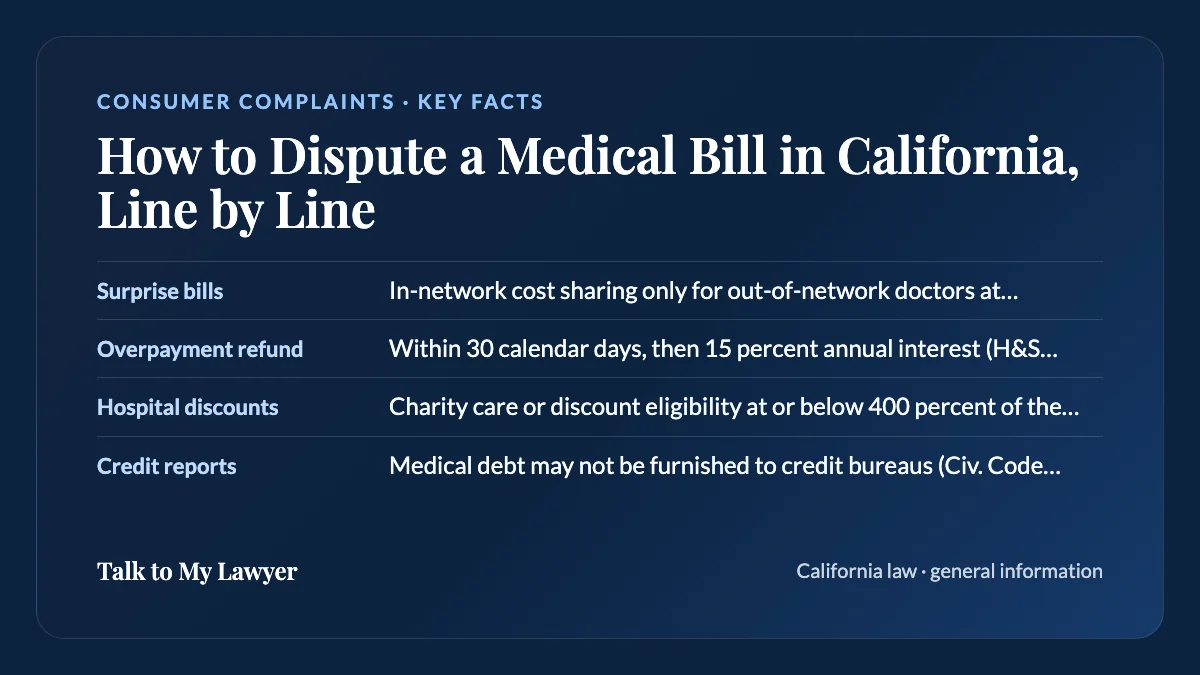
At a glance
- Surprise bills
- In-network cost sharing only for out-of-network doctors at in-network facilities (H&S 1371.9)
- Overpayment refund
- Within 30 calendar days, then 15 percent annual interest (H&S 1371.9(a)(4))
- Hospital discounts
- Charity care or discount eligibility at or below 400 percent of the federal poverty level (H&S 127405)
- Credit reports
- Medical debt may not be furnished to credit bureaus (Civ. Code 1785.27)
- Uninsured estimate dispute
- Federal process if billed $400 or more above the good faith estimate, within 120 days
What should you do first when a medical bill looks wrong?
Ask for an itemized bill and put it next to your insurer's explanation of benefits (EOB). Look for any mismatch between the two: a service you did not receive, a duplicate line, a claim the insurer never saw, or a provider billing you for the part the plan already discounted.
- Check names, dates of service and your insurance ID on every page.
- Look for duplicate charges and items from days you were not there.
- Confirm the provider sent the claim to your insurer at all. A bill can arrive before the claim is processed.
- Compare the patient responsibility on the EOB with the amount on the bill.
- Write down every call: date, name and what was said. Then confirm the key points in writing.
Then decide which rule fits. The answer depends on whether you were insured, where the care happened, and who billed you.
Can an out-of-network doctor bill you after care at an in-network hospital?
Generally, only for your in-network share. For health care service plan contracts covered by Health and Safety Code section 1371.9, if you receive covered services at a contracting facility from a doctor or other professional who is not in your network, you pay no more than the cost sharing you would owe an in-network provider. The professional may not bill or collect anything beyond that amount. The section does not cover emergency services or Medi-Cal managed care plans, which follow other rules.
- Before your plan tells you the in-network amount, any message from the provider must say in 12-point bold type that it is not a bill.
- If you overpaid, the provider must refund the excess within 30 calendar days. After that, interest runs at 15 percent a year and must be added automatically.
- The provider may not report you to a credit bureau, and may not sue for at least 150 days after the initial bill.
- Wage garnishment and liens on your primary residence are off the table for these amounts.
- The exception: if your plan has out-of-network benefits, the professional may bill out-of-network cost sharing only with your written consent, given at least 24 hours before care, on a separate document with a written cost estimate, and not at admission or while you are being prepared for a procedure.
The federal No Surprises Act adds protection for out-of-network bills from emergency room visits, certain non-emergency care at in-network hospitals and surgery centers, and air ambulance services. If you think a plan decision violates it, the federal guidance is to appeal through your plan, and you can also submit a complaint.
Do California hospitals have to discount bills for lower-income patients?
Yes, within limits. Every hospital must keep a written charity care policy and a discount payment policy. Uninsured patients, and patients with high medical costs, at or below 400 percent of the federal poverty level are eligible (Health and Safety Code section 127405). Rural hospitals may set lower levels, and no hospital may impose a deadline for applying.
- For patients eligible for a discount, the hospital must limit expected payment to what it would receive from Medicare or Medi-Cal, whichever is greater.
- The hospital may not count your savings or other monetary assets when deciding eligibility.
- Discount policies must include an extended payment plan that considers your family income and living expenses.
- A hospital may not sell patient debt to a debt buyer unless, among other conditions, it found you ineligible for financial assistance or you did not respond for 180 days (section 127425).
- Before sending a bill to collections, the hospital must send you a notice with the dates of service, the collector's name, how to get an itemized bill, and a financial assistance application. It may not report the debt to a credit bureau, or sue for nonpayment before 180 days after the first bill.
Uninsured patients are also entitled to a written estimate of what a hospital will require them to pay for the services it expects to provide, along with its financial assistance policy and an application form (section 1339.585). The rule does not apply to emergency services. Under federal law, if you were uninsured or did not use insurance and the final bill is at least $400 above a provider's good faith estimate, you can start a federal dispute within 120 calendar days of the initial bill, for a $25 fee.
Can medical debt hurt your credit in California?
Not through the credit bureaus. Since January 1, 2025, Civil Code section 1785.27 (added by SB 1061) says that a person shall not furnish information about a medical debt to a consumer credit reporting agency. A medical debt is void and unenforceable if someone knowingly violates that rule.
The section, as in force in October 2026, also says that a written contract creating a medical debt, entered into on or after July 1, 2025, must include a notice of this ban; a contract without it is void and unenforceable. If a medical account shows up on your report anyway, you can dispute it with the bureau and write to the company that reported it. The bureau process is covered in how to fix a credit report error.
How to write a medical bill dispute letter
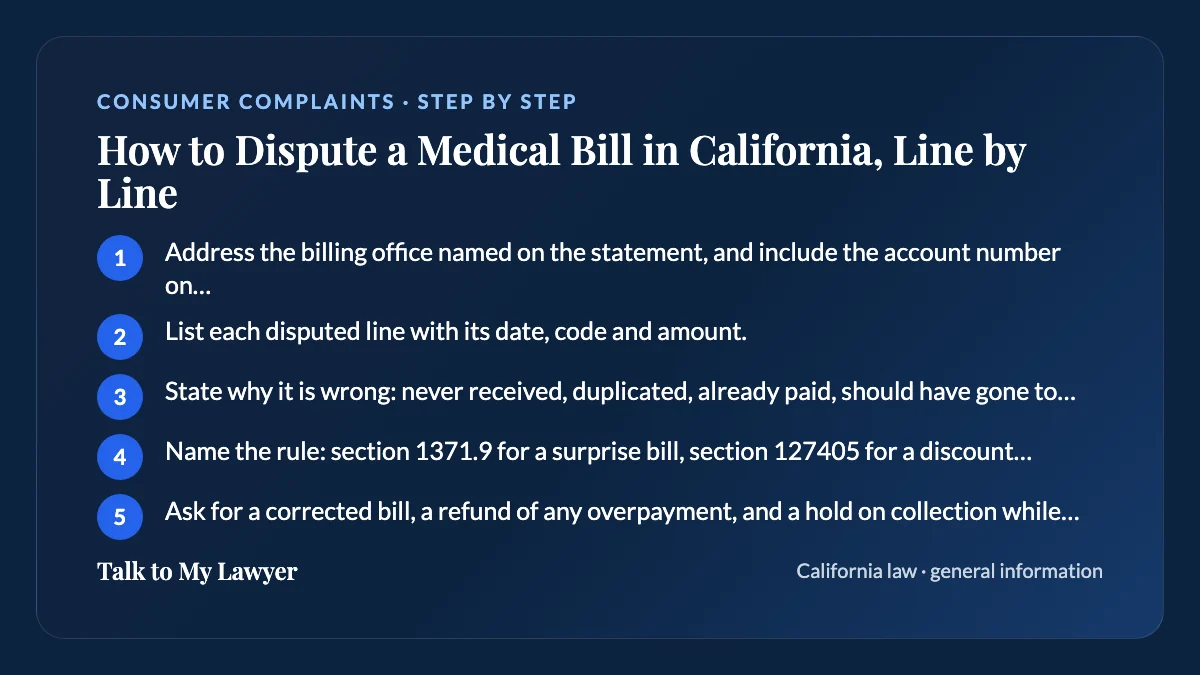
- Address the billing office named on the statement, and include the account number on every page.
- List each disputed line with its date, code and amount.
- State why it is wrong: never received, duplicated, already paid, should have gone to insurance, or above your in-network share.
- Name the rule: section 1371.9 for a surprise bill, section 127405 for a discount request, section 1785.27 if the debt was reported.
- Ask for a corrected bill, a refund of any overpayment, and a hold on collection while the dispute is reviewed.
- Attach copies, never originals, of the itemized bill, the EOB and any estimate.
- Send it by a method you can prove and keep a copy.
On March 4, I had surgery at Valley General Hospital, an in-network facility under my health plan. Your group, which does not contract with my plan, billed me $2,800 for anesthesia. Under California Health and Safety Code section 1371.9, I owe no more than my in-network cost-sharing amount, which my plan's explanation of benefits lists as $300. Please send a corrected statement for $300 and confirm that the account has not been referred to collections.
| Hypothetical line item | Billed | What the letter says |
|---|---|---|
| Anesthesia, March 4 | $2,800 | Out-of-network professional at in-network facility: in-network share of $300 only |
| Recovery room, March 5 | $640 | Discharged March 4; no recovery room stay on March 5 |
| Lab panel (listed twice) | $180 | Duplicate of line 7; remove one |
| Amount the letter asks to remove | $3,320 | Corrected balance: $300 |
What if the provider or insurer will not fix the bill?
Escalate in writing. For a hospital, ask for review by the business manager or chief financial officer named in its charity care policy, as section 127405 provides. For a plan decision, file a grievance with your plan and, if it is not resolved, contact the Department of Managed Health Care or, for insurance policies, the California Department of Insurance.
If your insurer denied the underlying claim, that is a coverage dispute rather than a billing error. Our guide to a denied health insurance claim in California walks through appeals and independent review.
When an attorney-written medical billing letter makes sense
A billing error starts with your own written dispute, naming the rule that applies. A lawyer's letter earns its place when a provider keeps billing above your in-network share, when a refund with interest is owed and unpaid, when a hospital ignores a discount application, or when a medical debt was reported to a credit bureau despite section 1785.27.
Through Talk to My Lawyer, a licensed California attorney writes your letter from your bills, EOBs and correspondence, cites the statutes that fit your situation, and sends it on your behalf. Coverage disputes and possible lawsuits need individual legal advice.
Frequently asked questions
Do I have to pay a medical bill while I dispute it?
California law does not set one rule for every bill, but some protections help while a dispute is open. For surprise bills under section 1371.9, the provider cannot sue for at least 150 days after the first bill or report you to a credit bureau, and hospitals cannot sue for nonpayment within 180 days of first billing (section 127425). Medical debt cannot be furnished to credit bureaus at all under Civil Code section 1785.27. Ask the provider in writing to pause collection during review.
How do I get an itemized hospital bill?
Call or write the hospital's billing office and ask for an itemized statement showing each service, date, code and charge. California's hospital fair pricing law also requires a written summary of services and charges at the time of billing (section 127425). Ask in writing so you have a record of the date.
What is the 400 percent federal poverty level rule?
California hospitals must offer charity care or discounted payment to uninsured patients and patients with high medical costs whose family income is at or below 400 percent of the federal poverty level. For eligible patients, expected payment is capped at what Medicare or Medi-Cal would pay, whichever is greater. Hospitals cannot consider savings or other monetary assets when deciding eligibility.
Can a medical bill show up on my credit report in California?
It should not. Since 2025, Civil Code section 1785.27 bars anyone from furnishing medical debt information to a consumer credit reporting agency, and a debt is void and unenforceable if that rule is knowingly broken. If a medical account appears, dispute it with the credit bureau and send a written dispute to the company that reported it.
What if I was uninsured and the bill is far higher than the estimate?
Under the federal No Surprises Act, uninsured and self-pay patients generally must get a good faith estimate for scheduled care. If a provider's bill is at least $400 more than its estimate, you may use the federal patient-provider dispute process if you start within 120 calendar days of the initial bill. The filing fee is $25.
Sources
Checked against these official sources on October 18, 2026.
- Health and Safety Code section 1371.9 (California Legislative Information)
- Health and Safety Code section 127405 (California Legislative Information)
- Health and Safety Code section 127425 (California Legislative Information)
- Civil Code section 1785.27 (California Legislative Information)
- Health and Safety Code section 1339.585 (California Legislative Information)
- Dispute a medical bill (Centers for Medicare & Medicaid Services)
This guide explains California law in general terms as of October 2026. It is general information, not legal advice for your situation, and local rules can add to it.
Join the email list and get a lawyer letter started
With Talk to My Lawyer, a licensed California attorney writes your letter from your facts and documents and sends it on your behalf. Join the Talk to My Lawyer email list for letter checklists, document prompts, and reminders before you start your letter.