Quick answer
A breach of NDA happens when someone bound by a nondisclosure agreement uses or shares covered confidential information in a way the agreement forbids. In California, remedies can include contract damages, a court order stopping further use, and, if the information is a trade secret, remedies under California's trade secret act (Civil Code 3426 and following). A cease and desist letter identifies the breach and demands it stop.
At a glance
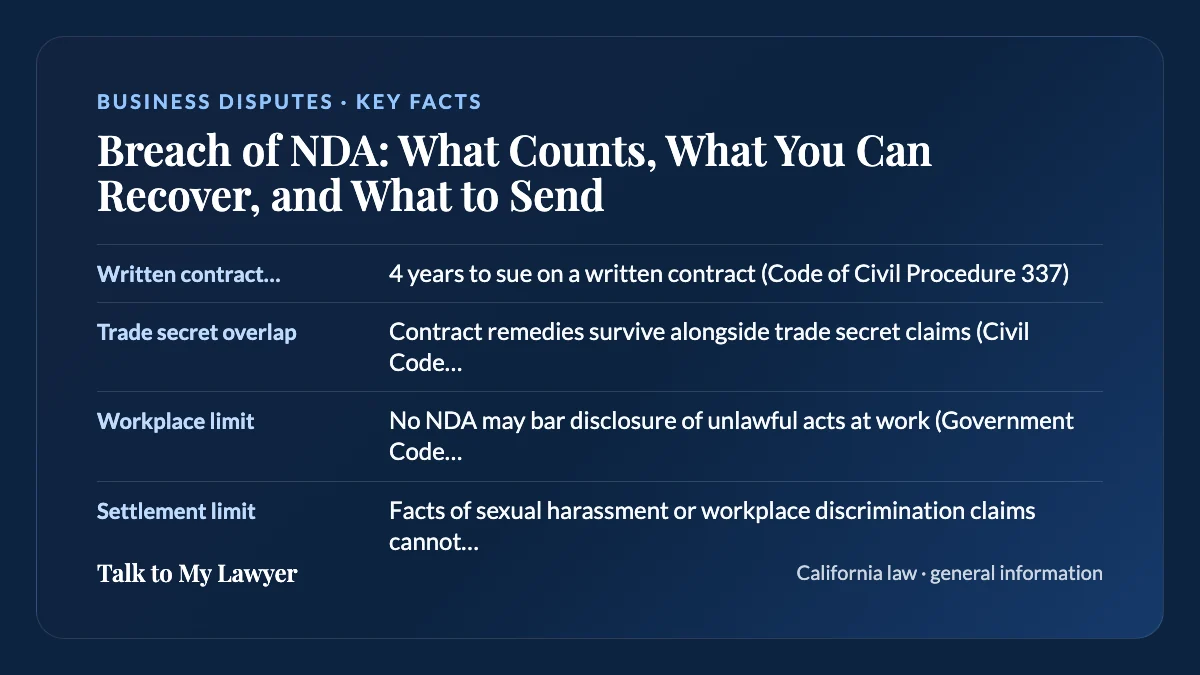
- Written contract deadline
- 4 years to sue on a written contract (Code of Civil Procedure 337)
- Trade secret overlap
- Contract remedies survive alongside trade secret claims (Civil Code 3426.7)
- Workplace limit
- No NDA may bar disclosure of unlawful acts at work (Government Code 12964.5)
- Settlement limit
- Facts of sexual harassment or workplace discrimination claims cannot be kept secret (CCP 1001)
- Federal whistleblower immunity
- Confidential reports to officials or attorneys protected (18 U.S.C. 1833(b))
What counts as a breach of an NDA?
A breach is a use or disclosure of information that the agreement covers, by a person it binds, in a way it does not allow. All three parts come from the document itself, so read it before you accuse anyone.
- Definition. How does the NDA define confidential information? Some list categories; others cover anything marked confidential, or anything disclosed during a project.
- Exclusions. NDAs commonly exclude information that is public, that the other side already knew, that it developed independently, or that it received from someone free to share it.
- Permitted use. Many NDAs allow use only to evaluate a deal or perform a contract. Using the same information to compete can be a breach even without any disclosure.
- Term. Check how long the duty lasts and whether it survives the end of the relationship.
- Return or destroy. Look for a clause requiring the other side to return or delete materials, and whether it requires written certification.
Then gather the proof: the signed agreement, what you shared and when, and how you know it was used. A screenshot of your slide in a competitor's pitch is stronger than a hunch.
What can you recover for a breach of NDA in California?
An NDA is a contract, so the starting remedy is damages for the loss the breach caused. A court can also issue an injunction, an order to stop using or sharing the information, when money alone would not fix the harm.
| Remedy | Where it comes from | What to know |
|---|---|---|
| Contract damages | Breach of the NDA | You must show the loss and link it to the breach. |
| Injunction | Court order | Can matter most when the information is still spreading. |
| Liquidated damages | A clause fixing an amount in advance | Outside consumer contracts and residential leases, valid unless shown unreasonable when signed (Civil Code 1671(b)). |
| Attorney's fees | A fee clause in the NDA | If the contract awards fees to one side, California makes the clause reciprocal (Civil Code 1717). |
| Trade secret remedies | Civil Code 3426 and the federal Defend Trade Secrets Act | Actual loss and unjust enrichment (or a reasonable royalty), plus exemplary damages of up to twice that award for willful and malicious misappropriation (Civil Code 3426.3). |
California's trade secret law expressly leaves contract remedies in place (Civil Code section 3426.7(b)), so one set of facts can support both claims. If the leaked material may be a trade secret, see our guide on trade secret theft by former employees.
What an NDA cannot stop in California
Some disclosures are protected no matter what the NDA says. A letter that demands silence on these points can backfire, so check them before you write.
| Rule | What it protects |
|---|---|
| Government Code 12964.5 | As a condition of employment, in exchange for a raise or bonus, or in a separation agreement, an employer cannot use a nondisparagement or similar clause to deny an employee the right to disclose information about unlawful acts in the workplace. A clause restricting talk about workplace conditions must include a carve-out saying nothing prevents the employee from disclosing harassment, discrimination or other conduct the employee has reason to believe is unlawful. |
| Code of Civil Procedure 1001 | Settlement terms cannot block disclosure of factual information about claims of sexual assault, sexual harassment, or workplace harassment, discrimination or retaliation that were filed in court or with an agency. The settlement amount can stay confidential. |
| Civil Code 1670.11 | A contract or settlement signed on or after January 1, 2019 cannot waive a party's right to testify about alleged criminal conduct or sexual harassment by the other party or its agents or employees, when required or requested by a court order, subpoena, or written request from an agency or the Legislature. |
| Labor Code 232.5 | Employers cannot bar employees from disclosing information about working conditions, though this does not cover trade secrets or privileged information. |
| 42 U.S.C. 19403 | Pre-dispute nondisclosure and nondisparagement clauses are not judicially enforceable in sexual assault or sexual harassment disputes. |
| 18 U.S.C. 1833(b) | No liability under trade secret law for confidential disclosure to a government official or attorney solely to report a suspected violation of law. |
One more limit: under Business and Professions Code section 16600, a contract is void to the extent it keeps someone from a lawful trade or business. An employee NDA drafted so broadly that it works like a noncompete can run into that rule. See our guide to noncompete agreements in California.
Checklist: what to have ready before you send a letter
- The signed NDA, any amendments, and any related contract it is tied to.
- A dated list of what you disclosed, to whom, and how it was marked.
- Evidence of the breach: emails, screenshots, posts, a customer's message, metadata.
- Your own secrecy steps: access limits, passwords, confidentiality legends, training.
- Any notice, cure or dispute-resolution clause, such as mandatory mediation, arbitration or a forum choice.
- A rough estimate of the harm: a lost client, a price you had to cut, a delayed launch.
The dispute clause matters. If the NDA requires written notice and a cure period before suit, your letter may be that notice, so match its terms exactly.
How to write an NDA breach demand letter
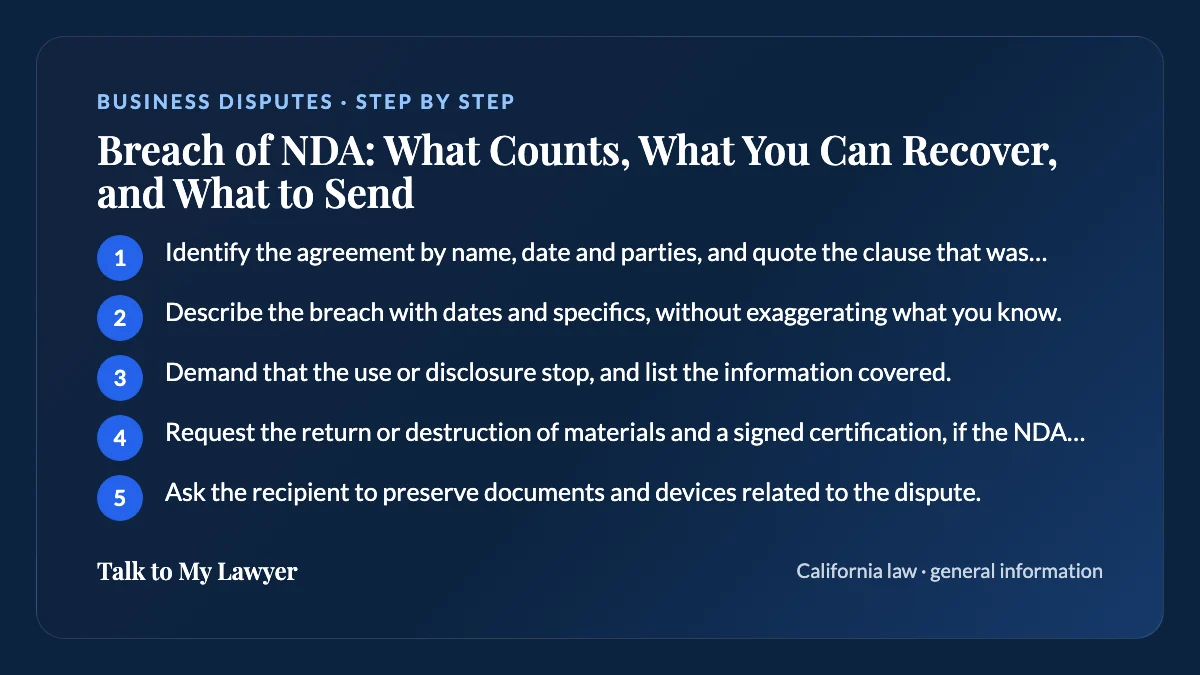
- Identify the agreement by name, date and parties, and quote the clause that was breached.
- Describe the breach with dates and specifics, without exaggerating what you know.
- Demand that the use or disclosure stop, and list the information covered.
- Request the return or destruction of materials and a signed certification, if the NDA provides for it.
- Ask the recipient to preserve documents and devices related to the dispute.
- Set a response date and say what you will consider if there is no reply, such as court or arbitration under the agreement.
Under the Mutual Nondisclosure Agreement dated February 3, your company agreed to use our pricing model only to evaluate a joint bid. On September 22, a slide containing that model appeared in your proposal to Bayline Logistics. Please stop all use and disclosure of the model, return or destroy every copy, and confirm in writing by October 10 that you have done so, as section 6 of the agreement requires.
Keep the tone factual. Publishing accusations or sending them to the recipient's customers can create new legal problems. For how these letters work generally, see what a cease and desist letter means.
What happens if they ignore the letter?
Silence does not end the matter. You can file a breach of contract claim, often joined with a request for a temporary restraining order or preliminary injunction when the information is still being used. If the NDA has an arbitration clause, the claim may belong in arbitration instead.
Watch the clock: a claim on a written contract in California generally must be filed within four years (Code of Civil Procedure section 337), and trade secret claims must be brought within three years of discovery (Civil Code section 3426.6). Your NDA may also choose another state's law or a specific forum.
If the other side answers with its own position, such as an exclusion or a claim that the information was already public, compare its points against the agreement before you reply.
When your confidential information is out: having an attorney write the letter
The agreement's own words set the limits of an NDA letter. A partner who slipped once may need only a plain reminder. Attorney drafting fits better when the information is still spreading, when an injunction may be needed, when the recipient is a former employee covered by California's workplace limits, or when the NDA's notice and cure terms must be followed exactly.
At Talk to My Lawyer, a licensed California attorney writes your letter from your facts and documents (the NDA, your timeline and the evidence of the breach) and sends it on your behalf. If an injunction may be needed, a lawyer can advise on timing and the right court for your situation.
Frequently asked questions
Can you sue someone for breaking an NDA?
Yes. An NDA is a contract, and a breach can support a claim for damages and, where the harm is ongoing, a court order to stop further use or disclosure. Some NDAs require arbitration, mediation or a specific court, and some say the other side must get written notice and time to fix the problem first. Read those clauses before filing anything.
Is an NDA enforceable in California?
Generally yes, for genuinely confidential business information. California limits NDAs in several areas: they cannot stop employees from disclosing unlawful acts in the workplace, cannot keep the facts of certain harassment and discrimination claims secret in settlements, and cannot be so broad that they restrain someone from working in a lawful trade or business.
What if the information in my NDA is now public?
NDAs commonly exclude information that becomes public through no fault of the recipient. If the recipient made it public, that exclusion may not help them, but the value of an injunction drops once information is widely known. The precise wording of the exclusion controls, so compare it with how the information came out.
How long does an NDA last?
As long as the agreement says. Some NDAs set a fixed term, such as two or five years from disclosure. Others protect trade secrets for as long as they remain secret. If the NDA is silent, the answer depends on how a court reads the contract as a whole, which is a question for a lawyer.
Can an NDA stop an employee from reporting illegal conduct?
No. California bars employers from requiring agreements that deny employees the right to disclose information about unlawful acts in the workplace, and federal law protects confidential disclosures of suspected violations to government officials or attorneys. Testimony required by a subpoena or court order about criminal conduct or sexual harassment is also protected.
Sources
Checked against these official sources on October 18, 2026.
- California Government Code section 12964.5 (California Legislative Information)
- California Code of Civil Procedure section 1001 (California Legislative Information)
- California Civil Code section 3426.7 (California Legislative Information)
- California Civil Code section 1670.11 (California Legislative Information)
- 42 U.S.C. 19403 (Legal Information Institute (Cornell Law School))
- 18 U.S.C. 1833 (Legal Information Institute (Cornell Law School))
This guide explains California law in general terms as of October 2026. It is general information, not legal advice for your situation, and local rules can add to it.
Join the email list and get a lawyer letter started
With Talk to My Lawyer, a licensed California attorney writes your letter from your facts and documents and sends it on your behalf. Join the Talk to My Lawyer email list for letter checklists, document prompts, and reminders before you start your letter.