Quick answer
Trade secret theft by a former employee in California falls mainly under the California Uniform Trade Secrets Act (Civil Code 3426 and following). Information qualifies if it has value from being secret and you took reasonable steps to keep it secret. A cease and desist letter demands return of the information, an end to its use and preservation of evidence. Claims are due within three years of discovery.
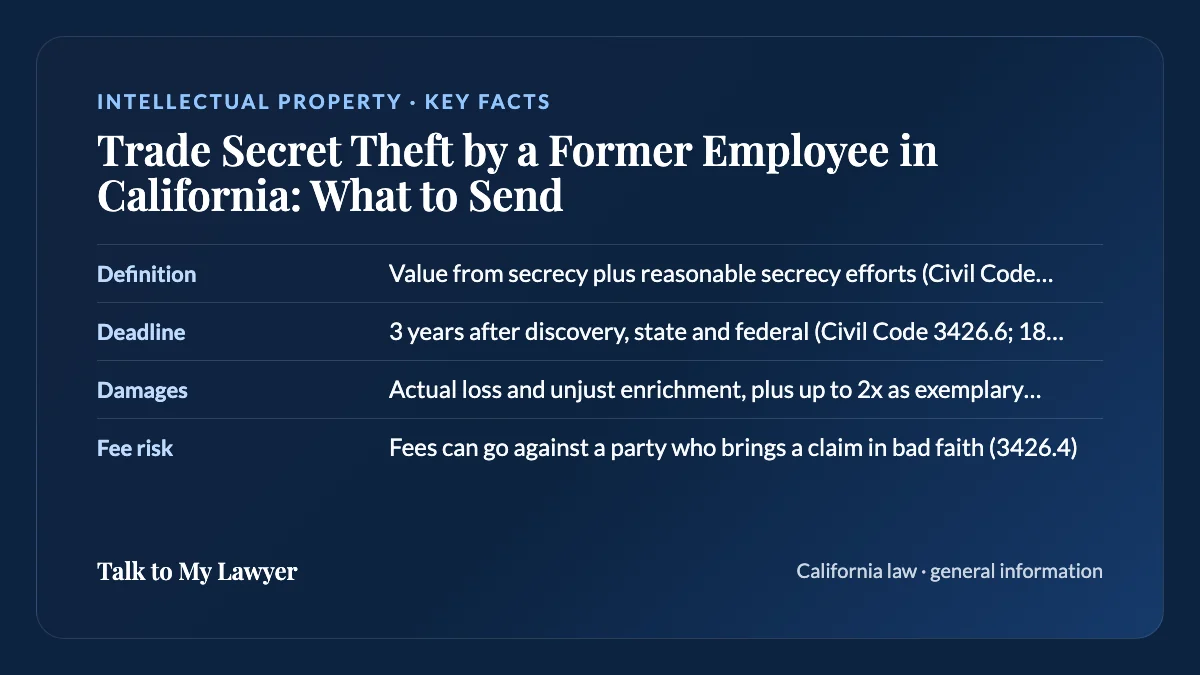
At a glance
- Definition
- Value from secrecy plus reasonable secrecy efforts (Civil Code 3426.1(d))
- Deadline
- 3 years after discovery, state and federal (Civil Code 3426.6; 18 U.S.C. 1836(d))
- Damages
- Actual loss and unjust enrichment, plus up to 2x as exemplary damages if willful and malicious (3426.3)
- Fee risk
- Fees can go against a party who brings a claim in bad faith (3426.4)
- Noncompetes
- Void for employees, and enforcing one is a civil violation (Bus. & Prof. Code 16600, 16600.5)
What counts as a trade secret in California?
Information qualifies when two things are true: it has actual or potential economic value because it is not generally known to others who could profit from it, and you took steps that were reasonable under the circumstances to keep it confidential (Civil Code section 3426.1(d)). Compilations, programs, methods and processes all count.
Reasonable efforts are what a court can see you did. Gather evidence of yours before you write:
- Confidentiality or invention assignment agreements the employee signed.
- Access limits: role-based permissions, passwords, multifactor sign-in.
- Confidential labels on files, folders and reports.
- Policies and training on handling confidential data.
- Exit procedures: return of devices, revoked access, an exit interview reminder.
Misappropriation means acquiring a trade secret by improper means, or using or disclosing it without consent when there was a duty to keep it secret (section 3426.1(b)). Reverse engineering and independent development are not improper means.
Is a customer list a trade secret?
It can be, when the list has value because competitors do not have it and you protected it. A compilation of buyer contacts, order histories, pricing and renewal dates built over years is a stronger candidate than names anyone could find online.
| Points toward a trade secret | Points away |
|---|---|
| Compiled with effort and cost over time | Readily found in directories, LinkedIn or trade shows |
| Includes nonpublic details: pricing, volumes, contract terms, decision-makers | Just company names and general phone numbers |
| Access limited and marked confidential | Shared freely, emailed to personal accounts without objection |
| Exported or copied shortly before resignation | Remembered from years of ordinary relationships |
A former employee may still use general skill and experience. The line a letter should draw is between that and using your protected compilation.
What can't a California employer stop a former employee from doing?
Working for a competitor. Business and Professions Code section 16600 voids contracts that restrain anyone from a lawful profession, trade or business, and as of 2024 it says it must be read to void any employee noncompete, however narrow, unless a statutory exception applies.
Overreaching has a cost. An employer that tries to enforce a void noncompete commits a civil violation, and a former employee can sue for an injunction, actual damages and attorney's fees (section 16600.5). A clause that simply bars soliciting former customers can face the same problem.
What remedies does California trade secret law allow?
| Remedy | California (Civil Code) | Federal (18 U.S.C. 1836) |
|---|---|---|
| Injunction against actual or threatened misappropriation | Yes, 3426.2 | Yes, but not to block a new job |
| Damages | Actual loss plus unjust enrichment, or a reasonable royalty, 3426.3 | Similar |
| Exemplary damages | Up to twice the award if willful and malicious, 3426.3(c) | Up to twice, if willful and malicious |
| Attorney's fees | If willful and malicious, or if the claim is made in bad faith, 3426.4 | Similar |
| Seizure of property without notice | No equivalent | Only in extraordinary circumstances |
The federal claim requires that the trade secret relate to a product or service used in interstate or foreign commerce. Federal law also requires employers to give notice of whistleblower immunity in agreements covering confidential information. If you did not, you cannot recover exemplary damages or attorney's fees under the federal act against that employee (18 U.S.C. 1833(b)(3)).
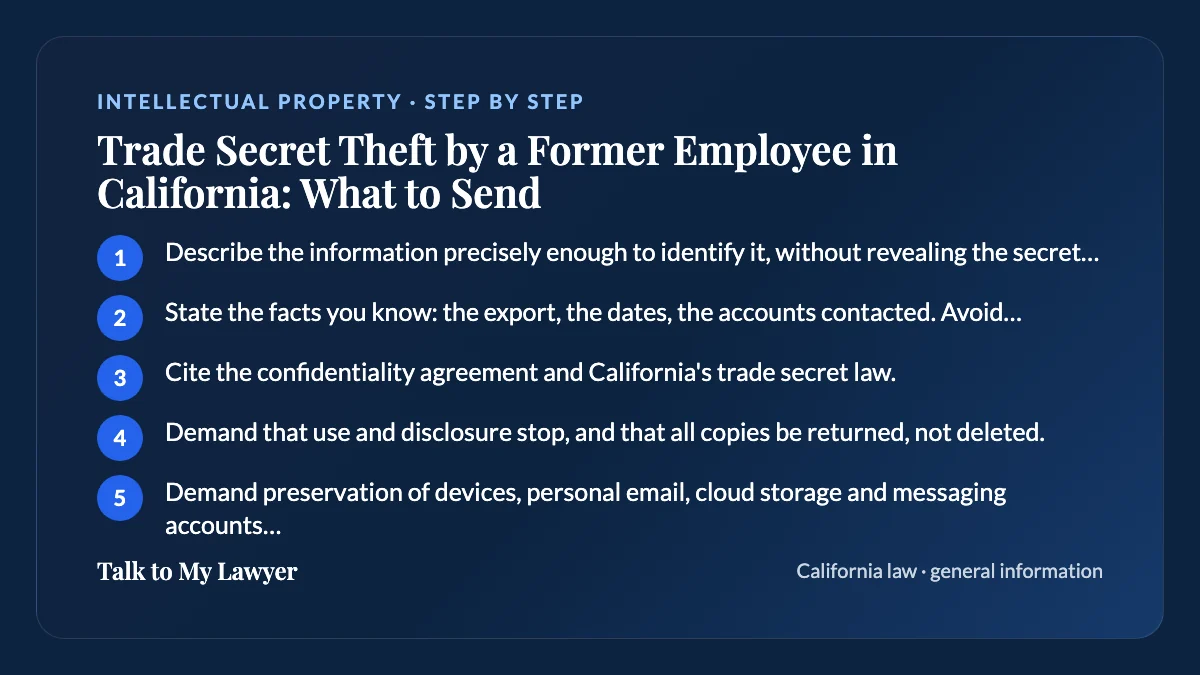
How to write a trade secret cease and desist and preservation letter
- Describe the information precisely enough to identify it, without revealing the secret itself in the letter.
- State the facts you know: the export, the dates, the accounts contacted. Avoid accusations you cannot support.
- Cite the confidentiality agreement and California's trade secret law.
- Demand that use and disclosure stop, and that all copies be returned, not deleted.
- Demand preservation of devices, personal email, cloud storage and messaging accounts, with no wiping or resetting.
- Ask for a written confirmation by a specific date, including where the information went.
- Keep your own evidence intact: image the employee's work laptop and save access logs before reissuing equipment.
Company records show that on May 8, the evening before your resignation, your account exported our full customer pricing and renewal report to a personal storage drive. That report is confidential under the agreement you signed on hire and is protected under California Civil Code section 3426 and following. Please do not delete it. Instead, by May 20, return all copies, confirm in writing that you have stopped using it, identify anyone you shared it with, and preserve every device and account that held it.
Precision matters later too. If you sue under California's act, you must identify the trade secret with reasonable particularity before seeking discovery about it (Code of Civil Procedure section 2019.210). Drafting a precise letter now is good practice for that step.
Should you also write to the new employer?
Sometimes, with care. A short, factual letter can put the new employer on notice that information it receives may be your trade secret, which matters because misappropriation includes using information one has reason to know was acquired improperly.
Keep it to what you can prove, and do not suggest the employer cannot hire the person. Statements beyond the facts can lead to claims of interference or defamation. If the employee signed a nondisclosure agreement, quote its confidentiality terms rather than describing it as a noncompete. For the noncompete side of this, see noncompete agreements in California.
When customer data walks out the door: an attorney-written letter
A forgotten laptop calls for a friendly note. A full export the night before a resignation calls for a more careful letter: one that describes the information without revealing it, demands preservation rather than deletion, and stays clear of a void noncompete. Attorney drafting fits those facts, and fits when customers are already being contacted or a new employer is involved. A letter that threatens a void noncompete or overstates the facts can create claims against your business.
With Talk to My Lawyer, a licensed California attorney writes your letter from your facts and documents (your agreements, access logs and timeline) and sends it on your behalf. Whether to seek a restraining order is a strategic call to make with a lawyer who knows the full record.
Frequently asked questions
Can I sue a former employee for taking my customer list in California?
Possibly, if the list qualifies as a trade secret and the employee acquired, used or disclosed it improperly. The list needs value from not being generally known and reasonable secrecy measures behind it. Names anyone could find online are weaker. The deadline is three years from when you discovered the taking, or reasonably should have.
Can I stop a former employee from working for a competitor in California?
Generally no. California voids employee noncompete agreements, with narrow statutory exceptions, and an employer that tries to enforce a void one can face a lawsuit for damages and attorney's fees. What you can pursue is the misuse of trade secrets, through a demand letter and, if needed, a court order limited to that misuse.
What is the difference between CUTSA and the Defend Trade Secrets Act?
CUTSA is California's trade secret statute; the Defend Trade Secrets Act is the federal law. Both define misappropriation similarly, allow injunctions and damages, and set three-year deadlines from discovery. The federal act requires a link to interstate commerce, allows rare property seizures without notice, and bars injunctions that prevent someone from taking a job.
Should I ask the employee to delete the files?
Not as a first step. Deleted files can destroy evidence of what was taken and where it went. A letter can request that the files be returned and the devices preserved, with a forensic process agreed later for removing copies. Talk to a lawyer about the right sequence.
Is it a crime to steal trade secrets in California?
It can be under state and federal law, but a civil demand letter should not threaten criminal charges to gain pressure in a negotiation. Keep the letter to the civil claims, the facts and the specific steps you want the recipient to take. Whether to report a matter to law enforcement is a separate decision to discuss with a lawyer.
Sources
Checked against these official sources on October 18, 2026.
- California Civil Code section 3426.1 (California Legislative Information)
- California Civil Code section 3426.3 (California Legislative Information)
- California Civil Code section 3426.6 (California Legislative Information)
- California Business and Professions Code section 16600.5 (California Legislative Information)
- California Code of Civil Procedure section 2019.210 (California Legislative Information)
- 18 U.S.C. 1836 (Legal Information Institute (Cornell Law School))
This guide explains California law in general terms as of October 2026. It is general information, not legal advice for your situation, and local rules can add to it.
Join the email list and get a lawyer letter started
With Talk to My Lawyer, a licensed California attorney writes your letter from your facts and documents and sends it on your behalf. Join the Talk to My Lawyer email list for letter checklists, document prompts, and reminders before you start your letter.