Quick answer
California pay transparency law (Labor Code section 432.3) requires employers with 15 or more employees to include a pay scale in every job posting. Any employer must give a current employee the pay scale for their position on request, and an applicant on reasonable request. Employers may not seek salary history. The Labor Commissioner can impose $100 to $10,000 per violation.
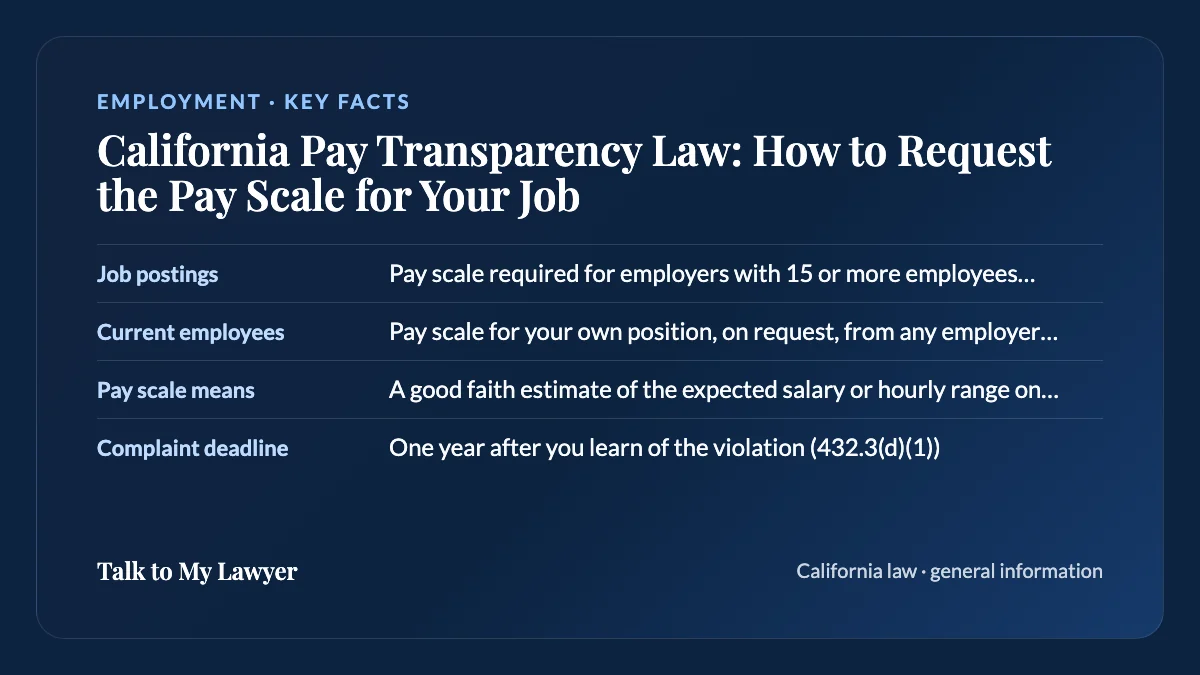
At a glance
- Job postings
- Pay scale required for employers with 15 or more employees (432.3(c)(3))
- Current employees
- Pay scale for your own position, on request, from any employer (432.3(c)(2))
- Pay scale means
- A good faith estimate of the expected salary or hourly range on hire, as of 2026 (432.3(m))
- Complaint deadline
- One year after you learn of the violation (432.3(d)(1))
- Penalty
- $100 to $10,000 per violation, set by the Labor Commissioner (432.3(d)(4))
What does California pay transparency law require?
Labor Code section 432.3, expanded by SB 1162 from January 1, 2023 and amended again by SB 642 from January 1, 2026, sets five duties:
- Postings: an employer with 15 or more employees must put the pay scale in any job posting, and must give it to any recruiter or job board that posts for it, which must then include it.
- Current employees: on request, an employer must give you the pay scale for the position you hold now.
- Applicants: on reasonable request, an employer must give an applicant the pay scale for the position applied for.
- Salary history: an employer may not ask for an applicant's pay history, directly or through an agent, or rely on it to decide whether to hire or what to offer.
- Records: employers must keep each employee's job title and wage rate history for the length of employment plus three years.
The section applies to all employers, including state and local government. Only the posting duty depends on the 15-employee count, so a small business still has to answer an employee's pay scale request.
What counts as a pay scale under section 432.3?
As of October 2026, a pay scale is "a good faith estimate of the salary or hourly wage range that the employer reasonably expects to pay for the position upon hire" (section 432.3(m)(1), as amended by SB 642).
The Labor Commissioner's Equal Pay Act and pay transparency FAQ adds practical detail:
- Bonuses, tips and benefits do not have to be included, although an employer may add them.
- If the job is paid by piece rate or commission, the posting must give a good faith estimate of that piece rate or commission range.
- The range must appear in the posting itself. A link or QR code that leads to the range does not satisfy the rule.
- The office reads the posting duty to cover any position that may ever be filled in California, in person or remotely.
A range such as "$40,000 to $400,000" for a mid-level role invites the question whether it is a good faith estimate. The statute does not set a maximum width, so the test is what the employer reasonably expects to pay.
Can you ask for the pay scale of the job you already have?
Yes. Section 432.3(c)(2) says an employer, "upon request," must provide an employee the pay scale for the position in which the employee is currently employed. The statute does not require a reason, a particular form or a waiting period.
What it does not require is equally specific. Your employer does not have to tell you what a named coworker earns, according to the Labor Commissioner's FAQ. You can still ask. Labor Code section 1197.5(k) bars an employer from prohibiting employees from disclosing their own wages, discussing or asking about others' wages, and the Labor Commissioner says an employer cannot retaliate against you for asking.
How to write a pay scale request
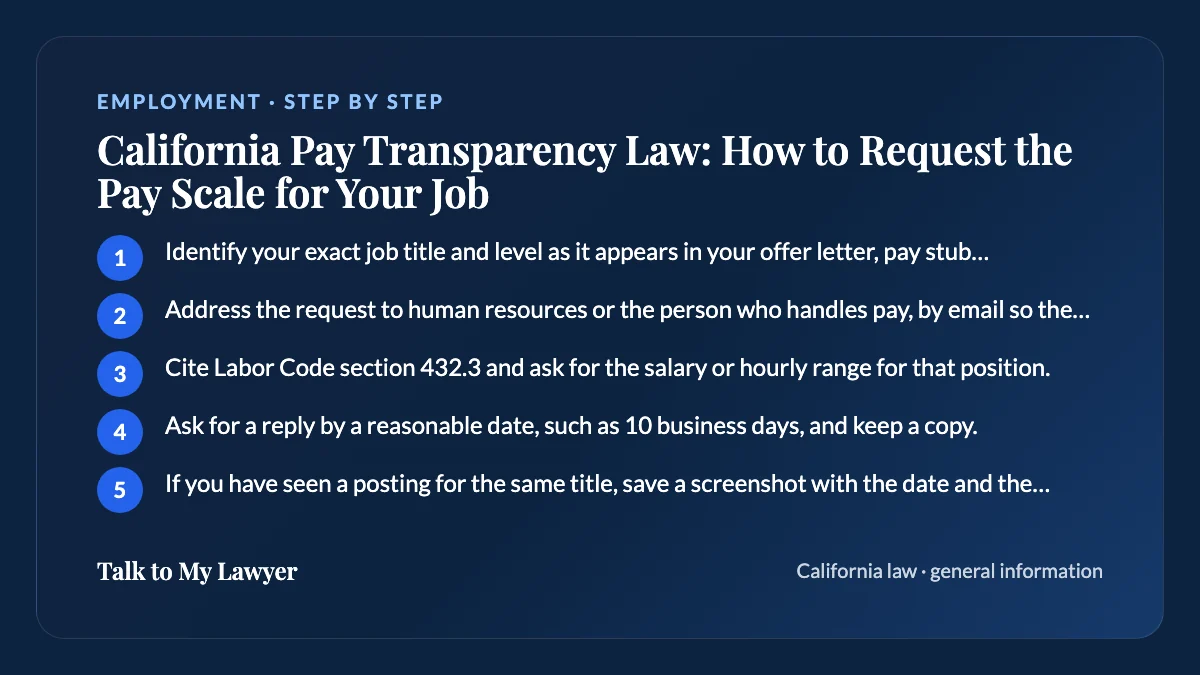
- Identify your exact job title and level as it appears in your offer letter, pay stub or HR system.
- Address the request to human resources or the person who handles pay, by email so the date is recorded.
- Cite Labor Code section 432.3(c)(2) and ask for the salary or hourly range for that position.
- Ask for a reply by a reasonable date, such as 10 business days, and keep a copy.
- If you have seen a posting for the same title, save a screenshot with the date and the range shown.
- Compare the range with your pay. If you are below it, or if coworkers of another sex, race or ethnicity doing substantially similar work appear to earn more, write down the details before raising the issue.
I am a Senior Account Coordinator in the Sacramento office and have held this position since May 2023. Under California Labor Code section 432.3(c)(2), I am requesting the pay scale for my current position. Please send the salary range by email by November 6. Thank you for your help.
Keep the first request short and neutral. A request for information is a right of its own, and it does not need to accuse anyone of anything.
Example: what the range can tell you
Example (hypothetical): an analyst earns $84,000. HR replies that the pay scale for the role is $92,000 to $118,000. A public posting for the same title shows the same range.
| Question | Why it matters |
|---|---|
| Is $84,000 below the bottom of the range? | Yes, by $8,000. That alone is not a violation, but it is information to raise with the employer. |
| Do others in the role earn more? | If the gap tracks sex, race or ethnicity for substantially similar work, the Equal Pay Act may apply. |
| What reason does the employer give? | Seniority, merit, production-based pay and bona fide job-related factors are the recognized defenses. Prior salary is not. |
| How long has the gap existed? | Relief can reach back up to six years for an Equal Pay Act violation, as of January 1, 2026. |
When does a pay gap become an Equal Pay Act claim?
A pay gap becomes a potential claim under Labor Code section 1197.5 when you are paid less than employees of another sex, or of another race or ethnicity, for substantially similar work, judged as a composite of skill, effort and responsibility under similar working conditions. The employer must then show the gap is entirely explained by seniority, merit, a production-based system or a bona fide, job-related factor such as education or experience.
SB 642 made several changes effective January 1, 2026. A civil action may be filed within three years after the last date the cause of action occurs, and relief can cover the whole period of the violation up to six years. "Wages" for this section now expressly include salary, overtime, bonuses, stock, stock options, profit sharing and benefits. Remedies include the wage difference with interest and an equal amount as liquidated damages.
If the gap connects to other treatment at work, our employment discrimination letter guide explains the broader civil rights rules.
What happens if an employer ignores the pay transparency law?
You can file a written complaint with the Labor Commissioner within one year after you learned of the violation, naming the employer and describing what happened (section 432.3(d)). The Labor Commissioner must promptly investigate and, if it finds a violation, may order a civil penalty. You may also go to court for injunctive relief and other relief the court considers appropriate.
- The penalty is $100 to $10,000 per violation, based on the circumstances, including any earlier violations.
- For a first violation of the posting and request rules in subdivision (c), no penalty is assessed if the employer shows that all job postings for open positions now include the pay scale.
- If the employer did not keep the required title and wage history records, the law presumes in favor of the employee's claim.
If you are disciplined or sidelined after asking about pay, see our workplace retaliation guide for the complaint deadlines.
When a pay transparency letter from an attorney makes sense
A pay scale request is one short email; the harder letter is the one that follows a refusal or a range that shows you below the floor. Legal help earns its place when the employer refuses or stalls, when the range shows a gap that may raise Equal Pay Act issues, when several employees in the same role see the same pattern, or when your job changed after you asked.
Through Talk to My Lawyer, a licensed California attorney writes your letter from your title history, pay records and the employer's replies, sets out the sections of the Labor Code that apply, and sends it on your behalf. Whether a pay gap supports an Equal Pay Act claim turns on details, so get a lawyer's view before filing.
Frequently asked questions
Do small businesses have to post salary ranges in California?
Only employers with 15 or more employees must include the pay scale in job postings (Labor Code section 432.3(c)(3)). The Labor Commissioner counts employees the same way it did for the 2022 COVID-19 supplemental paid sick leave and minimum wage rules, and at least one employee must be located in California. A smaller employer still must give a current employee their own position's pay scale on request and give an applicant the scale on reasonable request.
Can an employer ask what I earn now?
No. California employers may not seek an applicant's salary history, including compensation and benefits, whether they ask themselves or through a recruiter, and may not rely on it to decide whether to hire you or what to offer. They may ask what salary you expect. If you volunteer your pay history without being prompted, the employer may consider it, but prior salary can never justify a pay disparity.
Does the posted range have to include bonuses?
No. According to the Labor Commissioner, the pay scale covers the salary or hourly wage range, and bonuses, tips and benefits do not have to be listed, although an employer may include them. If the job is paid by piece rate or commission, the posting must include a good faith estimate of that rate or commission range.
Can I be fired for asking about pay?
California law prohibits an employer from discharging or retaliating against an employee who asks about, discusses or discloses wages, or who acts to enforce the Equal Pay Act (Labor Code section 1197.5(k)). If an adverse action follows protected activity within 90 days, the law presumes in the employee's favor. A civil action for that retaliation must be filed within one year.
How do I report a job posting with no salary range?
File a written complaint with the California Labor Commissioner's Office within one year after you learned of the violation. Include the employer's name and address, a copy or screenshot of the posting, and the date you saw it. The office investigates and can order civil penalties of $100 to $10,000 per violation, though a first posting violation can be excused if the employer fixes all open postings.
Sources
Checked against these official sources on October 18, 2026.
- California Labor Code section 432.3 (California Legislative Information)
- California Labor Code section 1197.5 (California Legislative Information)
- California Equal Pay Act and pay transparency FAQ (California Labor Commissioner's Office)
- SB 642 (2025), Employment: payment of wages (California Legislative Information)
This guide explains California law in general terms as of October 2026. It is general information, not legal advice for your situation, and local rules can add to it.
Join the email list and get a lawyer letter started
With Talk to My Lawyer, a licensed California attorney writes your letter from your facts and documents and sends it on your behalf. Join the Talk to My Lawyer email list for letter checklists, document prompts, and reminders before you start your letter.