Quick answer
If you bought a used car from a private seller in California and found problems, an "as is" sale generally excludes implied warranties (Commercial Code section 2316), so a hidden defect may be yours to fix. As-is does not protect a seller who lied or hid a known defect (Civil Code sections 1709 and 1710), skipped the required smog certificate, or falsified the odometer.
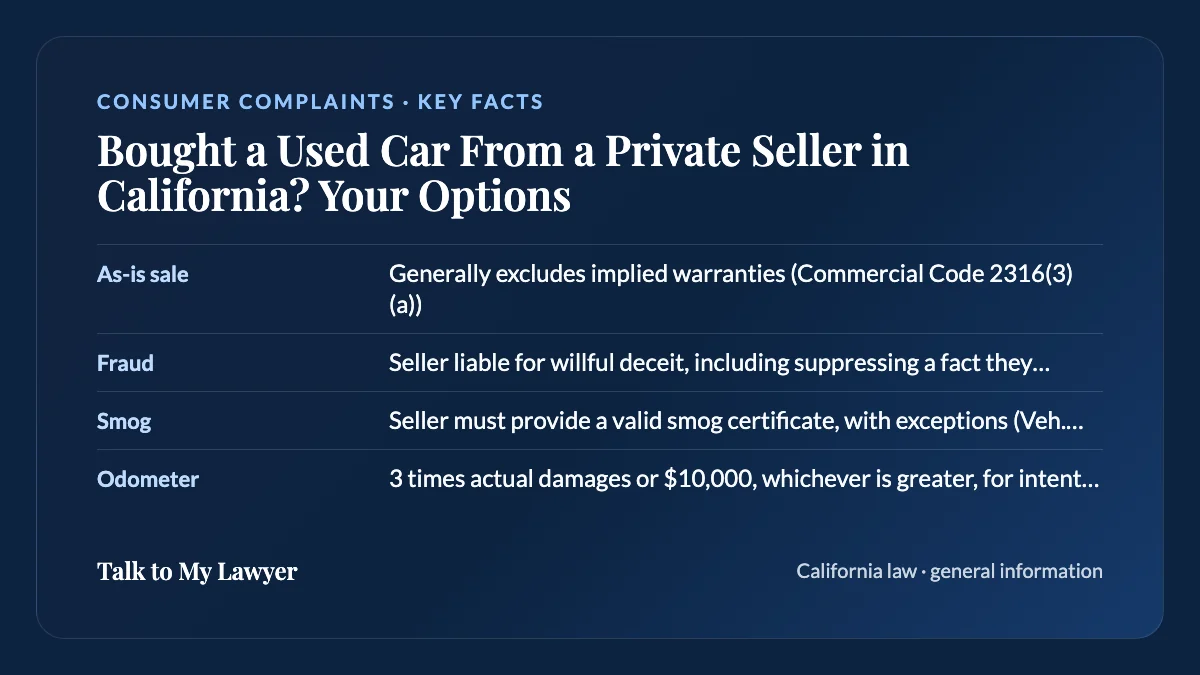
At a glance
- As-is sale
- Generally excludes implied warranties (Commercial Code 2316(3)(a))
- Fraud
- Seller liable for willful deceit, including suppressing a fact they had to disclose (Civil Code 1709, 1710)
- Smog
- Seller must provide a valid smog certificate, with exceptions (Veh. Code 24007(b), 4000.1(d))
- Odometer
- 3 times actual damages or $10,000, whichever is greater, for intent to defraud (49 U.S.C. 32710)
- Deadlines
- 3 years from discovering fraud (CCP 338(d)); 2 years for federal odometer claims
Can you return a used car bought from a private seller in California?
Not simply because a problem shows up after the sale. If the listing or bill of sale said "as is," Commercial Code section 2316(3)(a) provides that expressions like "as is" or "with all faults" exclude implied warranties unless the circumstances indicate otherwise. The implied warranty of merchantability also arises only when the seller is a merchant in goods of that kind (Commercial Code section 2314), which a person selling their own car generally is not.
California's lemon law is built around manufacturer warranties, so it does not fit a typical sale between two individuals. If you bought from a dealer, start instead with what to do about car dealer fraud.
What as-is does not cover is a lie. A seller who made false statements of fact, or hid a defect they knew about, can still be liable.
When does an as-is sale still lead to liability?
An as-is sale can still lead to liability when the seller deceived you. Civil Code section 1709 makes a person who willfully deceives another, intending to induce them to act to their injury, liable for the resulting damage. Section 1710 defines deceit to include:
- Stating as fact something the seller does not believe is true.
- Stating as fact something the seller has no reasonable ground to believe is true.
- Suppressing a fact the seller is bound to disclose, or giving other facts that mislead because that fact is left out.
- Making a promise with no intention of keeping it.
In a private car sale, look first at the listing and the messages: "transmission rebuilt last year," "never in an accident," "clean title." A mechanic's report that the problem plainly predates the sale, together with any sign the seller had it diagnosed, can connect the defect to what the seller knew.
What paperwork must a private seller give you in California?
| Requirement | What the law says | Source |
|---|---|---|
| Smog certificate | Seller must give the buyer a valid certificate of compliance or noncompliance before or at delivery | Vehicle Code 24007(b)(2) |
| Smog exceptions | Not required for non-diesel vehicles four or fewer model years old, transfers between a parent, grandparent, sibling, child, grandchild or spouse, pre-1976 vehicles, or a transfer submitted within an existing certificate's 90-day validity | Vehicle Code 4000.1(d) |
| Title | Seller must properly endorse, date and deliver the certificate of ownership | Vehicle Code 5753(a) |
| Notice to DMV | Seller must notify the DMV of the sale within 5 calendar days, including the odometer mileage | Vehicle Code 5900 |
| Odometer disclosure | Seller must give a written mileage disclosure; vehicles of model year 2010 or older are exempt | 49 U.S.C. 32705; 49 C.F.R. 580.17 |
On your side, the DMV says a change in ownership must be reported within 10 days. Keep the signed title, bill of sale and any smog certificate together. They become the first exhibits in any letter.
What if the odometer was rolled back?
Federal law requires the seller to give you a written disclosure of the mileage when ownership transfers, or a statement that the actual mileage is unknown if they know the odometer reading is wrong (49 U.S.C. section 32705). Under the federal rules in force in 2026, vehicles of model year 2010 or older are exempt; model year 2011 and newer vehicles stay covered until 20 years after their model year (49 C.F.R. section 580.17).
A person who violates the federal odometer law with intent to defraud is liable for three times the actual damages or $10,000, whichever is greater (49 U.S.C. section 32710), and the claim must be brought within two years after it accrues. Service invoices, inspection records or a vehicle history report showing higher mileage at an earlier date can reveal a rollback.
Example: putting numbers on a private sale dispute
Example (hypothetical): a buyer pays $9,800 for a 2017 sedan. The listing says "transmission rebuilt last year, no mechanical issues." Five days later the transmission fails. A transmission shop finds no sign of a rebuild and wear consistent with a long-standing problem. The seller also provided no smog certificate.
| Item | Amount | Basis |
|---|---|---|
| Transmission replacement estimate | $3,650 | False statement about the rebuild (Civil Code 1709, 1710) |
| Diagnosis and towing | $310 | Costs caused by the defect |
| Smog check and repairs needed to pass | $420 | Seller's duty to provide a certificate (Vehicle Code 24007) |
| Total requested | $4,380 | Below the $12,500 individual small claims cap |
The other route is to undo the sale: return the car and ask for the price back. In small claims, the judge may grant rescission or restitution in place of, or along with, money damages (Code of Civil Procedure section 116.220(b)).
Steps to take after a bad private car purchase
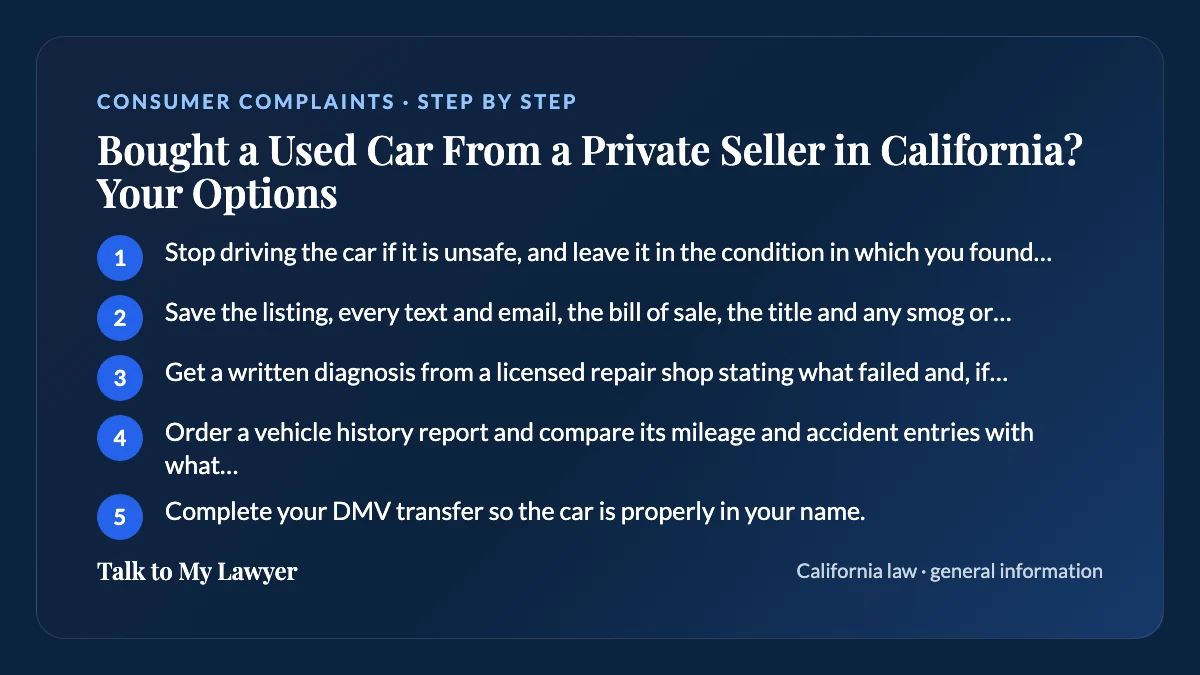
- Stop driving the car if it is unsafe, and leave it in the condition in which you found the problem.
- Save the listing, every text and email, the bill of sale, the title and any smog or odometer paperwork.
- Get a written diagnosis from a licensed repair shop stating what failed and, if possible, how long the problem has existed.
- Order a vehicle history report and compare its mileage and accident entries with what the seller told you.
- Complete your DMV transfer so the car is properly in your name.
- Decide whether you want repair costs or to undo the sale.
- Send a written demand with copies of your evidence and a response date.
What to say in a demand letter to a private car seller
Name the specific statement or missing document, show why it was false or missing, and ask for one remedy. Leave out guesses about the seller's character and stay with what the ad said and what the mechanic found.
On May 3 I paid you $9,800 in cash for the 2017 sedan, VIN ending 33821, after reading your listing stating that the transmission had been rebuilt last year and that the car had no mechanical issues. On May 8 the transmission failed. The enclosed report from Oak Street Transmission states that the unit shows no sign of a rebuild and has wear consistent with a long-standing problem. You also did not provide the smog certificate required by California Vehicle Code section 24007. Please pay $4,380, the cost of repair, diagnosis, towing and smog compliance, by June 1, or confirm by that date that you will refund the $9,800 purchase price when I return the car.
Watch the calendar. A fraud claim generally must be filed within three years of discovering the facts (Code of Civil Procedure section 338(d)), and a federal odometer claim within two years. A small claims court will want to see that you asked for payment before filing; our guide to a demand letter before small claims covers that step.
When a private car sale dispute needs a lawyer's letter
A private seller has no customer service desk, and the whole record may be one listing and a handful of texts, so the letter has to make that record do the work. Attorney drafting is worth a look if the price was high, if you want to undo the sale rather than collect repair money, if odometer fraud and its federal damages may be involved, or if the seller has stopped responding.
Through Talk to My Lawyer, a licensed California attorney writes your letter from your listing screenshots, messages, title papers and mechanic's report, and sends it on your behalf. For advice on whether to sue, talk to a lawyer about your facts.
Frequently asked questions
Can I sue a private seller for selling me a bad car in California?
You can if the seller lied, hid a known defect they had a duty to disclose, broke a specific promise, skipped the required smog certificate, or falsified the mileage. An as-is sale generally excludes implied warranties, so a defect on its own may not be enough. Individuals can bring claims up to $12,500 in small claims court after asking the seller to pay.
Who pays for smog in a private party sale in California?
The seller. Vehicle Code section 24007(b)(2) requires the seller to give the buyer a valid smog certificate before or at the time of delivery. Exceptions listed in Vehicle Code section 4000.1(d) include non-diesel vehicles four or fewer model years old, transfers between close family members, and vehicles made before the 1976 model year.
Does an as-is sale protect a private seller who lied?
Generally not. As-is language removes implied warranties about quality, but it does not excuse deceit. Under Civil Code sections 1709 and 1710, a seller who states something false as fact, or suppresses a fact they are bound to disclose, can be liable for the damage caused. Written statements in the listing or in messages are the clearest evidence of what was promised.
How long do I have to report a private car purchase to the DMV?
The DMV says changes in ownership must be reported within 10 days. The seller has a separate duty under Vehicle Code section 5900 to notify the DMV of the sale within five calendar days, which the DMV handles through its Notice of Transfer and Release of Liability. Completing your transfer promptly makes registration and responsibility for the car clear.
What is the penalty for odometer fraud?
Under federal law, 49 U.S.C. section 32710, a person who violates the odometer rules with intent to defraud is liable for three times the actual damages or $10,000, whichever is greater. The claim must be filed within two years after it accrues. Vehicles of model year 2010 and older are currently exempt from the federal mileage disclosure requirement.
Sources
Checked against these official sources on October 18, 2026.
- California Commercial Code section 2316 (California Legislative Information)
- California Civil Code section 1710 (California Legislative Information)
- California Vehicle Code section 24007 (California Legislative Information)
- California Vehicle Code section 4000.1 (California Legislative Information)
- 49 U.S. Code section 32710: Civil actions by private persons (Legal Information Institute, Cornell Law School)
- 49 CFR section 580.17: Exemptions (Legal Information Institute, Cornell Law School)
This guide explains California law in general terms as of October 2026. It is general information, not legal advice for your situation, and local rules can add to it.
Join the email list and get a lawyer letter started
With Talk to My Lawyer, a licensed California attorney writes your letter from your facts and documents and sends it on your behalf. Join the Talk to My Lawyer email list for letter checklists, document prompts, and reminders before you start your letter.