Quick answer
California has no statute setting a maximum late fee on rent. A residential late fee is treated as liquidated damages under Civil Code section 1671(d): it is void unless the actual damage from late payment would be impracticable or extremely difficult to fix, and courts also look for a reasonable estimate of the landlord's loss. Late fees cannot go in a three-day notice to pay rent or quit.
At a glance
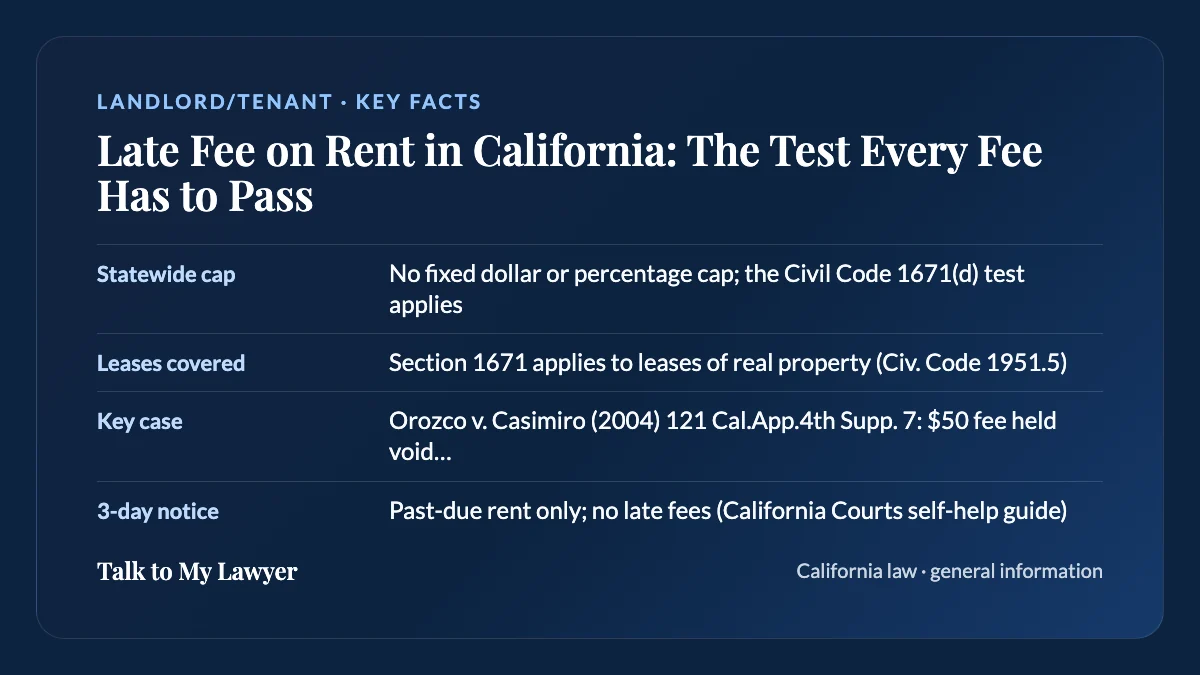
- Statewide cap
- No fixed dollar or percentage cap; the Civil Code 1671(d) test applies
- Leases covered
- Section 1671 applies to leases of real property (Civ. Code 1951.5)
- Key case
- Orozco v. Casimiro (2004) 121 Cal.App.4th Supp. 7: $50 fee held void on that record
- 3-day notice
- Past-due rent only; no late fees (California Courts self-help guide)
- Small claims
- Up to $12,500 for individuals (CCP 116.221)
Is there a legal limit on a late fee on rent in California?
There is no fixed number. California's statutes do not set a dollar or percentage cap on residential rent late fees. What they set is a test, found in the liquidated damages rule of Civil Code section 1671, which section 1951.5 applies to leases of real property.
Liquidated damages means an amount the parties agree in advance will be paid if one side breaks the contract. For contracts outside the consumer and residential categories, such a clause is valid unless shown to be unreasonable (section 1671(b)). For a lease of a home, section 1671(c) and (d) flip that presumption:
- The clause is void, except that
- the parties may agree on an amount that will be presumed to be the damage caused by the breach,
- when, from the nature of the case, it would be impracticable or extremely difficult to fix the actual damage.
Case law adds a second question: whether the amount is a reasonable estimate of the loss that late payment causes. A fee designed to raise revenue or punish lateness is on weak ground; a fee built from the landlord's real costs of handling late payments is on stronger ground.
What Orozco v. Casimiro says about rent late fees
In Orozco v. Casimiro (2004) 121 Cal.App.4th Supp. 7, a superior court appellate division reviewed an eviction judgment. The landlord had served a three-day notice over an unpaid $50 late charge, under a residential lease that allowed a three-day grace period.
- The tenant argued late fees in residential leases are always void because the landlord's only loss is interest.
- The court rejected that argument: a landlord's loss can also include administrative costs reasonably related to collecting and accounting for late payments.
- But the landlord had neither pleaded nor proved that actual damages were impracticable or extremely difficult to fix, so the presumption never applied.
- Result: on that evidence the $50 fee was void and unenforceable, and the judgment for the landlord was reversed.
Two lessons follow. Late fees are not automatically illegal in California, and a landlord who wants to enforce one should be ready to show why the actual cost of late rent is hard to pin down and how the fee estimates it. An appellate division decision carries less weight than a Court of Appeal opinion, so ask a lawyer how it applies to your facts.
Does California require a grace period before a late fee?
California's statutes do not set a general grace period for residential rent. The due date, and whether any grace days come before a fee, are terms of the lease, and some local ordinances or subsidized housing programs add their own rules.
Read the lease clause closely. Useful questions: what day rent is due, how many days of grace (if any) apply, whether the fee is flat or grows daily, whether it has a ceiling, and whether the lease explains what the fee is meant to cover. A daily fee with no ceiling is harder to defend as an estimate of real cost than a single modest charge.
Can late fees go in a three-day notice to pay rent or quit?
No. Code of Civil Procedure section 1161(2) requires a pay-or-quit notice to state the amount of rent that is due. According to the California Courts self-help guide, fees of any kind, including late fees, bounced-check fees and utility charges, do not belong in this notice, and a notice demanding more than the tenant owes is invalid.
That does not erase a valid late fee. A landlord may still try to collect it by a separate written demand or in a small claims case. For the notice itself, see our guide to the three-day notice to pay rent or quit.
How a tenant can dispute a rent late fee
Keep the rent and the fee separate. Pay the rent you owe on time if you can, and dispute the fee in writing, so the disagreement stays about the fee.
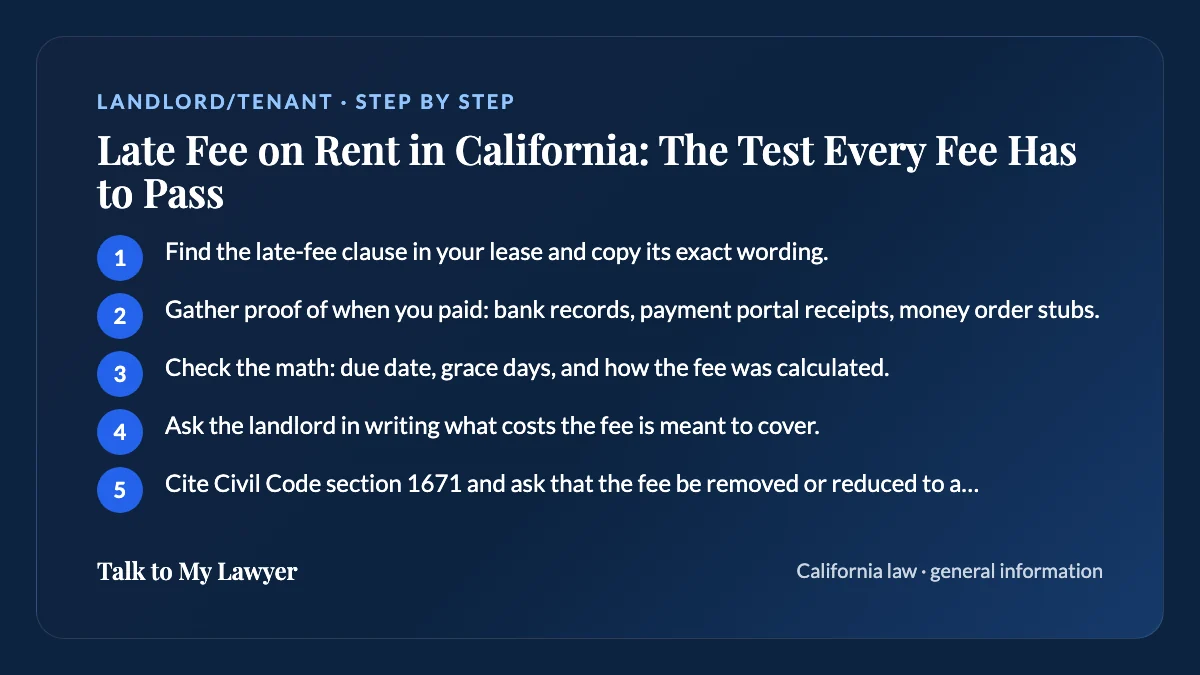
- Find the late-fee clause in your lease and copy its exact wording.
- Gather proof of when you paid: bank records, payment portal receipts, money order stubs.
- Check the math: due date, grace days, and how the fee was calculated.
- Ask the landlord in writing what costs the fee is meant to cover.
- Cite Civil Code section 1671(d) and ask that the fee be removed or reduced to a documented amount.
- Keep a copy of your letter and any reply, and check whether the fee later appears in a notice or a deposit deduction.
My October rent of $2,100 for 77 Cedar Way, Unit 12, was due October 1 and paid in full on October 8. The ledger now shows a $25-per-day late charge totaling $175. Under California Civil Code section 1671(d), a late fee in a residential lease is void unless the actual damage from late payment would be impracticable or extremely difficult to fix. Please remove the charge, or send me a written explanation of the costs it reflects, by October 25.
How landlords can set and collect a late fee that holds up
A landlord's position is strongest when the fee is modest, explained and supported. Some practical points drawn from section 1671 and the Orozco decision:
| Question | Weaker approach | Stronger approach |
|---|---|---|
| Basis for the amount | A round number chosen to discourage lateness | An estimate built from staff time, bank charges, interest and bookkeeping costs |
| Lease wording | Fee stated with no explanation | Lease states why actual damages are hard to fix and what the fee estimates |
| Structure | Daily fee with no ceiling | Single charge, or a capped amount |
| Collection | Added to a three-day notice | Billed and demanded separately from rent |
| Records | None | A file showing the costs that late payments actually create |
Example (hypothetical): a landlord with 12 units tracks the time spent on reminders, ledger corrections and bank reconciliation for late payments over a year, and the costs average about $60 per late payment. A $60 fee backed by that record is easier to defend than a $200 fee with no explanation.
When writing to a tenant about an unpaid fee, state the clause, the payment date, the amount, and the basis for it, and keep the demand separate from any rent notice. For a larger unpaid balance, our guide to a landlord's demand letter for unpaid rent covers the rest of the process.
When an attorney-written letter about late fees makes sense
A single disputed $50 charge may need nothing more than a short note. Months of stacked daily fees, late charges that show up in a pay-or-quit notice, or a property manager who applies rent payments to fees first and then calls the rent short are situations where the dispute can grow into an eviction question, and precise wording helps.
Through Talk to My Lawyer, a licensed California attorney writes your letter from your lease, ledger and payment records, whether you are the tenant disputing a fee or the landlord explaining one, and sends it on your behalf. Local rent ordinances can add rules, so talk to a lawyer about your city and your facts.
Frequently asked questions
How much can a landlord charge for late rent in California?
No California statute sets a maximum. Under Civil Code section 1671(d), a residential late fee is void unless actual damages from late payment would be impracticable or extremely difficult to fix, and case law also asks whether the fee is a reasonable estimate of the landlord's loss. The answer depends on the lease and the landlord's real costs. Local ordinances or subsidized housing rules can add limits.
Is a 5 percent or 10 percent late fee legal in California?
No statute approves or forbids a particular percentage. The question is whether the fee, whatever its form, passes the section 1671(d) test. A percentage fee that tracks the landlord's actual costs of handling late payments is easier to defend than one set high to discourage lateness. A court decides based on the evidence in the case.
Can my landlord evict me for not paying late fees?
A three-day notice to pay rent or quit may demand only past-due rent. The courts' self-help guide treats a pay-or-quit notice padded with late fees as invalid. A landlord can still pursue a valid fee through a separate written demand or a small claims case. Talk to a lawyer if a fee appears in an eviction notice.
Can I get back late fees I already paid?
If a fee was void under section 1671(d), you can ask the landlord in writing to refund it, citing the statute and the dates you paid. If the landlord refuses, a money claim within $12,500 can be filed in small claims court by an individual (Code of Civil Procedure section 116.221). Statutes of limitations apply, so check the filing deadline for your claim.
Can a landlord charge a late fee every day rent is late?
The lease can say so, but a daily fee still has to meet the section 1671(d) test. A fee that keeps growing with no ceiling looks less like an estimate of the landlord's handling costs and more like a penalty. If you face a mounting daily charge, ask in writing for the basis of the amount.
Sources
Checked against these official sources on October 18, 2026.
- California Civil Code section 1671 (California Legislative Information)
- California Civil Code section 1951.5 (California Legislative Information)
- California Code of Civil Procedure section 1161 (California Legislative Information)
- Types of notices (California Courts Self-Help Guide)
- California Code of Civil Procedure section 116.221 (California Legislative Information)
This guide explains California law in general terms as of October 2026. It is general information, not legal advice for your situation, and local rules can add to it.
Join the email list and get a lawyer letter started
With Talk to My Lawyer, a licensed California attorney writes your letter from your facts and documents and sends it on your behalf. Join the Talk to My Lawyer email list for letter checklists, document prompts, and reminders before you start your letter.