Quick answer
Civil Code section 1942.5 bars retaliatory eviction in California. If you are current on rent, a landlord may not evict you, raise your rent or cut services within 180 days after you request repairs, report a bed bug problem, or complain to a housing agency, unless the notice states a provable good-faith reason. Remedies include actual damages and, for acts done with fraud, oppression or malice, $100 to $2,000 each.
At a glance
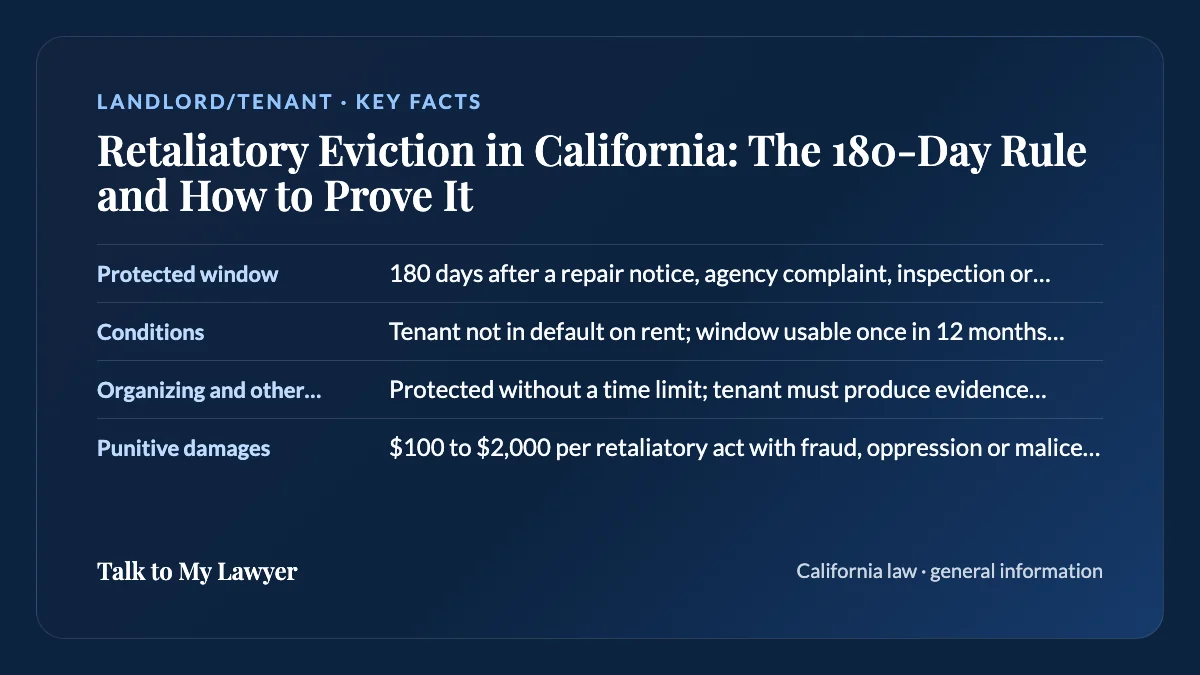
- Protected window
- 180 days after a repair notice, agency complaint, inspection or court filing (Civ. Code 1942.5(a))
- Conditions
- Tenant not in default on rent; window usable once in 12 months (1942.5(a), (b))
- Organizing and other rights
- Protected without a time limit; tenant must produce evidence (1942.5(d))
- Punitive damages
- $100 to $2,000 per retaliatory act with fraud, oppression or malice (1942.5(h))
- Immigration threats
- Expressly retaliatory (1942.5(c), (e)); disclosure: 6 to 12 times monthly rent per person (1940.35)
What counts as retaliatory eviction in California?
Retaliation is a landlord punishing a tenant for using a legal right. Civil Code section 1942.5 covers four kinds of punishment: trying to recover possession, causing you to leave involuntarily, raising the rent, and decreasing services.
The statute protects two broad groups of tenant activity, and they work differently:
- Habitability activity, covered by section 1942.5(a): asking for repairs, reporting a suspected bed bug infestation, complaining to a government agency about the unit's condition, or going to court or arbitration over it.
- Organizing and other lawful rights, covered by section 1942.5(d): joining or organizing a tenants' association or an organization advocating tenants' rights, or lawfully and peaceably exercising any other legal right.
Section 1942.5(d) also makes it unlawful to threaten any of those acts for a retaliatory purpose. A message saying the rent will go up if you call the city again can count.
How the 180-day retaliation rule works
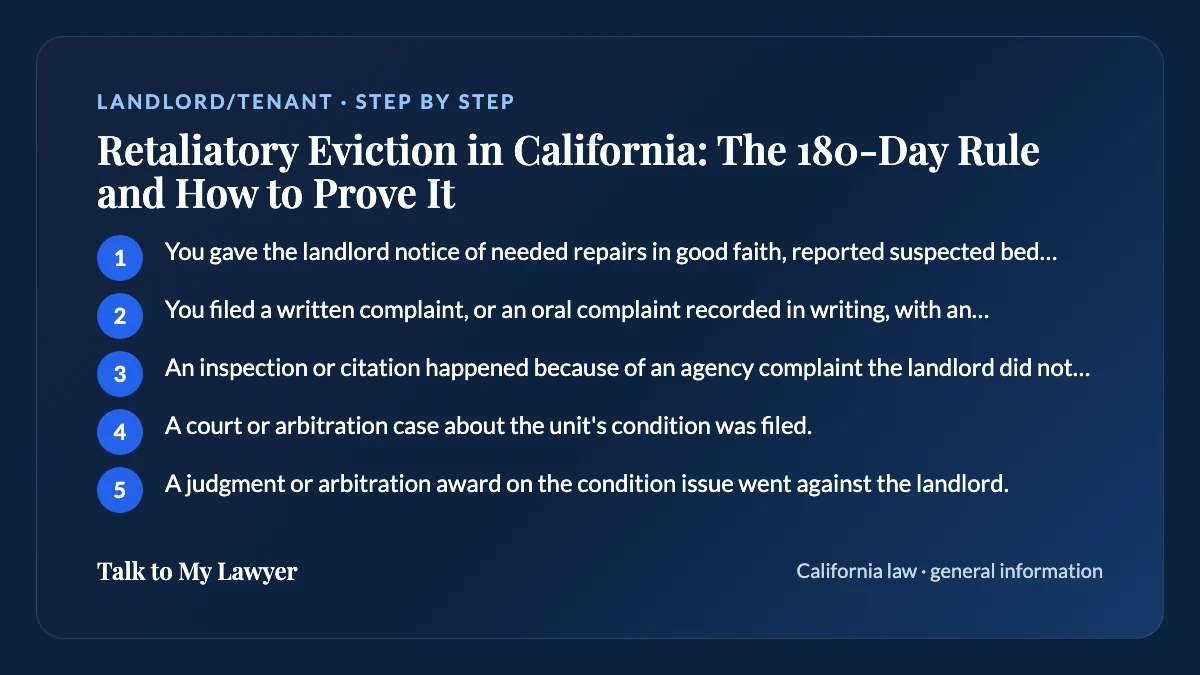
Under section 1942.5(a), if you are not in default on rent, a landlord who retaliates may not take any of the four actions within 180 days after the latest of these events:
- You gave the landlord notice of needed repairs in good faith, reported suspected bed bugs, or complained orally about the unit's condition.
- You filed a written complaint, or an oral complaint recorded in writing, with an appropriate agency, and the landlord knew about it.
- An inspection or citation happened because of an agency complaint the landlord did not know about.
- A court or arbitration case about the unit's condition was filed.
- A judgment or arbitration award on the condition issue went against the landlord.
The window runs from whichever of these dates is latest. That matters when an agency complaint the landlord did not know about leads to an inspection weeks later: the inspection date then becomes the starting point.
Three limits apply:
- Rent must be current. The 180-day protection in subdivision (a) applies only if you are not in default on rent.
- Once a year. Section 1942.5(b) lets a tenant invoke subdivision (a) no more than once in any 12-month period.
- Stated good-faith grounds. Section 1942.5(g) lets a landlord act inside the window if the notice states the ground on which the landlord is acting in good faith. If you dispute that ground, the landlord must prove it is true at trial.
Is it still retaliation after 180 days?
It can be. The 180-day rule is one route, not the only one. Section 1942.5(d) bars retaliation for organizing or for lawfully exercising any right under the law, with no time window. Under that subdivision, the tenant carries the burden of producing evidence that the landlord's conduct was retaliatory.
Other statutes cover related ground:
- Government Code section 12955(f) makes it unlawful to harass or evict a person when the owner's dominant purpose is retaliation for opposing housing discrimination, reporting it, or helping someone else assert fair housing rights.
- Civil Code section 1940.2 bars harassment aimed at getting a tenant to leave, including threats to disclose immigration status, with a civil penalty of up to $2,000 per violation.
If the retaliation looks like a pattern of pressure rather than a single act, the harassment statutes may fit better; see our guide to landlord harassment and a written response.
Is threatening to report a tenant to immigration retaliation?
Yes. Sections 1942.5(c) and (e) state that reporting, or threatening to report, a tenant or people known to be associated with the tenant to immigration authorities is a form of prohibited retaliation.
Civil Code section 1940.35 goes further for actual disclosures. A landlord who discloses a tenant's or occupant's immigration or citizenship status to any immigration authority, law enforcement agency or government agency to harass, intimidate, retaliate or force a move faces statutory damages of 6 to 12 times the monthly rent for each person whose status was disclosed, plus injunctive relief and attorney's fees to the prevailing party. A landlord complying with federal law, a subpoena, a warrant or a court order is not in violation.
What can a tenant recover for landlord retaliation?
A landlord or agent who violates section 1942.5 is liable in a civil action for the tenant's actual damages, and for punitive damages of not less than $100 nor more than $2,000 for each retaliatory act where the landlord or agent acted with fraud, oppression or malice.
- Attorney's fees: in a damages case for retaliatory eviction, the court awards reasonable fees to the prevailing party if either side asks for them when the case begins.
- Other remedies: the section's remedies are in addition to any others in statute or case law.
- No waiver: a lease clause giving up these rights is void.
- Eviction defense: section 1942.5(a) says a retaliating landlord may not recover possession in any action, so retaliation can be raised in response to an unlawful detainer case.
How to prove retaliation: build a dated timeline
Retaliation cases turn on sequence. A clean timeline shows what you did, when the landlord learned of it, and what the landlord did next.
| Date | Event | Proof |
|---|---|---|
| Feb 3 | Tenant emails landlord about a broken heater | Sent email with date |
| Feb 20 | Tenant files complaint with city code enforcement | Complaint receipt |
| Mar 6 | Inspector visits and issues a citation | Inspection report |
| Apr 10 | Landlord serves a 60-day notice with no stated reason | Photo of the notice |
| Day count | 35 days after the inspection, well inside 180 | Calendar |
Example (hypothetical): the table above shows a tenant current on rent who has not used the 180-day protection in the past year. The landlord first learned of the city complaint when the inspector arrived, so the March 6 inspection is the latest triggering date and the window runs into early September.
- Save every repair request, complaint and agency receipt, with dates.
- Collect rent receipts or bank records showing you were current.
- Keep the landlord's notices, envelopes and messages, and photograph anything posted on your door.
- Note any services cut after the complaint: parking, laundry access, repairs that stopped.
- Write down conversations the same day, including threats, with names and times.
What a letter about landlord retaliation should say
The letter should set out the dates in order, cite section 1942.5, and ask the landlord to withdraw the notice, rent increase or service cut. Keep the tone level; the dates do the persuading.
On February 20 I filed a complaint with the city about the broken heater at 51 Linden Street, Unit 7, and an inspector issued a citation on March 6. On April 10, 35 days later, I received a notice ending my tenancy that states no reason. My rent is paid in full. Civil Code section 1942.5 does not allow a landlord to retaliate for these steps by recovering possession within 180 days of them. Please withdraw the notice in writing by April 24.
If the underlying repair is still not done, a separate repair demand letter can keep that issue moving on its own track.
When to have an attorney write about retaliation
Retaliation is the rare tenant issue where the landlord's paperwork can look perfectly normal: a standard rent increase, an ordinary 60-day notice. What makes it unlawful is the timing and the reason behind it, and the letter has to lay that sequence out date by date, next to the subdivision of section 1942.5 it triggers.
Through Talk to My Lawyer, a licensed California attorney writes your letter from your timeline, complaint records and notices, cites section 1942.5 and any related statute that fits, and sends it on your behalf. Where an unlawful detainer case has started, retaliation can be part of your answer, and a lawyer or legal aid office can explain how to raise it in time.
Frequently asked questions
Can a landlord increase rent after a repair complaint in California?
Not in retaliation. If you are current on rent, a rent increase made to punish a good-faith repair request or agency complaint falls inside section 1942.5(a) when it comes within the 180-day window. A landlord may still raise rent for a legitimate reason stated in good faith in the notice, and must prove that reason if you dispute it. State and local rent caps can also limit the increase.
What if I am behind on rent?
The 180-day protection in section 1942.5(a) applies only to a tenant who is not in default on rent. Retaliation for organizing or for exercising other legal rights under section 1942.5(d) does not contain that condition, though you would need to produce evidence that the landlord's conduct was retaliatory. Talk to a lawyer about how unpaid rent affects your situation.
How long after a complaint can a landlord evict me in California?
There is no fixed date after which retaliation becomes lawful. The 180-day rule in section 1942.5(a) gives added protection inside that window, measured from the latest triggering event. After it ends, a landlord still may not act for a retaliatory purpose under section 1942.5(d), but the tenant carries the burden of producing evidence of that purpose.
Can I use the 180-day protection more than once?
Section 1942.5(b) says a tenant may not invoke subdivision (a) more than once in any 12-month period. That limit applies to the 180-day rule itself. It does not cancel the separate protection in subdivision (d) for organizing or lawfully exercising other rights, and it does not limit other statutes, such as the harassment rules in Civil Code section 1940.2.
Is a reduction in services retaliation?
It can be. Section 1942.5 lists decreasing services alongside eviction and rent increases as retaliatory acts. Taking away a parking space, laundry access or a promised repair schedule soon after a complaint may fit. Record what changed and when, and compare it with the date of your request or complaint.
Sources
Checked against these official sources on October 18, 2026.
- California Civil Code section 1942.5 (California Legislative Information)
- California Civil Code section 1940.35 (California Legislative Information)
- California Civil Code section 1940.2 (California Legislative Information)
- California Government Code section 12955 (California Legislative Information)
This guide explains California law in general terms as of October 2026. It is general information, not legal advice for your situation, and local rules can add to it.
Join the email list and get a lawyer letter started
With Talk to My Lawyer, a licensed California attorney writes your letter from your facts and documents and sends it on your behalf. Join the Talk to My Lawyer email list for letter checklists, document prompts, and reminders before you start your letter.