Quick answer
San Francisco rent control comes from the Rent Ordinance (Administrative Code Chapter 37). Many units in buildings built on or before June 13, 1979 can get one increase every 12 months, capped at the Rent Board's annual amount: 1.6% of base rent from March 1, 2026 through February 28, 2027. Landlords need a rent increase license, may bank skipped increases, and must follow buyout rules in Section 37.9E.
At a glance
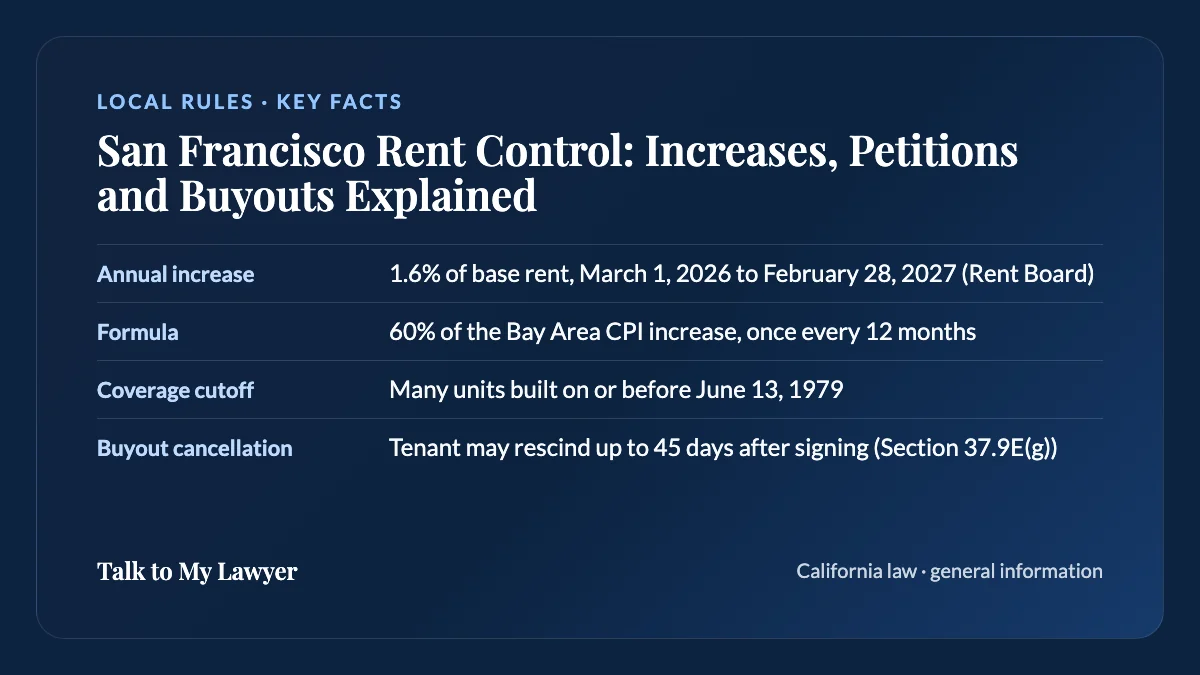
- Annual increase
- 1.6% of base rent, March 1, 2026 to February 28, 2027 (Rent Board)
- Formula
- 60% of the Bay Area CPI increase, once every 12 months
- Coverage cutoff
- Many units built on or before June 13, 1979
- Buyout cancellation
- Tenant may rescind up to 45 days after signing (Section 37.9E(g))
- Petition fee
- No charge to file a Tenant Petition at the Rent Board
Which San Francisco units have rent control?
Many residential units built on or before June 13, 1979 have both rent control and eviction protection under the Rent Ordinance, unless the unit is used as a single-family dwelling. The first thing to check is the construction date, which you can look up on the city's Property Information Map.
Some units get eviction protection but no limit on increases. The Rent Board lists these:
- Units built after June 13, 1979.
- Most single-family homes and condos, if you moved in on or after January 1, 1996.
- Units that have undergone substantial rehabilitation.
- Units whose rents are controlled or regulated by another government agency.
A small group of housing is outside the ordinance entirely, including dormitories run by schools, nonprofit cooperatives controlled by their residents, hospitals and care facilities, and hotel rooms where the same guest has not stayed 32 or more continuous days. A unit with no local rent cap may still fall under the statewide cap and the state rules on rent increase notices.
How much can a San Francisco landlord raise the rent in 2026?
For a rent-controlled unit, the annual allowable increase is 1.6% for increases effective March 1, 2026 through February 28, 2027. The Rent Board sets the figure each year at 60% of the increase in the Consumer Price Index for All Urban Consumers in the Bay Area.
| Period | Allowable annual increase |
|---|---|
| March 1, 2024 to February 28, 2025 | 1.7% |
| March 1, 2025 to February 28, 2026 | 1.4% |
| March 1, 2026 to February 28, 2027 | 1.6% |
The rules around the number matter as much as the number itself:
- The increase is calculated on base rent only, which includes housing services such as parking or storage but not temporary passthroughs.
- Increases cannot be rounded up to the next dollar.
- The first increase can come 12 months after the lease began, and then no sooner than 12 months after the last one.
- Notice must be written: 30 days, or 90 days if the increase (alone or combined with others that year) exceeds 10%, plus 5 more days when mailed.
- The landlord must hold a rent increase license, which requires reporting the unit to the Rent Board Housing Inventory, before imposing annual or banked increases.
- Adding a roommate does not by itself allow a rent increase, even if the lease says otherwise.
How do banked rent increases work?
A landlord who skips an increase on your anniversary date can save it and add it later. That is called banking, and it is why a San Francisco increase can be larger than the current year's percentage.
Example (hypothetical): a tenant moved in on September 1, 2023 at $2,400 base rent. The landlord raised nothing in 2024 or 2025 and serves a proper notice for September 1, 2026. The Rent Board adds the percentages in effect on each skipped anniversary: 1.7% for 2024 and 1.4% for 2025, plus the 1.6% now in effect. That is 4.7%, or $112.80, for a new base rent of $2,512.80. An increase of $150 on the same facts would exceed the allowed amount.
Timing can also cost the landlord. If the landlord moves your anniversary date earlier, a year that had not yet banked can be lost permanently. A notice that charges for that lost year is one of the errors worth flagging in writing.
What can you take to the Rent Board?
There is no charge to file a Tenant Petition. A petition may be resolved at a mediation session or go to a hearing before an Administrative Law Judge, and one petition can combine several claims:
- Substantial decrease in housing services, such as a lost parking space or laundry room.
- Failure to repair and maintain.
- Unlawful rent increase, or a request to determine the lawful rent.
- Improper utility, water bond or general obligation bond passthroughs.
- Failure to discontinue a capital improvement passthrough.
The Rent Board does not decide harassment, discrimination, retaliation or security deposit disputes. Those go to court or another forum. For harassment, our guide to a landlord harassment cease and desist letter covers the state-law side.
Can your landlord pass through renovation costs?
Yes, but only after filing a Capital Improvement Petition with the Rent Board and before serving the rent increase notice. Capital improvements are work that adds value or extends the building's life, such as new windows or a roof. Routine repairs, like patching a roof or replacing a broken pane, do not count.
- The passthrough is not part of base rent and must stop at the end of its amortization period. If it does not stop, the landlord owes you the overpayments.
- In buildings with one to five residential units, the passthrough cannot exceed the greater of $30 or 5 percent of your petition base rent in any 12-month period.
- A tenant who moved in after the work was done cannot be charged for it.
- If paying would be a financial hardship, you can file a Tenant Financial Hardship Application after receiving the notice or the Rent Board decision. While it is pending, you do not pay the passthrough; if it is denied, the amount is owed back to the notice's effective date.
What does Section 37.9E require before a buyout?
Before any buyout discussion starts, the landlord must give each tenant the Rent Board's written disclosure form and file a declaration with the Rent Board. The disclosure tells you that you can refuse to negotiate, can consult an attorney, and can cancel a signed agreement within 45 days.
| Step | Rule under Section 37.9E |
|---|---|
| Signing | Not sooner than 30 days after buyout negotiations began; in writing, with required 14-point statements initialed by each tenant |
| Cancelling | Up to and including day 45 after all parties sign, by hand delivery, email or mail |
| Filing | Landlord files the agreement with the Rent Board between day 46 and day 59 |
| Late filing | If the landlord has not filed by day 59, any waiver or release of claims is void at the tenant's option |
An agreement missing the required statements or initials is not effective and can be rescinded at any time. These rules apply however generous the offer is, and the clock for the 30-day wait starts only when negotiations begin.
How to challenge a San Francisco rent increase in writing
A short letter that shows your arithmetic puts the error on record and asks for a corrected notice. Work through it in this order:
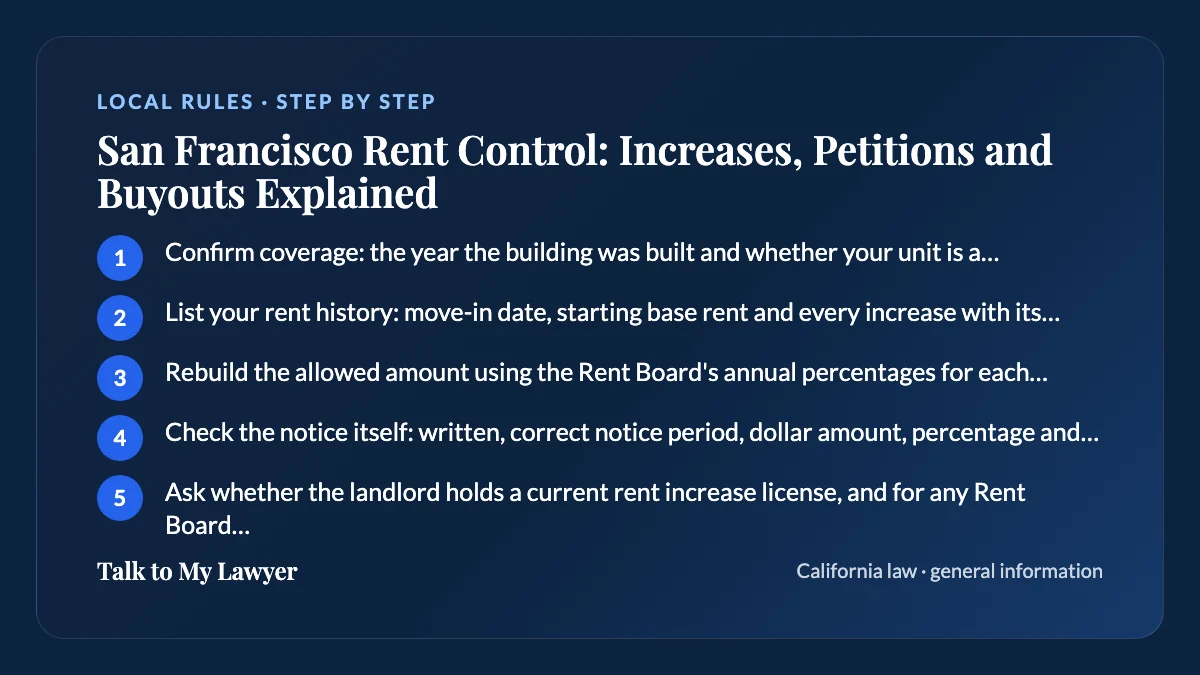
- Confirm coverage: the year the building was built and whether your unit is a single-family home or condo you moved into after 1995.
- List your rent history: move-in date, starting base rent and every increase with its effective date.
- Rebuild the allowed amount using the Rent Board's annual percentages for each anniversary, adding banked years only where 12 full months had passed.
- Check the notice itself: written, correct notice period, dollar amount, percentage and effective date.
- Ask whether the landlord holds a current rent increase license, and for any Rent Board decision supporting a passthrough.
- Send the letter with a response date and keep proof of delivery. If it is not resolved, consider a Tenant Petition.
Your notice dated May 2 raises my base rent from $2,400 to $2,550 effective June 1, 2026. My records show my last increase took effect June 1, 2025. Under the Rent Ordinance, the allowable annual increase in effect on June 1, 2026 is 1.6%, or $38.40, for a lawful base rent of $2,438.40. Please send a corrected notice by May 20, or the Rent Board decision that authorizes the larger amount.
If you already paid more than the lawful amount, our guide to a rent overcharge demand letter explains how to ask for a refund.
When a San Francisco rent dispute calls for an attorney letter
Three years of banked increases folded into one notice, a passthrough still billed after its amortization ended, or a buyout signed under pressure with the 45-day window still open: each turns on dates and dollar amounts that are easy to get wrong. A letter from counsel can set that record out clearly before a petition or lawsuit.
Through Talk to My Lawyer, a licensed California attorney writes your letter (from your lease, rent history, notices and other documents) and sends it on your behalf. The Rent Board's counselors can explain the ordinance, while advice on your own options should come from a lawyer familiar with your tenancy.
Frequently asked questions
What is the allowable rent increase in San Francisco for 2026?
For rent-controlled units, the Rent Board's allowable annual increase is 1.6% for increases effective March 1, 2026 through February 28, 2027. It applies to base rent only. On a $2,000 base rent, that is $32, for a new base rent of $2,032. The 2026 figure was announced on January 14, 2026; the Rent Board will publish the rate for March 2027 onward on its website.
Is my single-family home or condo rent controlled in San Francisco?
Usually not for rent limits, if you moved in on or after January 1, 1996. State law exempts most single-family homes and condos from local rent caps, though they keep San Francisco's just cause eviction protections. A tenant who moved in before 1996 may still have rent control. Mixed cases, such as a house with a second unit, are hard to classify, so ask a Rent Board counselor before relying on either answer.
Can my landlord raise the rent more than 1.6% this year?
Possibly. A landlord can add banked increases from skipped years, pass through certain costs approved by the Rent Board, or get a larger increase through a landlord petition. Each needs a basis you can check. A landlord without a rent increase license cannot impose annual or banked increases at all, so ask for the license and the calculation if the number looks high.
How long do I have to cancel a buyout agreement in San Francisco?
Section 37.9E lets you rescind a buyout agreement up to and including the 45th day after all parties sign it. You cancel by hand delivering, emailing or mailing a signed statement to the landlord. An agreement that leaves out the required statements or tenant initials is not effective and can be cancelled at any time.
Does the San Francisco Rent Board handle security deposit disputes?
No. The Rent Board decides rent-related claims such as unlawful increases, decreased services and passthroughs, but it does not decide security deposit, harassment, discrimination or retaliation disputes. A deposit claim goes to court, such as small claims court, under California Civil Code section 1950.5.
Sources
Checked against these official sources on October 18, 2026.
- Annual Rent Increase for 3/1/26 - 2/28/27 Announced (San Francisco Rent Board)
- Learn about rent increases in San Francisco (San Francisco Rent Board)
- Learn about San Francisco rental laws (San Francisco Rent Board)
- Sec. 37.9E - Tenant Buyout Agreements (San Francisco Rent Board)
- Capital Improvement Petitions (San Francisco Rent Board)
- Tenant petitions (San Francisco Rent Board)
This guide explains California law in general terms as of October 2026. It is general information, not legal advice for your situation, and local rules can add to it.
Join the email list and get a lawyer letter started
With Talk to My Lawyer, a licensed California attorney writes your letter from your facts and documents and sends it on your behalf. Join the Talk to My Lawyer email list for letter checklists, document prompts, and reminders before you start your letter.