Quick answer
Oakland rent control limits covered units, generally rentals built before 1983 other than single-family homes and condos, to one increase every 12 months at the Rent Adjustment Program's CPI rate: 2.3% from August 1, 2026 through July 31, 2027. Owners can add banked increases within limits, must attach the RAP Notice, and need just cause to evict. Tenants have 180 days to petition RAP over an unlawful increase.
At a glance
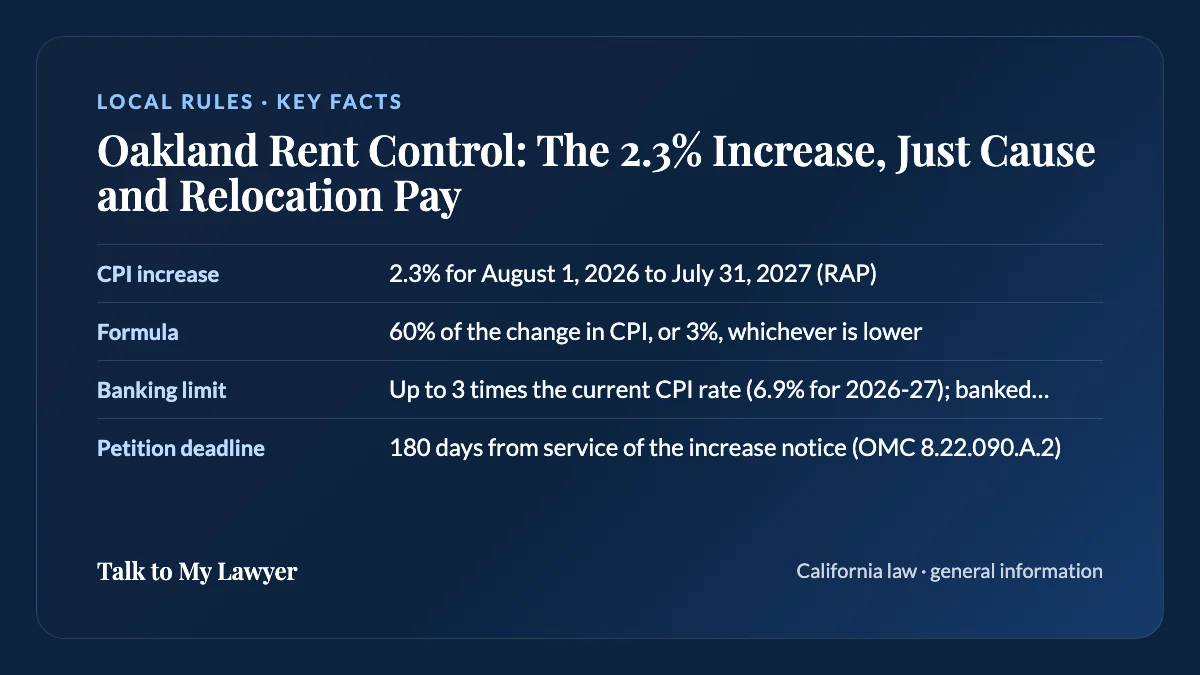
- CPI increase
- 2.3% for August 1, 2026 to July 31, 2027 (RAP)
- Formula
- 60% of the change in CPI, or 3%, whichever is lower
- Banking limit
- Up to 3 times the current CPI rate (6.9% for 2026-27); banked increases expire after 5 years
- Petition deadline
- 180 days from service of the increase notice (OMC 8.22.090.A.2)
- Relocation
- $8,293.13 to $12,599.18 by unit size, July 1, 2026 through June 30, 2027
What is Oakland's allowable rent increase for 2026-27?
The CPI rent increase for covered Oakland units is 2.3% effective August 1, 2026, and it stays in effect through July 31, 2027. Since a 2022 amendment, the Rent Adjustment Program (RAP) calculates it as 60% of the change in the Consumer Price Index, or 3%, whichever is lower.
| Effective date | CPI increase |
|---|---|
| August 1, 2024 | 2.3% |
| August 1, 2025 | 0.8% |
| August 1, 2026 | 2.3% |
An owner can raise the rent on a covered unit only once in 12 months. The first increase cannot take effect earlier than 12 months after you moved in, and none can be imposed until at least six months after you were first served the RAP Notice (OMC 8.22.060). If all the tenants are new, the owner can set the starting rent at market rate; if any original occupant remains, the ordinance limits still apply.
Checklist: does your Oakland rent increase notice hold up?
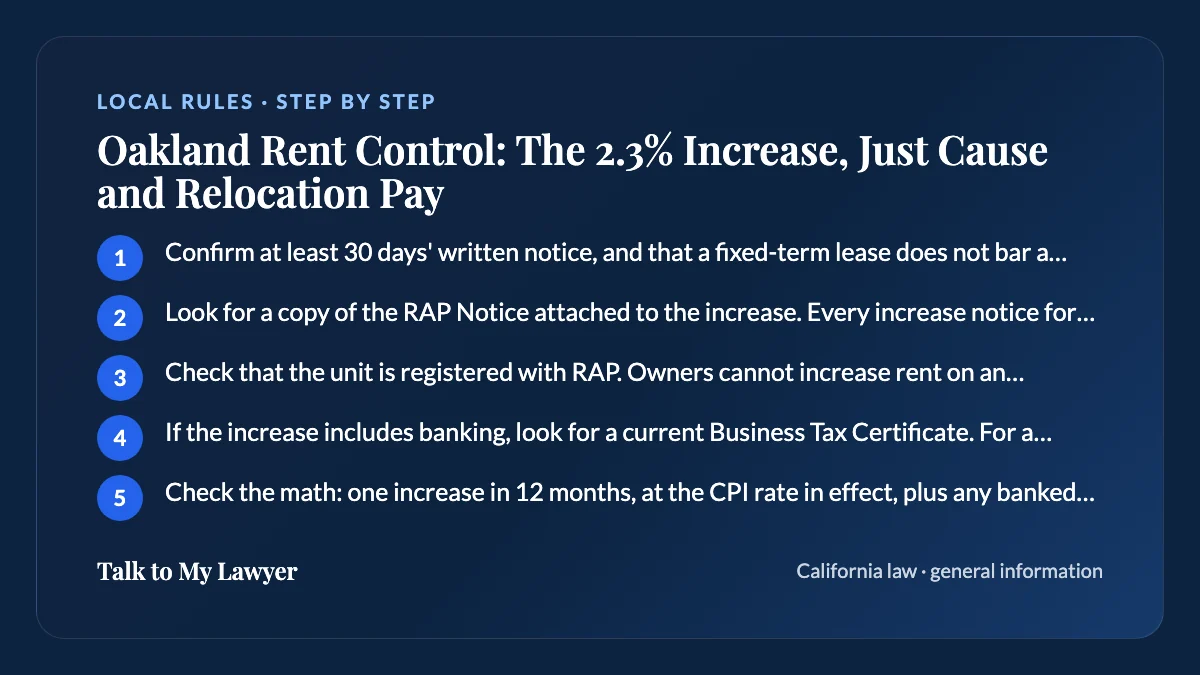
Before checking the math, check the paperwork. Go through the notice in this order:
- Confirm at least 30 days' written notice, and that a fixed-term lease does not bar a mid-lease increase.
- Look for a copy of the RAP Notice attached to the increase. Every increase notice for a covered unit must include one.
- Check that the unit is registered with RAP. Owners cannot increase rent on an unregistered covered unit.
- If the increase includes banking, look for a current Business Tax Certificate. For a CPI-only increase, the owner may attach either the certificate or a signed payment plan for delinquent business taxes.
- Check the math: one increase in 12 months, at the CPI rate in effect, plus any banked amount within the limits below.
- Write down the date you were served. That starts your 180-day window to file a tenant petition.
The business tax rules took effect in stages: owners delinquent on business taxes have been barred from issuing increases since April 15, 2025, and the certificate must be for the current calendar year for notices served on or after April 30.
Which Oakland units are covered by rent control?
The Rent Adjustment Ordinance (OMC Chapter 8.22) covers most rental units except those RAP lists as exempt. The three most common exemptions are government-subsidized housing, units built after January 1, 1983, and single-family homes or condominiums exempt under the state Costa-Hawkins Rental Housing Act.
Other exemptions include the unit an owner lives in, units sharing a kitchen or bath with the owner, substantially rehabilitated units, short hotel stays, and nonprofit cooperatives. An exempt unit has no local limit on increases, but Oakland's just cause rules may still apply, and state limits may too; here is how California's statewide rent cap and notice periods work.
How much can banking add to an Oakland rent increase?
Banking lets an owner add CPI increases from earlier years that were not taken, without filing a petition. City Council amendments adopted in December 2024 narrowed it, and one of them took effect only on January 1, 2026, so older notices and new ones follow different rules.
| Rule | What it says |
|---|---|
| Single-year ceiling | No banked increase can exceed 3 times the current CPI rate: 6.9% for August 1, 2026 to July 31, 2027 |
| How far back | From January 1, 2026, increases can be banked for five years, not ten (notices served on or before December 31, 2025 keep the old rule) |
| Change of owner | Since December 24, 2024, banked increases expire when the property is transferred, except certain family inheritances |
| State ceiling | Combined with any RAP-approved increase, an annual increase cannot exceed the state cap: 8.8% from August 1, 2026 |
| Five-year limit | RAP treats an increase as unlawful if it exceeds 30% over five years, except fair return increases |
Above banking, an owner needs a RAP petition, for example to pass through 70% of capital improvement costs or to claim fair return. If challenged, the owner must back up banked amounts with the unit's rent history.
When can an Oakland landlord evict?
Only for one of ten just causes listed in OMC section 8.22.300, such as unpaid rent, a material lease violation after written notice, substantial damage, owner or relative move-in, Ellis Act withdrawal, or substantial repairs that cannot be done with the tenant in place. The expiration of a lease, a sale or foreclosure, and a change in Section 8 status do not count as just causes.
- Measure V (effective December 30, 2022) extended just cause to units built after 1995, except new construction with a certificate of occupancy within the past 10 years, and removed refusal to sign a new lease as a ground.
- No-fault notices cannot expire during the Oakland Unified school year if the household includes school-age children or OUSD educators.
- Owners delinquent on business taxes cannot pursue owner move-in or substantial repairs evictions, and must attach a current Business Tax Certificate to those notices.
- Every eviction notice must be filed with RAP within 10 days of service. Failing to file is a defense to the eviction case.
What counts as harassment under Oakland's Tenant Protection Ordinance?
The Tenant Protection Ordinance (TPO) treats a range of bad-faith conduct by an owner as harassment and gives tenants civil remedies. The city's list includes:
- Cutting off or threatening to cut off housing services, or failing to make repairs.
- Abusing the right to enter the unit, or taking photos or video inside without a lawful purpose.
- Pressuring a tenant to leave through fraud, intimidation or coercion, including threats to report immigration status.
- Repeating buyout offers within six months after the tenant says in writing not to send more.
- Refusing to accept lawful rent, or holding a rent check more than 30 days without giving a receipt.
- Charging a late fee before rent is five days late, or one larger than 3 percent of the monthly rent.
For some repair and rent-acceptance claims, a tenant may need to notify the owner first and allow 15 days to fix the problem before suing. A dated written notice serves that purpose; see our guide to a landlord harassment cease and desist letter.
How much relocation pay does Oakland require?
Under the Uniform Residential Tenant Relocation Ordinance (OMC 8.22.800 and following), owners must pay relocation when tenants are displaced by owner or relative move-ins, code compliance work, the Ellis Act or condominium conversions. The amounts adjust each July 1.
| Unit size | July 1, 2026 through June 30, 2027 |
|---|---|
| Studio or one-bedroom | $8,293.13 |
| Two-bedroom | $10,206.93 |
| Three or more bedrooms | $12,599.18 |
Households that include lower-income, elderly or disabled tenants, or minor children, are owed one additional $2,500 payment per unit. The termination notice must tell tenants they have a right to relocation payments. Temporary code compliance displacements instead require payment of actual temporary housing costs. Our guide to relocation assistance for no-fault evictions compares this with state law.
How do RAP tenant petitions work?
Tenants can petition RAP to lower the rent ceiling for housing code violations, habitability problems, or lost space or services, and to contest an unlawful increase, an increase served without the RAP Notice, an improperly served notice, or a capital improvement charge past its amortization period.
Since December 24, 2024, a petition challenging an unlawful increase is due within 180 days of service of the notice. If the owner never gave the RAP Notice at the start of the tenancy, the 180 days run from when you first receive it. The owner can respond, a Hearing Officer decides the petition with or without a hearing, and either side can appeal to the Rent Board. RAP counselors answer questions at (510) 238-3721.
Your notice served on September 3, 2026 raises my rent from $1,900 to $2,040, a 7.4% increase, effective October 4. It did not include the RAP Notice or a Business Tax Certificate, and my last increase took effect on January 1, 2026. Under OMC Chapter 8.22, please withdraw this notice. Any increase on or after January 1, 2027 is limited to the 2.3% CPI rate, plus any banked amount you can document.
When a missing RAP Notice or relocation check needs an attorney letter
Oakland's ordinance is full of attachment and timing rules, and the problems follow them: a missing RAP Notice, a banked increase carried over from an earlier owner, a relocation check that never arrived, or a no-fault notice timed to expire during the school year. A letter that lines those facts up against Chapter 8.22 gives the owner a clear chance to correct course before a petition or court case.
Through Talk to My Lawyer, a licensed California attorney writes your letter (from your notices, rent records, correspondence and your account of what happened) and sends it on your behalf. RAP counselors can explain how the ordinance works; a lawyer who has read your notices can advise on strategy for your unit.
Frequently asked questions
How much can my rent go up in Oakland in 2026?
For a covered unit, the CPI increase is 2.3% for increases effective from August 1, 2026 through July 31, 2027, once in a 12-month period. An owner can add banked increases from prior years, but no single banked increase can exceed three times the CPI rate, which is 6.9% for this period. Larger increases require an approved RAP petition.
Is my Oakland apartment rent controlled if it was built after 1983?
Generally no. Units built after January 1, 1983 are exempt from Oakland's rent limits. They may still have just cause eviction protection, which Measure V extended to most units built after 1995, except new construction with a certificate of occupancy issued within the past 10 years. State rent caps may also apply.
What is the deadline to challenge a rent increase in Oakland?
As of October 2026, you have 180 days from the date the owner served the rent increase notice to file a tenant petition with the Rent Adjustment Program. This deadline was extended from 90 days in December 2024. If the owner never gave you the RAP Notice when your tenancy began, the 180 days start when you first receive it.
How much relocation money do Oakland tenants get for an owner move-in?
For displacements from July 1, 2026 through June 30, 2027, the base payment is $8,293.13 for a studio or one-bedroom, $10,206.93 for a two-bedroom, and $12,599.18 for three or more bedrooms. Households with lower-income, elderly or disabled members, or minor children, get one extra $2,500 payment per unit.
Can an Oakland landlord evict me because my lease ended?
No. Under Oakland's Just Cause for Eviction Ordinance, the end of a lease term is not a just cause. Since Measure V took effect in December 2022, refusing to sign a new lease is not a ground either. The owner must state one of the ten listed causes in the notice and file the notice with RAP within 10 days.
Sources
Checked against these official sources on October 18, 2026.
- Learn More About Allowable Rent Increases (City of Oakland Rent Adjustment Program)
- Info Sheet: Rent Levels and Rent Regulation (May 28, 2026) (City of Oakland Rent Adjustment Program)
- Info Sheet: Uniform Residential Tenant Relocation Ordinance (May 28, 2026) (City of Oakland Rent Adjustment Program)
- Understanding Evictions in Oakland (City of Oakland Rent Adjustment Program)
- Tenant Protection Ordinance (City of Oakland)
- Properties Exempt from the Rent Adjustment Program (City of Oakland Rent Adjustment Program)
This guide explains California law in general terms as of October 2026. It is general information, not legal advice for your situation, and local rules can add to it.
Join the email list and get a lawyer letter started
With Talk to My Lawyer, a licensed California attorney writes your letter from your facts and documents and sends it on your behalf. Join the Talk to My Lawyer email list for letter checklists, document prompts, and reminders before you start your letter.