Quick answer
Berkeley rent control, under Berkeley Municipal Code Chapter 13.76, sets a rent ceiling for fully covered units, mostly multi-unit buildings built before June 1980. Ceilings rise once a year by the Annual General Adjustment: 1.0% from January 1, 2026. Fully and partially covered tenants also earn yearly interest on security deposits and need just cause to be evicted.
At a glance
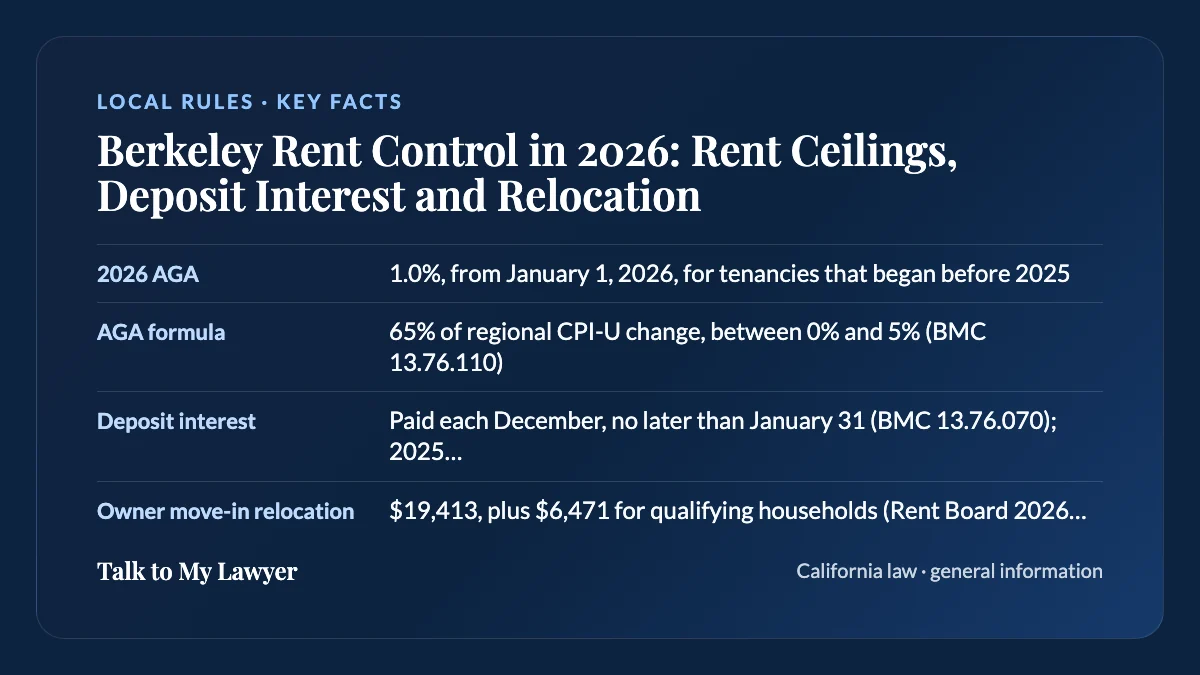
- 2026 AGA
- 1.0%, from January 1, 2026, for tenancies that began before 2025
- AGA formula
- 65% of regional CPI-U change, between 0% and 5% (BMC 13.76.110)
- Deposit interest
- Paid each December, no later than January 31 (BMC 13.76.070); 2025 rate 0.9%
- Owner move-in relocation
- $19,413, plus $6,471 for qualifying households (Rent Board 2026 figures)
- Retaliation
- Presumed if within six months of exercising rights (BMC 13.76.140)
Is your Berkeley unit fully covered, partially covered or exempt?
Berkeley sorts rentals into three levels of protection under the Rent Stabilization and Eviction for Just Cause Ordinance (Berkeley Municipal Code Chapter 13.76, renamed from the Good Cause title in 2024). Your level decides whether your rent has a ceiling at all.
| Coverage | What you get | Typical examples |
|---|---|---|
| Full | Rent ceiling raised only by the AGA, just cause for eviction, deposit interest | Most multi-unit buildings built before June 1980; single-family homes with tenants who moved in before 1996 |
| Partial | No rent ceiling, but just cause for eviction and deposit interest | Single-family homes rented from 1996 on, most condos, units with a certificate of occupancy after June 1980 |
| None | No local rent limit, no local just cause, no deposit interest | Rooms sharing a kitchen or bath with a resident landlord, owner-occupied duplexes that qualify as Golden Duplexes, dormitories |
Unpermitted units are generally covered. After voters passed Measure BB in November 2024, government-owned and government-subsidized units, such as Section 8 housing, must also be registered with the Rent Board as fully or partially covered. Partially covered tenants may still be protected by state rent increase limits and notice periods.
What is Berkeley's Annual General Adjustment for 2026?
The 2026 Annual General Adjustment (AGA) is 1.0%. Starting January 1, 2026, eligible landlords may raise the rent ceiling of fully covered units by 1.0% for tenancies that began before January 1, 2025, after giving written notice.
- The ordinance sets the AGA at 65% of the increase in the Consumer Price Index for All Urban Consumers in the San Francisco-Oakland-San Jose region for the 12 months ending June 30, never below 0% or above 5% (BMC 13.76.110).
- A tenancy that started in 2025 is not eligible for the 2026 AGA, because the initial rent was set that year.
- Notice is 30 days for increases of 10% or less and 90 days for more than 10%.
- The Board publishes the next year's AGA on or about October 31, so check the Rent Board site for the 2027 figure once it is announced.
A higher ceiling is not an automatic increase. If your lease sets a lower rent than the ceiling, the lease rent controls until the lease expires. You can look up a unit's registered ceiling in the Rent Board's online Rent Registry.
When can a Berkeley landlord not take the AGA?
According to the Rent Board, a landlord is not eligible for the AGA if any of these apply:
- The unit is not properly registered under BMC 13.76.080, including the vacancy registration form required when a new tenancy begins.
- The landlord has not complied with a Rent Board order or regulation after being ordered to.
- There is an outstanding housing code Notice of Violation from the City, or the landlord has not complied with a Hearing Examiner's decision.
- The landlord has not returned the annual interest on the tenant's security deposit.
A tenant who believes one of these applies files an Individual Rent Adjustment petition for illegally high rent. The petition can also ask for a refund of overcharged rent and overdue deposit interest.
How much interest does a Berkeley landlord owe on your deposit?
Your deposit is held in a fiduciary capacity for your benefit and earns simple interest at the average rate paid on six-month certificates of deposit by banks doing business in Berkeley (BMC 13.76.070). The interest year runs November 1 to October 31. The landlord pays it each December as cash or a rent credit, no later than January 31, and pays the balance when you move out.
Example (hypothetical): a tenant with a $3,000 deposit lived in a fully covered unit all of the November 2024 to October 2025 interest year. At the 0.9% annual rate for December 2025, the landlord owed $27.00. If that tenant moves out on October 31, 2026, the move-out payment for the following 12 months at the Rent Board's 0.6% rate for October 2026 move-outs is $18.00.
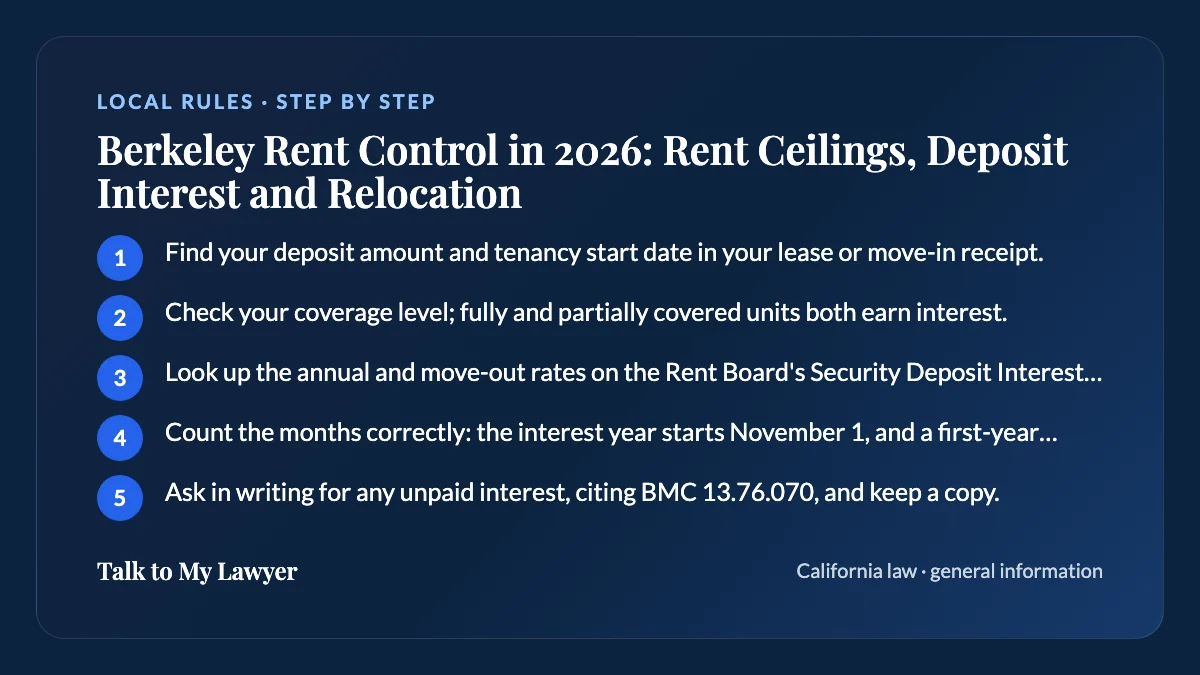
- Find your deposit amount and tenancy start date in your lease or move-in receipt.
- Check your coverage level; fully and partially covered units both earn interest.
- Look up the annual and move-out rates on the Rent Board's Security Deposit Interest page.
- Count the months correctly: the interest year starts November 1, and a first-year payment counts only months since move-in.
- Ask in writing for any unpaid interest, citing BMC 13.76.070, and keep a copy.
- If it stays unpaid, file a petition or call a Rent Board housing counselor for help with multi-year amounts.
Late payment has a cost under Rent Board Regulation 704: once January 31 passes without payment, the unpaid interest for the immediately preceding year is figured at a 10% rate, and the tenant may deduct it from rent without first giving notice. The Rent Board's 2026 notice puts it as deducting 10% of the deposit amount from a rent payment. Deposit return itself follows state law; see our guide to a security deposit demand letter in California.
What does Berkeley require for an owner move-in eviction?
An owner move-in is one of the just causes in BMC 13.76.130, but Berkeley adds conditions on top of state procedure. They apply to every unit with just cause protection, including condos, single-family homes and newer buildings.
- The landlord must hold at least a 50% recorded ownership interest.
- Qualifying relatives are limited to a spouse, registered domestic partner, parent or child.
- Relocation of $19,413 is owed to a household that has lived in the unit at least one year, deposited with the Rent Board within 10 days of serving the notice. Low-income, disabled or elderly tenants, households with minor children, and tenancies that began before January 1, 1999 may be owed $6,471 more. These are the Rent Board's 2026 figures.
- The owner or relative must move in within three months and live there for 36 continuous months.
- A household with minor children cannot be evicted for owner move-in if the notice expires while the Berkeley Unified school year is in session.
- Landlords with larger Berkeley holdings face limits on evicting long-term tenants, and longer-term senior or disabled tenants.
If the landlord's stated reason was false or not carried out within two months after you leave, BMC 13.76.150(B) lets the tenant regain possession and recover actual damages, or the greater of $750 or three times actual damages for willful conduct.
What can a Berkeley tenant do about overcharges or lost services?
Fully covered tenants can file an Individual Rent Adjustment petition asking the Rent Board to lower the rent ceiling for illegally high rent, a decrease in living space or housing services, substantial deterioration, or housing code and habitability failures. The same petition can ask for a refund of overcharged rent or overdue deposit interest. A tenant association can also file one petition for common-area problems on behalf of affected tenants.
Outside the petition process, BMC 13.76.150 lets a tenant sue for actual damages when a landlord keeps rent above the lawful ceiling, plus up to $750 on proof of bad faith. The ordinance also lists withholding rent from a landlord who fails to register or overcharges, but withholding can lead to an eviction case over unpaid rent, so it is a step to discuss with a lawyer first.
My security deposit of $3,000 has been held since March 2021. I did not receive the annual interest payment due by January 31, 2026, as required by Berkeley Municipal Code section 13.76.070. Please pay the interest owed for each year since my tenancy began, with any penalty under Rent Board regulations, by November 15. Until then, I understand the 2026 Annual General Adjustment is not available for my unit.
When unpaid deposit interest or an AGA dispute needs an attorney letter in Berkeley
Berkeley's rules reward exact numbers: several years of unpaid deposit interest at different annual rates, an AGA taken while the unit was unregistered, or an owner move-in notice served without the relocation deposit each come down to dates and amounts. The ordinance also protects you: retaliation within six months of asserting your rights is presumed under BMC 13.76.140.
Through Talk to My Lawyer, a licensed California attorney writes your letter (from your lease, registry record, payment history and your own timeline of events) and then sends it on your behalf to your landlord or property manager. Rent Board housing counselors can explain the rules; whether to petition, sue or negotiate is a question for a lawyer who has seen your documents.
Frequently asked questions
How much can rent go up in Berkeley in 2026?
For a fully covered unit, the rent ceiling can rise by the 2026 Annual General Adjustment of 1.0%, effective no earlier than January 1, 2026, with at least 30 days' written notice. The AGA does not apply to tenancies that began in 2025. Partially covered units have no local rent ceiling, though state rent caps may apply.
Do Berkeley landlords have to pay interest on security deposits?
Yes, for fully and partially covered units. Berkeley Municipal Code section 13.76.070 requires simple interest based on local six-month certificate of deposit rates. The annual payment for the November to October interest year is due in December, as cash or a rent credit, and no later than January 31. The 2025 annual rate was 0.9%.
Is my Berkeley condo or house rent controlled?
Usually it is partially covered. Most condos, and single-family homes where the tenancy began on or after January 1, 1996, have no rent ceiling but do get just cause eviction protection and deposit interest. A single-family home whose current tenant moved in before 1996, or one with five or more rooms rented on separate leases, can be fully covered.
How much relocation does a Berkeley landlord pay for an owner move-in?
For 2026, the Rent Board lists a standard payment of $19,413 for a household that has lived in the unit at least a year, deposited with the Rent Board within 10 days of the notice. Households that are low-income, include disabled, elderly or minor members, or began their tenancy before 1999 may be owed an additional $6,471.
When will Berkeley announce the 2027 AGA?
The 2026 figure is 1.0%. The ordinance directs the Rent Board to publish the next Annual General Adjustment each fall, on or about October 31, for increases starting the following January 1. It equals 65% of the regional CPI-U change for the 12 months ending June 30, and cannot be less than 0% or more than 5%. Check the Rent Board's site for the new figure once it is announced.
Sources
Checked against these official sources on October 18, 2026.
- 2026 AGA Published and the 2025 Security Deposit Interest Payment Due Soon (Berkeley Rent Stabilization Board)
- Is Your Unit Covered by Rent Control? (Berkeley Rent Stabilization Board)
- Security Deposit Interest & Calculator (Berkeley Rent Stabilization Board)
- Owner Move-in Eviction (Berkeley Rent Stabilization Board)
- Tenant Individual Rent Adjustment Petitions (Berkeley Rent Stabilization Board)
- Berkeley Municipal Code Chapter 13.76 (City of Berkeley)
This guide explains California law in general terms as of October 2026. It is general information, not legal advice for your situation, and local rules can add to it.
Join the email list and get a lawyer letter started
With Talk to My Lawyer, a licensed California attorney writes your letter from your facts and documents and sends it on your behalf. Join the Talk to My Lawyer email list for letter checklists, document prompts, and reminders before you start your letter.