Quick answer
Sexual harassment at work in California is unlawful under Government Code section 12940(j). It includes quid pro quo demands (a job benefit tied to sexual conduct) and a hostile work environment created by unwelcome sex-based conduct. It covers employers of any size. You can report internally, and you can file with the Civil Rights Department within three years of the last act.
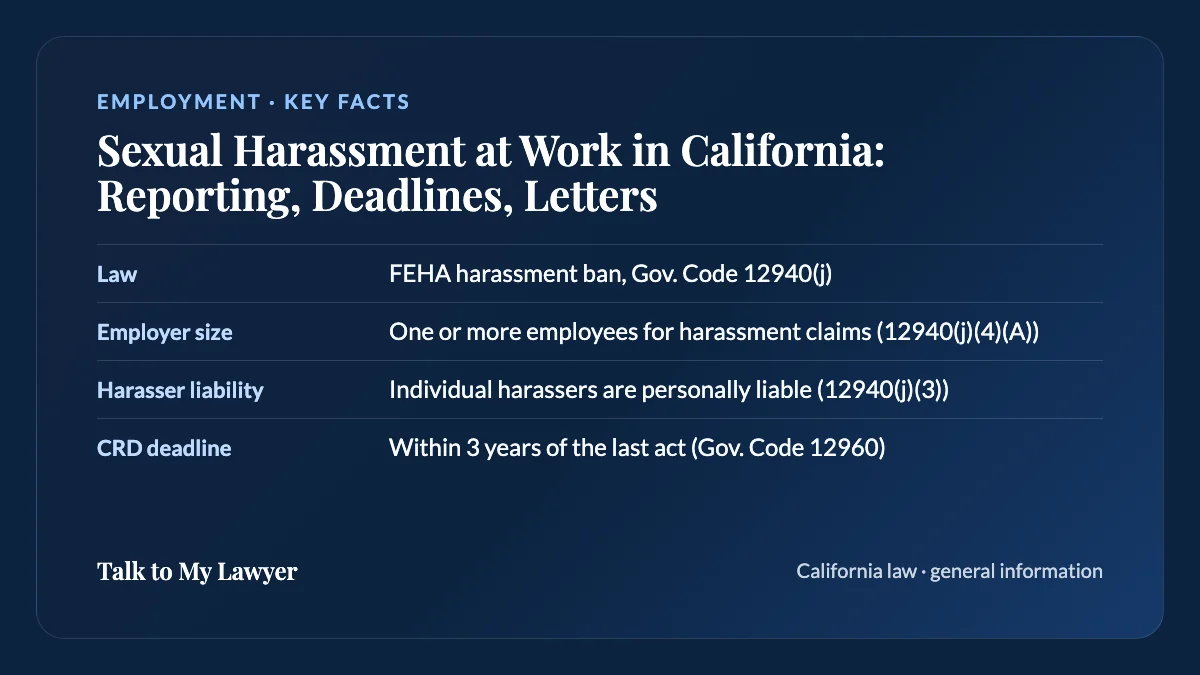
At a glance
- Law
- FEHA harassment ban, Gov. Code 12940(j)
- Employer size
- One or more employees for harassment claims (12940(j)(4)(A))
- Harasser liability
- Individual harassers are personally liable (12940(j)(3))
- CRD deadline
- Within 3 years of the last act (Gov. Code 12960)
- Settlement limits
- Facts of a filed harassment claim cannot be gagged (CCP 1001)
What counts as sexual harassment at work in California?
Sexual harassment is unwelcome conduct based on sex that either ties a work benefit to sexual conduct or makes the workplace hostile. The Civil Rights Department (CRD) describes two types:
- Quid pro quo (Latin for this for that): someone conditions a job, promotion or other benefit on your submission to sexual advances or other sex-based conduct.
- Hostile work environment: unwelcome comments or conduct based on sex unreasonably interfere with your work or create an intimidating, hostile or offensive environment. The conduct does not have to be aimed at you.
The CRD says the harassment must be severe or pervasive, and that a single act can be severe enough. Under section 12940(j)(4)(C), harassment because of sex includes gender harassment and harassment based on pregnancy, and it need not be motivated by sexual desire. The protection covers employees, applicants, unpaid interns, volunteers and some contractors.
When is the employer responsible for harassment?
Responsibility depends on who did the harassing. Under section 12940(j)(1), loss of a tangible job benefit is not required to prove harassment.
| Who harassed you | Employer responsibility | Source |
|---|---|---|
| Supervisor or agent | The employer is liable for harassment by its supervisors and agents | CRD sexual harassment fact sheet |
| Coworker | Liable if the employer knew or should have known and failed to take immediate and appropriate corrective action | Gov. Code 12940(j)(1) |
| Customer, client or vendor | Same knew-or-should-have-known test, considering the employer's control over that person | Gov. Code 12940(j)(1) |
| The harasser personally | Any employee who harasses is personally liable, whether or not the employer knew | Gov. Code 12940(j)(3) |
Employers must also take all reasonable steps to prevent harassment (section 12940(k)). The CRD fact sheet adds that employers with five or more employees must give one hour of prevention training to nonsupervisory staff and two hours to supervisors, repeated every two years.
How should you report sexual harassment to your employer?
Report in writing, to the person or channel your employer's policy names, and keep a copy. A written report fixes the date the employer learned about the conduct, which matters for coworker and customer harassment.
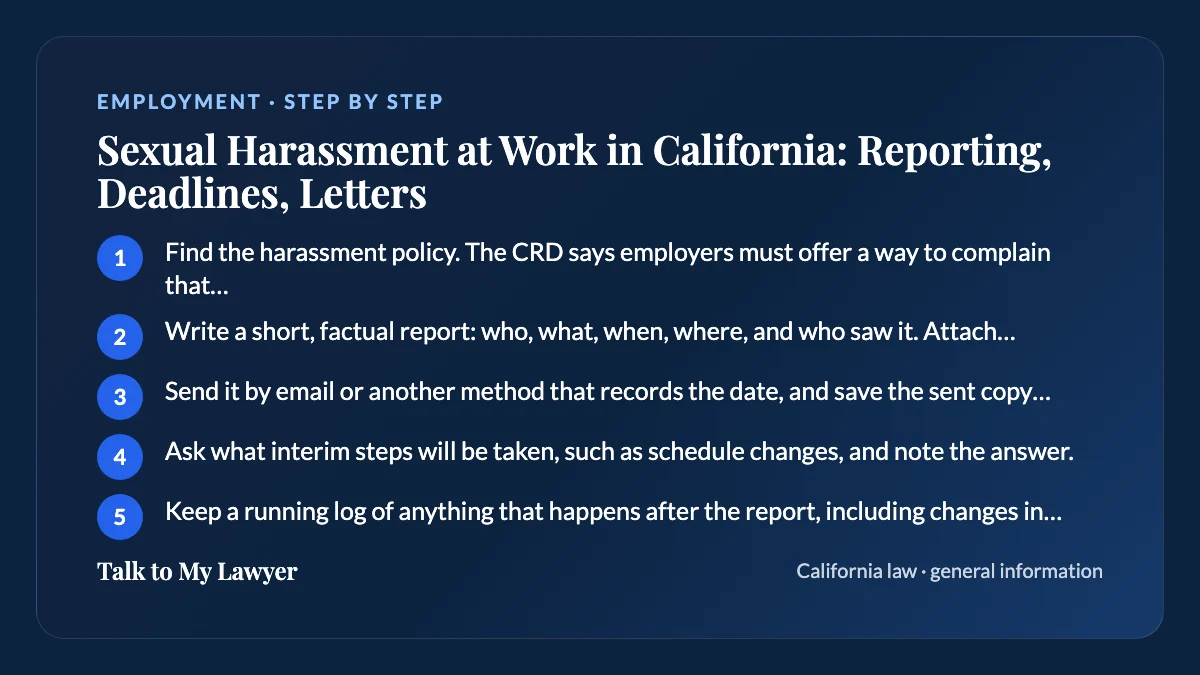
- Find the harassment policy. The CRD says employers must offer a way to complain that does not require going to your immediate supervisor.
- Write a short, factual report: who, what, when, where, and who saw it. Attach screenshots if you have them.
- Send it by email or another method that records the date, and save the sent copy outside work systems if company policy allows.
- Ask what interim steps will be taken, such as schedule changes, and note the answer.
- Keep a running log of anything that happens after the report, including changes in shifts, reviews or assignments.
- If the response is slow or the conduct continues, put that in writing too.
Evidence that supports a harassment complaint
Two questions shape a harassment claim: how serious or frequent the conduct was, and what the employer knew. Gather what answers both:
- Texts, chat messages, emails and social media messages, with dates and sender names visible.
- A diary written close to each event, noting what was said and who was nearby.
- Names of coworkers who saw the conduct or heard you describe it soon after.
- Your written report and any reply from HR or management.
- Performance reviews before and after the conduct, to show any change.
- Medical or counseling records only if you plan to claim emotional distress, and only as much as the claim needs.
What is the deadline to file a sexual harassment complaint?
You must file an intake form with the CRD within three years of the last act of harassment or retaliation (Gov. Code section 12960(e)(5)). After the CRD issues a right-to-sue notice, you generally have one year from the notice date to file in court (Gov. Code section 12965).
The CRD can investigate and help the parties resolve the dispute, or you can request an immediate right-to-sue notice if you plan to file your own lawsuit. Remedies listed by the CRD include damages for emotional distress, back pay, reinstatement and changes to the employer's policies.
What a sexual harassment demand letter says
A demand letter sets out the conduct in order, shows when the employer was told, and asks for specific steps. It can follow an internal complaint that went nowhere, or come after you have left the job.
Keep the tone factual. Quote messages exactly, give dates, and leave out labels you cannot prove. Ask for concrete things: an investigation with a written outcome, separation from the harasser, payment for lost wages, or a negotiated resolution.
Between January 9 and April 22, the regional manager sent me 14 messages commenting on my body and asking me to meet outside work. Copies are enclosed. I reported this in writing to Human Resources on April 23. Since then, my shifts have been cut from 38 to 22 hours a week. These facts describe harassment and retaliation prohibited by Government Code sections 12940(j) and 12940(h). Please contact me by May 20 to discuss restoring my hours and resolving my claims, and preserve all communications related to my report.
Can a sexual harassment settlement be kept secret in California?
Only in part. Code of Civil Procedure section 1001 bars settlement terms that prevent disclosure of factual information about sexual harassment, workplace harassment or discrimination, or related retaliation, when the claim was filed in court or in an administrative complaint. For sexual harassment, such terms in agreements made on or after January 1, 2019 are void. The rule's reach to other workplace harassment, discrimination and retaliation applies to agreements made on or after January 1, 2022.
| Term in a settlement | Allowed? | Rule |
|---|---|---|
| Gag on the facts of a filed harassment claim | No | CCP 1001(a) and (d) |
| Keeping your identity confidential, at your request | Yes, unless a government agency is a party | CCP 1001(c) |
| Keeping the settlement amount confidential | Yes | CCP 1001(e) |
| Separation agreement (not a negotiated settlement of a filed claim) barring disclosure of unlawful acts at work | No | Gov. Code 12964.5(b) |
| Nondisparagement clause | Only with the statutory carve-out language | Gov. Code 12964.5(b)(1)(B) |
Section 12964.5(b)(4) adds a notice rule for separation agreements: the employer must tell you that you may consult an attorney, and allow no fewer than five business days for it. Section 12964.5 does not apply to a negotiated settlement of a claim you have already filed, which is governed by section 1001.
When an attorney-written harassment letter makes sense
Putting harassment into words is draining, and a letter that overstates or understates the messages and dates can complicate a later claim. Having an attorney write it can help when the harasser is a supervisor or owner, when your hours or pay changed after you reported, when you are weighing a settlement offer, or when you are close to the three-year filing deadline. For advice on a CRD filing or a lawsuit, talk to a lawyer about your facts. If the harassment comes from someone outside work, our guide to the harassment cease and desist letter covers that situation.
With Talk to My Lawyer, a licensed California attorney writes your letter from your facts and documents (your messages, timeline and reports) and sends it on your behalf.
Frequently asked questions
Does a single incident count as sexual harassment in California?
It can. The Civil Rights Department says harassment must be severe or pervasive to be unlawful, and that a single act can be severe enough. A physical assault or an explicit demand for sex in exchange for a promotion are examples where one event may be enough. Repeated comments that are less serious on their own can add up to a hostile environment.
Does California harassment law apply to small businesses?
Yes. For harassment claims, Government Code section 12940(j)(4)(A) defines employer as anyone regularly employing one or more people, or receiving services from one or more contractors. That is broader than FEHA's discrimination rules, which generally apply to employers with five or more employees. Prevention training rules apply to employers with five or more employees.
Can I be personally sued for harassing a coworker?
Yes. Section 12940(j)(3) makes an employee personally liable for harassment they commit, whether or not the employer knew about it. That is different from discrimination claims, which usually run against the employer. For the person who was harassed, it means a claim may name both the company and the individual.
Do I have to report harassment to HR before filing with the CRD?
The CRD deadline does not wait for an internal report, and the statute does not require one before filing. Reporting matters in practice, though, because the employer's liability for coworker and customer harassment turns on whether it knew or should have known and failed to act. A dated written report is strong evidence of what the employer knew.
Can my employer make me sign an NDA to settle a harassment claim?
Not one that hides the facts of a harassment claim filed in court or with an agency. Code of Civil Procedure section 1001 voids those terms in sexual harassment settlements made since January 1, 2019. The settlement amount can be confidential, and you can ask that your own identity be protected. Separation agreements must also allow disclosure of information about unlawful acts in the workplace.
Sources
Checked against these official sources on October 18, 2026.
- California Government Code section 12940 (California Legislative Information)
- Sexual Harassment Fact Sheet (CRD-185) (California Civil Rights Department)
- California Code of Civil Procedure section 1001 (California Legislative Information)
- California Government Code section 12964.5 (California Legislative Information)
- California Government Code section 12960 (California Legislative Information)
- Complaint Process (California Civil Rights Department)
This guide explains California law in general terms as of October 2026. It is general information, not legal advice for your situation, and local rules can add to it.
Join the email list and get a lawyer letter started
With Talk to My Lawyer, a licensed California attorney writes your letter from your facts and documents and sends it on your behalf. Join the Talk to My Lawyer email list for letter checklists, document prompts, and reminders before you start your letter.