Quick answer
The small claims filing fee in California is $30 for claims up to $1,500, $50 for claims over $1,500 up to $5,000, and $75 for claims over $5,000 (Code of Civil Procedure section 116.230). Anyone who filed more than 12 small claims in California in the past 12 months pays $100. People who qualify can ask the court to waive the fee.
At a glance
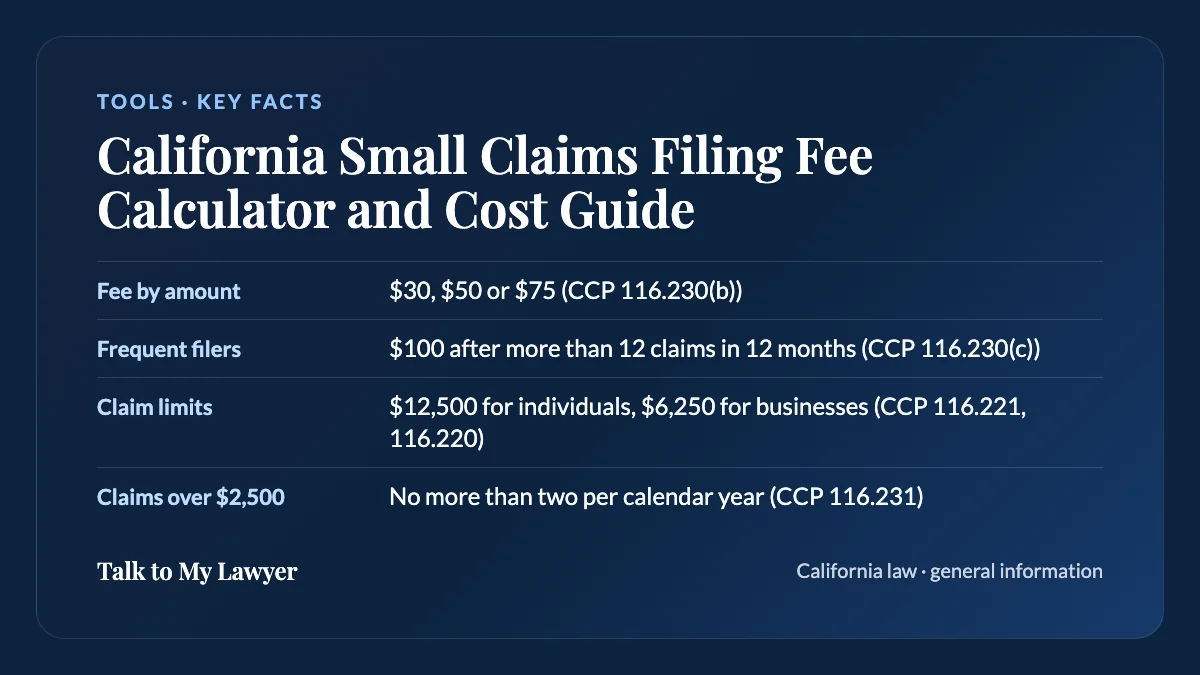
- Fee by amount
- $30, $50 or $75 (CCP 116.230(b))
- Frequent filers
- $100 after more than 12 claims in 12 months (CCP 116.230(c))
- Claim limits
- $12,500 for individuals, $6,250 for businesses (CCP 116.221, 116.220)
- Claims over $2,500
- No more than two per calendar year (CCP 116.231)
- Costs in the judgment
- Prevailing party gets costs, including service (CCP 116.610(g))
How much is the small claims filing fee in California?
The filing fee is set by statute and turns on the amount you demand: $30, $50 or $75, or $100 for frequent filers (CCP 116.230). The clerk may charge only fees the small claims chapter authorizes.
| Your situation | Fee |
|---|---|
| Claim of $1,500 or less | $30 |
| Claim over $1,500 up to $5,000 | $50 |
| Claim over $5,000 | $75 |
| More than 12 other small claims filed in California in the past 12 months | $100 |
| Amending a $30 claim into the $50 range | $20 more |
| Amending a $50 claim into the $75 range | $25 more |
| Amending a $30 claim into the $75 range | $45 more |
Lowering your claim later does not bring a refund of the difference (CCP 116.230(d)(4)). At filing you also declare whether you have filed more than 12 other small claims in the state in the last 12 months.
How to use the small claims filing fee calculator
Enter the amount you are claiming and the number of small claims you filed in California in the past 12 months. The estimator applies the fee tiers above. For a claim over $6,250 it reminds you that businesses are limited to $6,250 while a sole proprietor may claim up to $12,500, and it flags anything over $12,500.
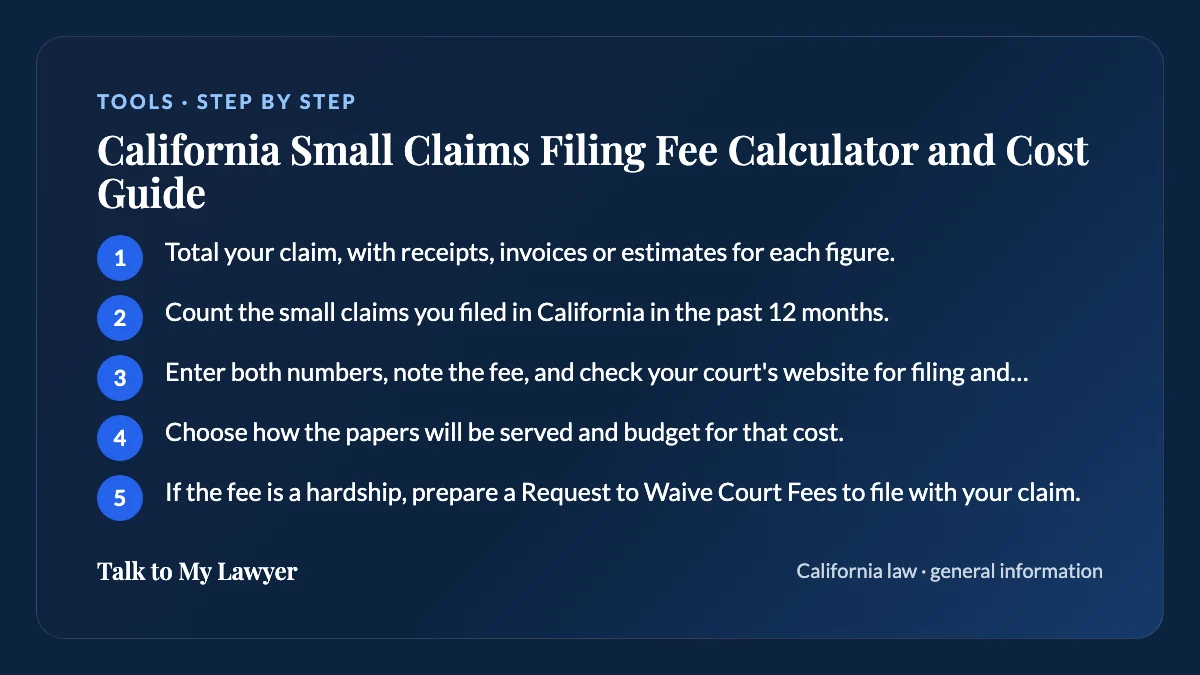
- Total your claim, with receipts, invoices or estimates for each figure.
- Count the small claims you filed in California in the past 12 months.
- Enter both numbers, note the fee, and check your court's website for filing and payment options.
- Choose how the papers will be served and budget for that cost.
- If the fee is a hardship, prepare a Request to Waive Court Fees (form FW-001) to file with your claim.
For the forms and filing steps, see how to file small claims in California.
How much can you claim, and how often?
An individual, including a sole proprietor, can ask for up to $12,500 (CCP 116.221). Corporations, partnerships, public entities and other businesses are limited to $6,250 (CCP 116.220(a)(1)).
A second cap is easy to miss: no one may file more than two small claims for over $2,500 anywhere in California in a calendar year (CCP 116.231). For any claim over $2,500, you declare under penalty of perjury that you are within that limit. This count runs January through December, unlike the 12-month look-back for the $100 fee.
Can you get the small claims fee waived?
Yes, if you qualify. You ask with a Request to Waive Court Fees (form FW-001). The California courts' self-help guide says you can qualify if you receive public benefits, if your income is below a set amount, or if you cannot pay the fee and still meet your basic needs.
The courts' guide to serving small claims papers adds that the sheriff, in counties where the sheriff serves, does not charge you if you have a fee waiver.
What other costs come with a small claims case?
Service comes next. You cannot hand the papers over yourself; an adult who is not part of the case must serve each defendant.
- A friend or relative who is 18 or older and not in the case, at no court fee.
- Certified mail by the clerk, in some courts only, for $15. The self-help guide says it often fails unless you are serving a business's agent for service of process.
- The county sheriff, in some counties, for a fee unless you have a fee waiver.
- A professional process server, at a price you agree with the server.
Smaller costs add up too: postage and a self-addressed stamped envelope if you file by mail, copies of evidence for the judge and the other side, and time off for the hearing. Service must be completed at least 15 days before the court date, or 20 days if the person served is in another county.
Can you get your filing fee back if the judge rules for you?
Generally, yes. The prevailing party is entitled to the costs of the action, including the cost of serving the claim on the defendant (CCP 116.610(g)(1)). Bring receipts for the filing and service fees so the judgment can include them.
One exception applies to frequent filers. If you paid the $100 fee, the part above the regular fee for your claim amount cannot be recovered as costs (CCP 116.610(g)(2)).
Costs in a judgment still have to be collected. If the other side does not pay, see how to collect a small claims judgment.
When a demand letter before filing makes sense
The Plaintiff's Claim form (SC-100) says you must ask the defendant to pay you before you sue, whether in person, in writing or by phone. A written request gives you a dated copy to show the judge. The guide to a demand letter before small claims covers what to include.
With Talk to My Lawyer, a licensed California attorney writes that demand letter from your facts and documents and sends it on your behalf, stating the amount owed, the basis for it and a date to respond. If that date passes without payment, the letter joins your receipts in the file you take to court.
Frequently asked questions
Who pays the small claims filing fee?
The person who files pays the fee at filing, unless the court grants a fee waiver. If the judge later rules for that person, the judgment can include the filing fee and service costs under CCP 116.610(g), except the extra part of a $100 frequent-filer fee.
Can I file a small claims case online or by mail?
Filing by mail is allowed: the self-help guide says to send the original and two copies with the fee and a self-addressed stamped envelope so the clerk can return your copies. Some courts also accept e-filing. Your local court's website lists its options, including how it takes payment.
Is the fee different for a business?
No. The tiers in CCP 116.230 apply to anyone filing, based on the amount demanded and the number of small claims filed in the past 12 months. The difference is the limit: $6,250 for a business entity and $12,500 for an individual or sole proprietor, and both face the two-claims-over-$2,500 rule.
What if my claim is more than $12,500?
Small claims court can award only up to its limit. If the amount is the only problem, CCP 116.220(d) lets you waive the excess, which means giving up any right to the amount above the limit; the waiver takes effect at judgment. Otherwise the claim belongs in regular civil court. Talk to a lawyer before deciding.
Sources
Checked against these official sources on October 18, 2026.
- California Code of Civil Procedure section 116.230 (California Legislative Information)
- California Code of Civil Procedure section 116.231 (California Legislative Information)
- California Code of Civil Procedure section 116.610 (California Legislative Information)
- Plaintiff's Claim and ORDER to Go to Small Claims Court (SC-100), rev. January 1, 2026 (Judicial Council of California)
- File your Plaintiff's Claim (California Courts Self-Help Guide)
- Serve your small claims forms (California Courts Self-Help Guide)
This guide explains California law in general terms as of October 2026. It is general information, not legal advice for your situation, and local rules can add to it.
Join the email list and get a lawyer letter started
With Talk to My Lawyer, a licensed California attorney writes your letter from your facts and documents and sends it on your behalf. Join the Talk to My Lawyer email list for letter checklists, document prompts, and reminders before you start your letter.