Quick answer
The statute of limitations on debt in California is generally four years for written contracts, credit card and other book accounts, and accounts stated (Code of Civil Procedure section 337), and two years for oral agreements (section 339). Once the four-year period runs, no one may sue or start arbitration to collect, and it can be extended only as section 360 allows, generally by a signed written acknowledgment or promise.
At a glance
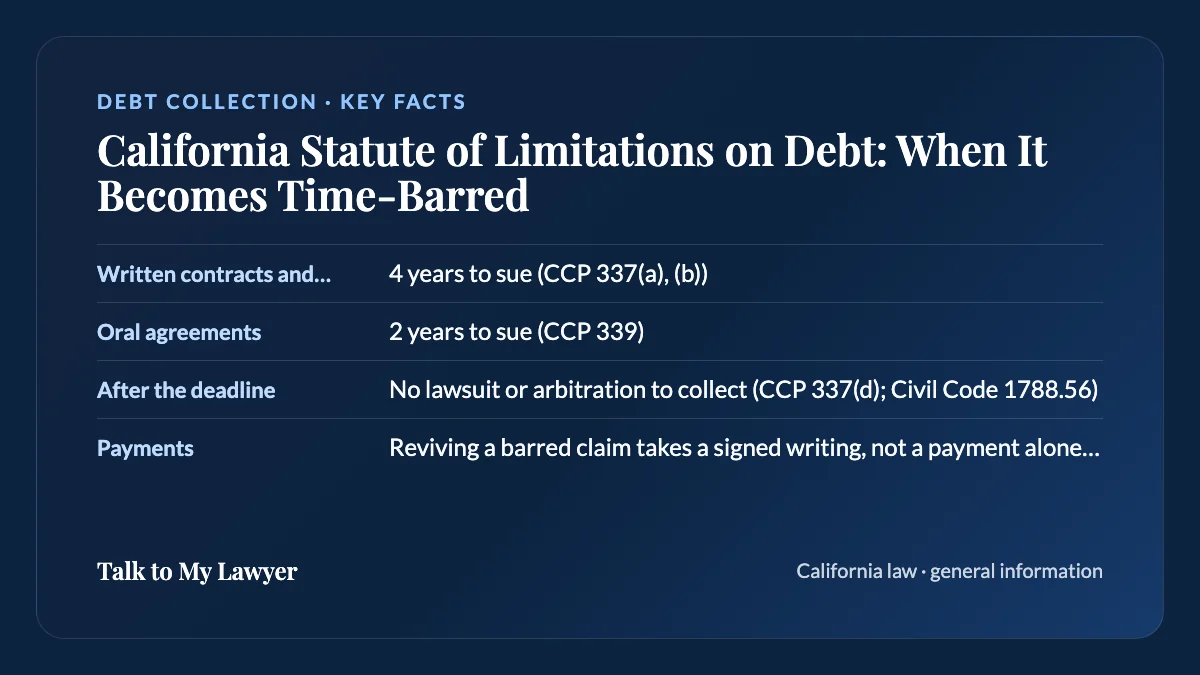
- Written contracts and accounts
- 4 years to sue (CCP 337(a), (b))
- Oral agreements
- 2 years to sue (CCP 339)
- After the deadline
- No lawsuit or arbitration to collect (CCP 337(d); Civil Code 1788.56)
- Payments
- Reviving a barred claim takes a signed writing, not a payment alone (CCP 337(d), 360)
- Collector letters
- Must say you will not be sued (Civil Code 1788.14(d))
- Credit reports
- Collection items limited to 7 years, with exceptions (15 U.S.C. 1681c)
What is the statute of limitations on debt in California?
For debts based on a written contract or account, it is four years. Code of Civil Procedure section 337 sets four years for a claim on a written contract, a book account, an account stated based on a written account, and the balance of an open account whose items are in writing. Credit card balances, signed loan agreements and itemized store or medical accounts can fit one of those categories.
If the deal was never written down, section 339 sets two years for a contract not founded on a writing.
| Kind of debt | Deadline to sue | Statute |
|---|---|---|
| Signed loan or other written contract | 4 years | CCP 337(a) |
| Book account (an itemized ledger of charges) | 4 years | CCP 337(b)(1) |
| Account stated (a balance both sides treated as owed) | 4 years | CCP 337(b)(2) |
| Open account with written items | 4 years | CCP 337(b)(3) |
| Oral agreement | 2 years | CCP 339 |
A contract claim generally accrues when the debt is breached, which for a monthly account is the missed payment that put it in default. For an account stated based on more than one item, section 337 says the time runs from the date of the last item. Because the start date decides the answer, pin it down with your own records: old statements, bank records and any letters from the original creditor.
Can a collector still contact you about a time-barred debt?
Yes, within limits. An expired deadline does not erase the debt; it removes the court option. Section 337(d) says that once the period has run, a person shall not bring suit or start an arbitration or other legal proceeding to collect the debt. Civil Code section 1788.56 says the same for debt buyers, and the federal rule goes a step further: a debt collector must not bring or threaten legal action on a time-barred debt (12 CFR 1006.26(b)).
California also controls what the collector's letters say. Under Civil Code section 1788.14(d), the first written communication after a debt becomes time-barred must include a set notice. For a debt still inside the credit-reporting period, it begins:
The law limits how long you can be sued on a debt. Because of the age of your debt, we will not sue you for it.
That notice goes on to say the collector may keep reporting the debt as unpaid for as long as the law permits. If the debt is also past the federal reporting period, the notice must instead say the collector will not report it to any credit reporting agency. Debt buyers owe the same notices under Civil Code section 1788.52(d). Keep any letter about an old debt that leaves these words out or hints at a lawsuit.
Does a payment restart the clock in California?
Not for lawsuits on a debt that is already time-barred. Since January 1, 2019, section 337(d) has said the four-year period can be extended only under Code of Civil Procedure section 360. Section 360 says an acknowledgment or a promise to pay counts only if it is in a writing signed by the person who owes the debt. The only payments it gives any effect are payments on a promissory note, and even for those it adds that no such payment, of itself, revives a claim once it is barred. Read together, the two sections give a payment alone no power to bring back the right to sue on a time-barred debt.
Two cautions. A payment on a promissory note made before the deadline is different: under section 360, each one can start a new period on the note. And a signed letter promising to pay is a different thing from a payment. Before signing any form a collector sends about an old account, talk to a lawyer about what it could mean.
If an outdated account is still listed, our guide to disputing a credit report error covers the dispute process with the credit bureaus.
How to work out whether your debt is time-barred
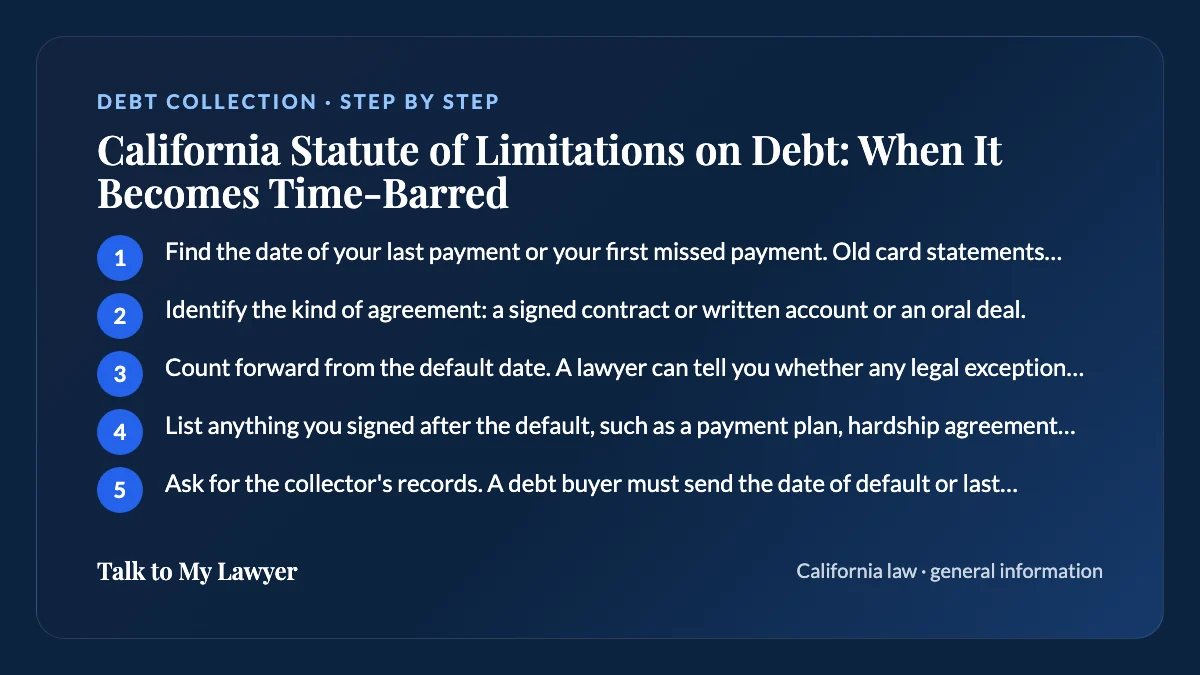
- Find the date of your last payment or your first missed payment. Old card statements and bank records are the best proof.
- Identify the kind of agreement: a signed contract or written account (four years) or an oral deal (two years).
- Count forward from the default date. A lawyer can tell you whether any legal exception paused the clock in your situation.
- List anything you signed after the default, such as a payment plan, hardship agreement or settlement form.
- Ask for the collector's records. A debt buyer must send the date of default or last payment, the charge-off balance and other details within 15 calendar days of your written request, and must stop collecting until it does (Civil Code 1788.52(c)).
- Compare its dates with yours and keep copies of every letter and envelope.
Example (hypothetical): a borrower's last credit card payment was in March 2021, and the account went into default in April 2021. In September 2026 a debt buyer writes asking for $3,240, with no mention of the account's age. More than four years have passed since the default, so the section 337 period for a written account appears to have run, and the buyer's first letter should have carried the notice in section 1788.52(d). A $50 payment sent in 2026 would not be a signed writing, so under sections 337(d) and 360 it would not, on its own, revive the right to sue.
What to put in a letter to a collector about an old debt
A short, factual letter does three jobs: it puts your dates on record, asks the collector to confirm its own, and shows you know the rules on time-barred debt.
- Your name, the account number the collector uses and the original creditor's name.
- The date of your last payment or default, and how much time has passed.
- A citation to Code of Civil Procedure section 337(d), plus Civil Code section 1788.56 if the sender is a debt buyer.
- A request for the account records listed in Civil Code section 1788.52.
- If a letter threatened suit or left out the required notice, what it said and the date it was sent.
- If you want contact to stop, a clear sentence saying so.
I received your letter dated September 12, 2026, about account ending 4471, originally issued by [original creditor]. My last payment on this account was made in March 2021. More than four years have passed, and under California Code of Civil Procedure section 337(d) and Civil Code section 1788.56, no lawsuit or arbitration may be brought to collect it. Your letter did not include the notice required by Civil Code section 1788.52(d). Please confirm in writing that you will not sue on this account, and send the records described in section 1788.52.
Pointing out a violation in writing has a second effect worth knowing. Under Civil Code section 1788.30(d), a collector that, within 15 days after receiving written notice of a curable violation, tells you about it and makes the corrections needed to cure it has no civil liability for that violation. Otherwise, under the same section, a debtor can sue for actual damages and, for willful and knowing violations, a penalty of $100 to $1,000, within one year of the violation (section 1788.30(b), (f)).
For the federal validation process, see our guide to debt validation and dispute letters. To stop calls and letters altogether, see how to send a cease-contact letter to a debt collector.
What if you are sued on an old debt anyway?
File a response. The statute of limitations is a defense, and it has to be raised in your Answer. The California Courts self-help guide says you must fill out an Answer, serve the other side and file it with the court within 30 days, or the debt collector can ask for a default, after which the court can decide the case without you.
For debt cases, the guide points to the Answer, Contract form (PLD-C-010), and it gives "the other side waited too long to sue you" as an example of a defense. The clerk's filing fee runs from $225 to $450, and you can ask for a fee waiver if you cannot afford it.
Deadlines for other kinds of claims, from injuries to property damage, are collected in our guide to California statutes of limitations for civil claims.
When an attorney letter about an old debt makes sense
An old card balance can resurface years later under a company name you have never seen, with a demand and no dates. A letter from a lawyer can be worth it when a collector has threatened to sue on a debt past the four-year mark, has ignored the dates you gave it, has skipped the notice California requires, or keeps contacting you after you asked it to stop.
Through Talk to My Lawyer, a licensed California attorney writes your letter from your statements, the collector's letters and your payment history, and sends it on your behalf. If you have already been served with a lawsuit, talk to a lawyer about your Answer deadline promptly.
Frequently asked questions
Is credit card debt time-barred after four years in California?
For lawsuits, generally yes. Credit card accounts rest on written agreements or book accounts, so Code of Civil Procedure section 337 sets a four-year period, generally counted from the default. After it runs, no suit or arbitration may be brought to collect. The debt is not erased, and a collector may still ask for payment in writing, as long as it says it will not sue.
Can a debt collector sue me after the statute of limitations runs out?
No. California bars bringing a suit, arbitration or other legal proceeding on a debt once the section 337 period has run, and the federal Regulation F bars debt collectors from bringing or even threatening that suit. If you are sued anyway, the expired deadline is a defense you raise in an Answer filed on time, so read the court papers and note the 30-day deadline.
Will a small payment on an old debt restart the statute of limitations?
For a debt that is already time-barred, a payment alone does not bring back the right to sue. Section 337(d) allows an extension only under Code of Civil Procedure section 360, which requires an acknowledgment or promise to be in a signed writing and says that even a payment on a promissory note does not, of itself, revive a barred claim. A signed form is a different matter, so read it carefully before signing.
How long can an old debt stay on my credit report?
Under the federal Fair Credit Reporting Act, accounts placed for collection or charged off generally cannot be reported once they are more than seven years old, counted from 180 days after the delinquency began (15 U.S.C. 1681c). That clock is separate from the four-year deadline to sue in California, so a debt may be too old for a lawsuit and still appear on a report.
Does the statute of limitations apply to debt buyers?
Yes. Civil Code section 1788.56 says a debt buyer may not bring suit or start arbitration on a consumer debt once the statute of limitations has expired. Debt buyers must also hold specific account records before writing to you, send them within 15 calendar days of your written request, and stop collecting until they do (Civil Code section 1788.52).
Sources
Checked against these official sources on October 18, 2026.
- California Code of Civil Procedure section 337 (California Legislative Information)
- California Code of Civil Procedure section 360 (California Legislative Information)
- California Civil Code section 1788.14 (California Legislative Information)
- California Civil Code section 1788.52 (California Legislative Information)
- 12 CFR 1006.26 Collection of time-barred debts (eCFR (Consumer Financial Protection Bureau rule))
- Respond to a debt lawsuit (California Courts Self-Help Guide)
This guide explains California law in general terms as of October 2026. It is general information, not legal advice for your situation, and local rules can add to it.
Join the email list and get a lawyer letter started
With Talk to My Lawyer, a licensed California attorney writes your letter from your facts and documents and sends it on your behalf. Join the Talk to My Lawyer email list for letter checklists, document prompts, and reminders before you start your letter.