Quick answer
A trust accounting demand in California is a written request that the trustee account under Probate Code section 16062, which requires an account at least annually, when the trust ends and when the trustee changes. If a requested account does not arrive within 60 days of a written request, and none was given in the prior six months, a beneficiary may petition the court to compel one (section 17200).
At a glance
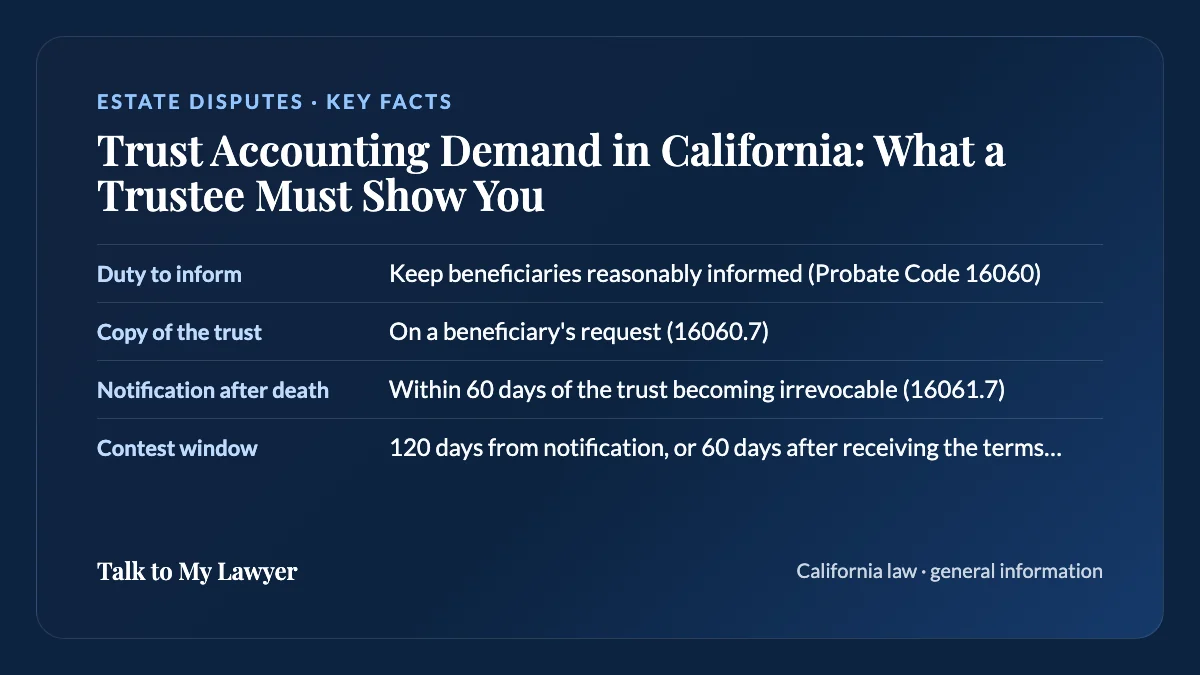
- Duty to inform
- Keep beneficiaries reasonably informed (Probate Code 16060)
- Copy of the trust
- On a beneficiary's request (16060.7)
- Notification after death
- Within 60 days of the trust becoming irrevocable (16061.7)
- Contest window
- 120 days from notification, or 60 days after receiving the terms, whichever is later (16061.8)
- Accounting
- At least annually, at termination and on a change of trustee (16062)
- Court petition
- If no account within 60 days of a written request (17200(b)(7))
What does a California trustee owe beneficiaries?
Information, on a schedule and on request. The Probate Code sets out four separate duties:
- Keep you reasonably informed of the trust and its administration (section 16060).
- Provide the terms of the trust when a beneficiary asks (section 16060.7).
- Answer reasonable requests for information about the administration that is relevant to your interest (section 16061).
- Account at least annually, at the termination of the trust and on a change of trustee, to each beneficiary to whom income or principal must be, or may in the trustee's discretion be, currently distributed (section 16062).
There are limits. The annual account goes only to beneficiaries who are, or may be, entitled to current distributions; someone whose share comes later, such as a remainder beneficiary, is not on that list, though section 16061 lets any beneficiary ask for relevant information. While a trust can still be revoked, the trustee need not account to the other beneficiaries, hand them the terms or answer their information requests; if no one holding the power to revoke is competent, the duty to account shifts to certain beneficiaries. None of these duties is owed when the beneficiary and the trustee are the same person (section 16069). Living trusts signed, and trusts created by wills executed, before July 1, 1987, are generally outside the annual accounting duty (section 16062(b), (c)).
A trust is not the same as a probate estate. If the property passes through probate court with an executor or administrator, see our guides to an executor who is delaying an inheritance and to requesting probate estate records.
When must the trustee notify beneficiaries after a death?
Generally within 60 days. When a revocable trust becomes irrevocable because a settlor (the person who created the trust) has died, Probate Code section 16061.7 requires the trustee to serve a notification on each beneficiary and each heir of the deceased settlor. The clock starts at the death, or later if the trustee learns of a person entitled to notice afterward or the trustee's office was vacant. The same duty arises on a change of trustee of an irrevocable trust.
The notification must give the settlor's name and the date the trust was signed, the name, address and phone number of each trustee, the address where the trust is administered, and a statement that you may request a complete copy of the trust terms.
A trustee who fails to serve the notification on a beneficiary is responsible for all damages, attorney fees and costs caused by the failure, unless the trustee made a reasonably diligent effort to comply (section 16061.9(a)).
What must a trust accounting include?
An account under section 16062 must contain the six items listed in Probate Code section 16063:
| Item | What to look for |
|---|---|
| Receipts and disbursements of principal and income for the period | Sale proceeds, rent, dividends, and every payment out |
| Assets and liabilities at the end of the period | Accounts, real estate, investments, loans and unpaid bills |
| The trustee's compensation | How much the trustee paid themselves, and for which period |
| Agents hired, their relationship to the trustee and their pay | Lawyers, accountants, property managers, relatives on the payroll |
| Notice of the right to petition under section 17200 | A statement that you may ask the court to review the account and the trustee's acts |
| The three-year warning | A statement that claims for breach of trust may not be made more than three years after you receive an account or report disclosing the facts behind the claim |
That last item matters. Once you receive an account that discloses a problem, the three-year period for a breach claim starts to run, so read each account when it arrives and keep it with the date you received it.
Can the trust document waive the accounting?
Partly. Under Probate Code section 16064, a trustee need not account to the extent the trust instrument waives it, or to a beneficiary who has waived the right in writing. A beneficiary's waiver can be withdrawn in writing for transactions after the withdrawal.
Two protections remain. Even with a waiver, the court may compel the trustee to account on a showing that a material breach of the trust is reasonably likely. And under section 16062(e), a waiver in the trust instrument is void as to certain sole trustees whom the Probate Code treats as disqualified persons.
Why does the written request matter for a court petition?
Because the statute ties the court remedy to it. Probate Code section 17200 lets a beneficiary petition the court about the internal affairs of a trust, including to compel the trustee to:
- Provide a copy of the terms of the trust.
- Provide information under section 16061, if the trustee has not done so within 60 days after your reasonable written request and you have not received the information within the six months before the request.
- Account to you, subject to section 16064, if the trustee has not delivered a requested account within 60 days after your written request and no account was made within the six months before it.
The same section allows petitions to settle accounts, review the trustee's compensation, remove a trustee and compel redress of a breach of trust. A dated written request, with proof of delivery, is what shows the court the 60 days have run. If the trustee is a relative and you suspect money is being taken from an older settlor while still alive, see our guide to elder financial abuse letters.
How to request a trust accounting, step by step
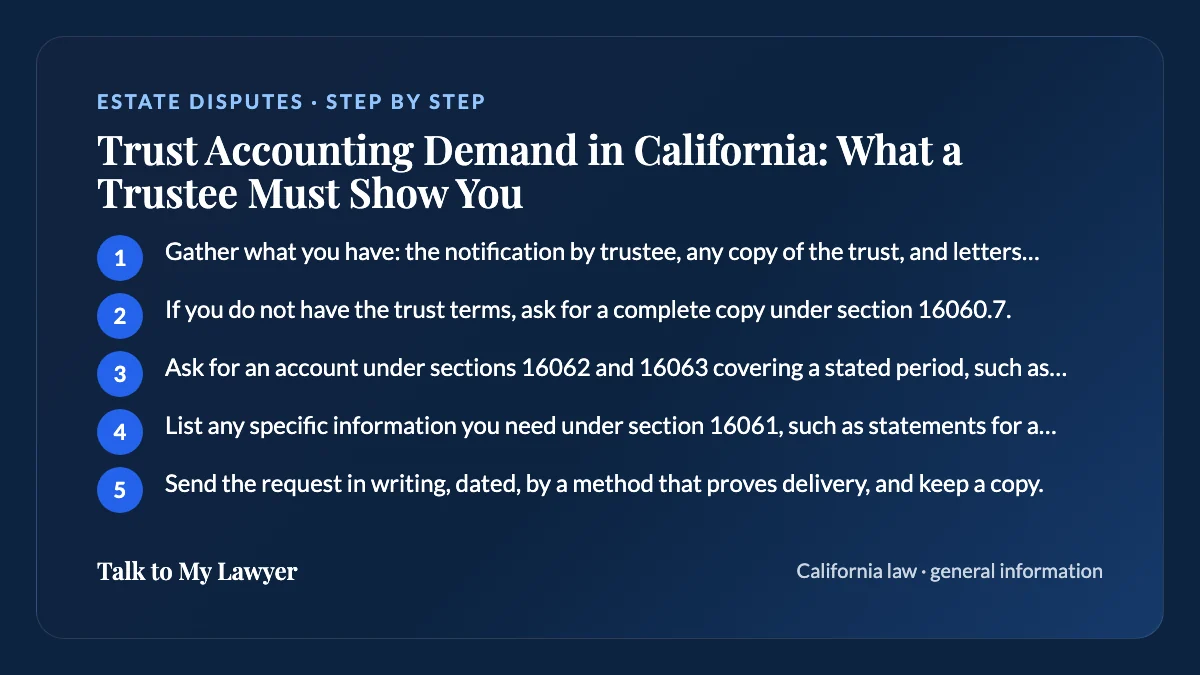
- Gather what you have: the notification by trustee, any copy of the trust, and letters or emails from the trustee.
- If you do not have the trust terms, ask for a complete copy under section 16060.7.
- Ask for an account under sections 16062 and 16063 covering a stated period, such as from the date of death to the present.
- List any specific information you need under section 16061, such as statements for a named account or the sale price of a house.
- Send the request in writing, dated, by a method that proves delivery, and keep a copy.
- Mark the date 60 days later. If nothing arrives, talk to a probate lawyer about a petition under section 17200.
I am a beneficiary of the [family name] Trust dated June 9, 2014, which became irrevocable on the death of [settlor's name] on March 2, 2026. Under California Probate Code sections 16060.7, 16061 and 16062, please provide (1) a complete copy of the trust and any amendments, (2) an account meeting the requirements of section 16063 for the period from March 2, 2026, to the present, and (3) the closing statement for the sale of [property address]. I have received no account in the past six months. Please send these within 60 days of this letter.
Example (hypothetical): the settlor dies on March 2, 2026, so the trustee's notification was generally due by May 1, 2026. A beneficiary who sends a written accounting request on July 10 and receives nothing may, after September 8, petition to compel an account, provided no account was made in the six months before the request.
When to have an attorney write to the trustee
A family trust may put a sibling or a long-time friend in charge, and a request from another family member can stall in silence or hurt feelings. A letter from a lawyer helps when the trustee has ignored a first request, when the notification never arrived, or when you want the request framed so the 60-day period under section 17200 is clearly running.
Through Talk to My Lawyer, a licensed California attorney writes your request from the trust documents, the trustee's notification and your timeline, and sends it on your behalf. For a trust contest, a petition or a suspected breach, talk to a probate lawyer about your facts.
Frequently asked questions
Is a trustee required to provide an accounting in California?
Generally yes. Probate Code section 16062 requires a trustee to account at least annually, when the trust ends and when the trustee changes, to each beneficiary entitled or eligible for current distributions. Exceptions include accounting waivers in the trust or signed by the beneficiary, revocable trusts while the settlor can still revoke, and trusts created before July 1, 1987. A court can still compel an account in some waiver cases.
How long does a trustee have to provide an accounting after a request?
The Probate Code does not set a delivery deadline for the account itself, but it sets a trigger for court help. Under section 17200(b)(7), if the trustee has not delivered a requested account within 60 days after your written request, and no account was made in the six months before it, you may petition the court to compel the trustee to account.
Can a beneficiary get a copy of the trust in California?
Yes. Under Probate Code section 16060.7, the trustee must provide the terms of the trust on a beneficiary's request, except while the trust is still revocable or when the beneficiary is also the trustee. After a settlor's death, the trustee's notification must also tell you that you can request a true and complete copy, and section 17200 lets you petition the court if the trustee refuses.
What is the deadline to contest a trust in California?
After a settlor's death, Probate Code section 16061.8 bars a contest brought more than 120 days after the trustee's notification is served on you, or 60 days after you receive a copy of the trust terms during that 120-day period, whichever is later. The deadline runs from service of the notification, so if you have received one, talk to a lawyer promptly.
What happens if the trustee never sends the notification after a death?
Probate Code section 16061.7 requires the notification within 60 days of the trust becoming irrevocable on a settlor's death. Under section 16061.9, a trustee who fails to serve it on a beneficiary is responsible for the damages, attorney fees and costs the failure causes, unless the trustee made a reasonably diligent effort to comply. The 120-day contest period runs only from service.
Sources
Checked against these official sources on October 18, 2026.
- California Probate Code section 16061.7 (California Legislative Information)
- California Probate Code section 16062 (California Legislative Information)
- California Probate Code section 16063 (California Legislative Information)
- California Probate Code section 16064 (California Legislative Information)
- California Probate Code section 16069 (California Legislative Information)
- California Probate Code section 17200 (California Legislative Information)
This guide explains California law in general terms as of October 2026. It is general information, not legal advice for your situation, and local rules can add to it.
Join the email list and get a lawyer letter started
With Talk to My Lawyer, a licensed California attorney writes your letter from your facts and documents and sends it on your behalf. Join the Talk to My Lawyer email list for letter checklists, document prompts, and reminders before you start your letter.