Quick answer
Unpaid commission in California is unpaid wages: the Labor Code defines wages to include pay calculated on a commission basis (section 200). Employers must put commission plans in writing, explain how commissions are computed and paid, and give you a signed copy (section 2751). Commissions earned by your last day are due with your final pay, and conditional ones are due once the condition is met.
At a glance
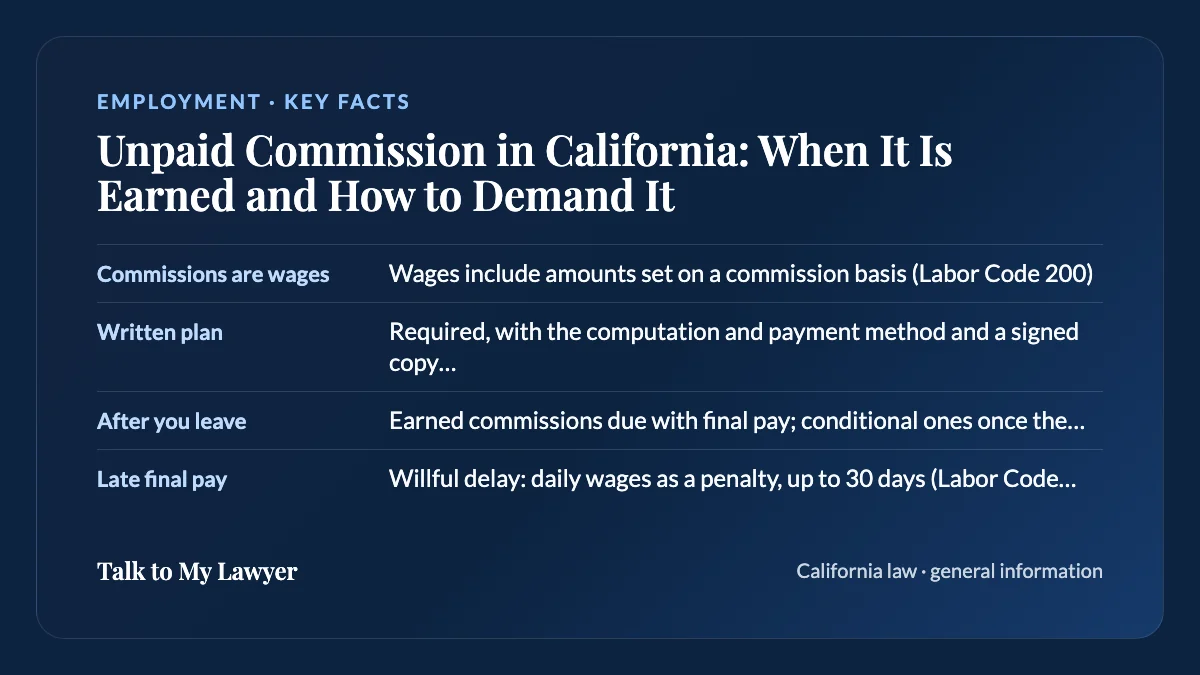
- Commissions are wages
- Wages include amounts set on a commission basis (Labor Code 200)
- Written plan
- Required, with the computation and payment method and a signed copy (Labor Code 2751)
- After you leave
- Earned commissions due with final pay; conditional ones once the condition is met
- Late final pay
- Willful delay: daily wages as a penalty, up to 30 days (Labor Code 203)
- Filing deadline
- 4 years on a written contract; 2 years on an oral promise (Labor Commissioner)
Are commissions wages in California?
Yes. Labor Code section 200 defines wages as all amounts for labor performed, whether fixed by time, task, piece, commission basis or another method. Unpaid commissions therefore carry the same protections as an unpaid hourly paycheck, including final pay deadlines and the ban on taking back wages already paid.
The Labor Code describes commission wages as pay for services in selling the employer's property or services, based proportionately on the amount or value of what was sold (section 204.1). That definition matters: a flat bonus for hitting a team target may not be a commission at all, while a percentage of each sale is.
What must a California commission agreement say?
When pay involves commissions for work in California, the contract must be in writing and must set out how commissions are computed and paid (Labor Code section 2751(a)). The employer must give you a signed copy and get a signed receipt from you.
- Expired plans keep working. If a plan expires and everyone keeps working under it, its terms are presumed to continue until it is replaced or employment ends (section 2751(b)).
- What does not count. For this section, commissions do not include short-term productivity bonuses like those paid to retail clerks, temporary incentives that only increase pay, or bonus and profit-sharing plans unless the employer offered a fixed percentage of sales or profits (section 2751(c)).
- Read the definitions. Look for when a commission is earned, what happens to deals that close after you leave, how returns or cancellations are handled, and whether the employer can change the plan mid-year.
If you never received a signed plan, say so in your letter and ask for a copy. Labor Code section 432 also entitles you to a copy of any document you signed relating to your employment.
Earned, advanced or charged back: which is your commission?
The written plan sets the point at which a commission is earned. Some plans say a commission is earned when the contract is signed, others when the customer is invoiced or pays. Until the conditions in the plan are met, money paid to you may be an advance rather than an earned wage.
| Situation | General rule | What to ask for |
|---|---|---|
| Deal closed and paid before you left | Earned; due with final pay | The full commission, plus any waiting time penalty |
| Deal closed before you left, customer paid after | Due once the condition in the plan is met | Payment as soon as the customer pays; the Labor Commissioner says immediately |
| Plan pays an advance against future commissions | The advance may be recoverable only as the plan allows | The plan language and the ledger of advances |
| Employer takes back a commission after a refund | Lawful only if the plan made the commission conditional on the customer keeping the product | The chargeback policy and the specific refund records |
Labor Code section 221 makes it unlawful for an employer to collect or receive back any part of wages it already paid. Whether a chargeback crosses that line depends on whether the commission was actually earned under the plan, which is a question an employment lawyer can assess against your documents. If the dispute turns on the plan as a contract, the guide to a breach of contract demand letter explains that side.
Do you get commissions after you quit or are fired in California?
Yes, for commissions earned by your last day. The Labor Commissioner says the employer must complete the calculations and pay them on the date of termination if you are fired, or if you quit with at least 72 hours' notice; without notice, they are due within 72 hours. The employer cannot wait for the next commission cycle.
If a commission depends on something that has not happened yet, such as the customer paying, it becomes due once that condition is met. A plan that says you forfeit all commissions on deals that close the day after you leave deserves a careful read, since the outcome depends on what work the plan required and when.
If an employer willfully misses the final pay deadline, Labor Code section 203 makes it pay a day's wages for each day of delay, capped at 30 days. The calculator below estimates that figure from a daily rate. For a commission-paid worker, working out the daily rate can involve averaging earnings, so treat the result as a starting estimate.
Example: adding up a commission claim
Example (hypothetical): a medical device sales representative's plan pays 8 percent of contract value once the customer's first invoice is paid. She gives two weeks' notice and leaves on May 30. Two of her deals were paid before she left; one was paid on June 18.
| Deal | Contract value | Commission at 8% | When due |
|---|---|---|---|
| Deal A (paid May 10) | $40,000 | $3,200 | Last day, May 30 |
| Deal B (paid May 24) | $25,000 | $2,000 | Last day, May 30 |
| Deal C (paid June 18) | $30,000 | $2,400 | Once the June 18 payment came in |
| Total | $95,000 | $7,600 |
If none of the $7,600 had been paid by July 1, her letter would list each deal, the plan's trigger, the date it was met and the amount. It could also note that waiting time penalties may apply to the amounts due on May 30.
How to write an unpaid commission demand letter
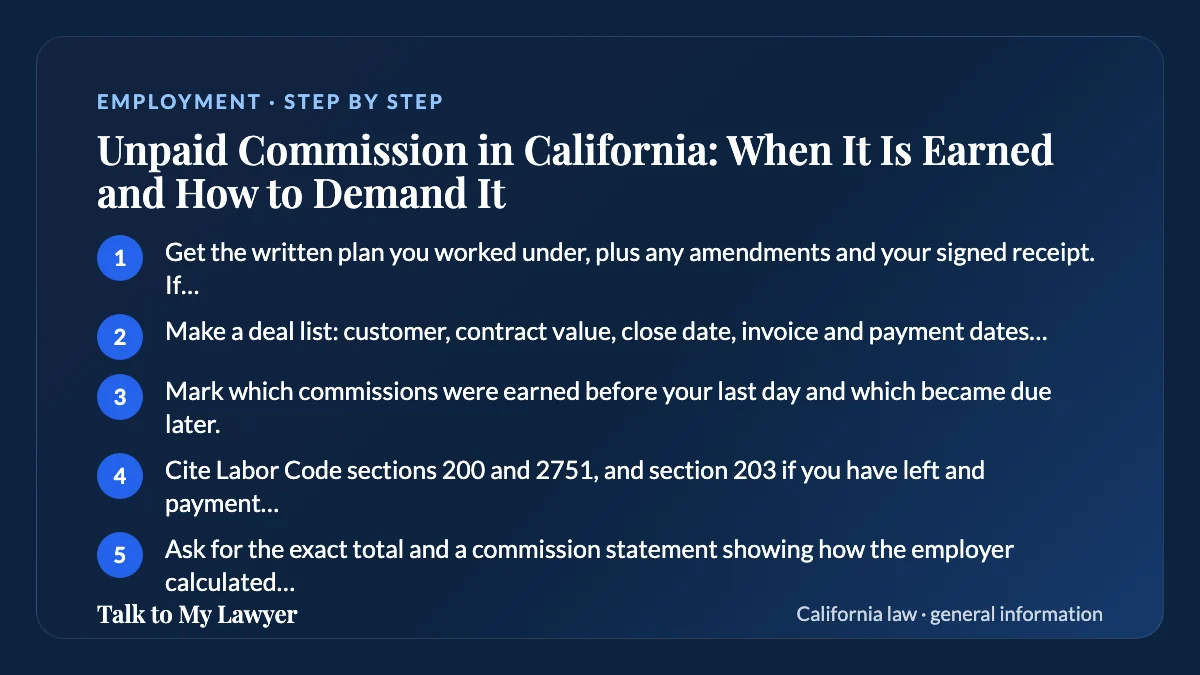
- Get the written plan you worked under, plus any amendments and your signed receipt. If you do not have them, request them.
- Make a deal list: customer, contract value, close date, invoice and payment dates, rate and commission owed.
- Mark which commissions were earned before your last day and which became due later.
- Cite Labor Code sections 200 and 2751, and section 203 if you have left and payment was late.
- Ask for the exact total and a commission statement showing how the employer calculated it.
- Give a firm, reasonable response date and keep proof of delivery.
Under the 2026 Sales Compensation Plan I signed on January 6, I earn 8 percent of contract value once a customer's first invoice is paid. Deals A and B were paid before my last day of May 30, and Deal C was paid on June 18. The commissions on these deals, totaling $7,600, have not been paid. Please pay this amount by July 15 and send a commission statement showing your calculation.
The Labor Commissioner's wage claim page lists four years to file a claim based on a written contract and two years for an oral promise to pay more than minimum wage, so whether your plan was in writing can affect your deadline. For the final paycheck rules that apply alongside commissions, see the guide to the California final paycheck demand letter.
When an attorney-written commission letter makes sense
Under California law, the written plan decides when a commission is earned, so a commission letter starts with its wording. When the employer leans on a forfeiture or chargeback clause, rewrote the plan mid-year, owes a large sum, or faces a waiting time penalty you want stated accurately, the letter has to read the plan against the Labor Code. A clear plan and a short deal list may be enough for a letter you write yourself.
With Talk to My Lawyer, a licensed California attorney writes your letter from your commission plan, deal records and pay history and sends it on your behalf. Choosing a wage claim over a lawsuit, or the reverse, is a call to make with a lawyer who has gone through your specific plan and deals.
Frequently asked questions
What if my employer never gave me a written commission plan?
Labor Code section 2751 requires a written contract explaining how commissions are computed and paid, a signed copy for you and a signed receipt. A missing plan does not erase commissions you earned. The terms may then be shown through emails, offer letters, past commission statements and how the employer actually paid you. Your letter can point out the missing plan and request a copy.
Can my employer change my commission plan after I made the sale?
Commissions already earned under the plan in effect are wages, and Labor Code section 221 bars an employer from taking back wages it already paid. Whether a change can reach a sale already made depends on the plan's terms and on when the commission was earned. Keep the version of the plan in effect when you closed each deal, since it is the starting point for the analysis.
Are bonuses treated the same as commissions in California?
Not always. Section 2751 excludes short-term productivity bonuses like those paid to retail clerks, temporary incentives that only increase pay, and bonus or profit-sharing plans that do not offer a fixed percentage of sales or profits from its written-plan rule. Earned nondiscretionary bonuses are still wages under section 200, and they count toward the regular rate used for overtime, so the label on the payment matters less than how it was promised.
When are commissions due after I quit without notice?
Within 72 hours of quitting, for commissions already earned, according to the Labor Commissioner. If you gave at least 72 hours' notice, or were fired, earned commissions are due on your last day. Commissions that depend on a later event, such as a customer's payment, become due once that event happens. A willful delay can add a daily-wage penalty for as long as 30 days.
Sources
Checked against these official sources on October 18, 2026.
- California Labor Code section 2751 (California Legislative Information)
- California Labor Code section 200 (California Legislative Information)
- California Labor Code section 221 (California Legislative Information)
- Paydays, pay periods and final wages frequently asked questions (California Labor Commissioner's Office)
- California Labor Code section 203 (California Legislative Information)
- How to file a wage claim (California Labor Commissioner's Office)
This guide explains California law in general terms as of October 2026. It is general information, not legal advice for your situation, and local rules can add to it.
Join the email list and get a lawyer letter started
With Talk to My Lawyer, a licensed California attorney writes your letter from your facts and documents and sends it on your behalf. Join the Talk to My Lawyer email list for letter checklists, document prompts, and reminders before you start your letter.