Quick answer
Vacation payout in California is required: when you leave a job, all vested vacation must be paid as wages at your final rate of pay, and a policy cannot make you forfeit it (Labor Code section 227.3). Vacation vests as you work, so use-it-or-lose-it rules are not allowed, though a reasonable cap on accrual is. Separate paid sick leave generally does not have to be paid out.
At a glance
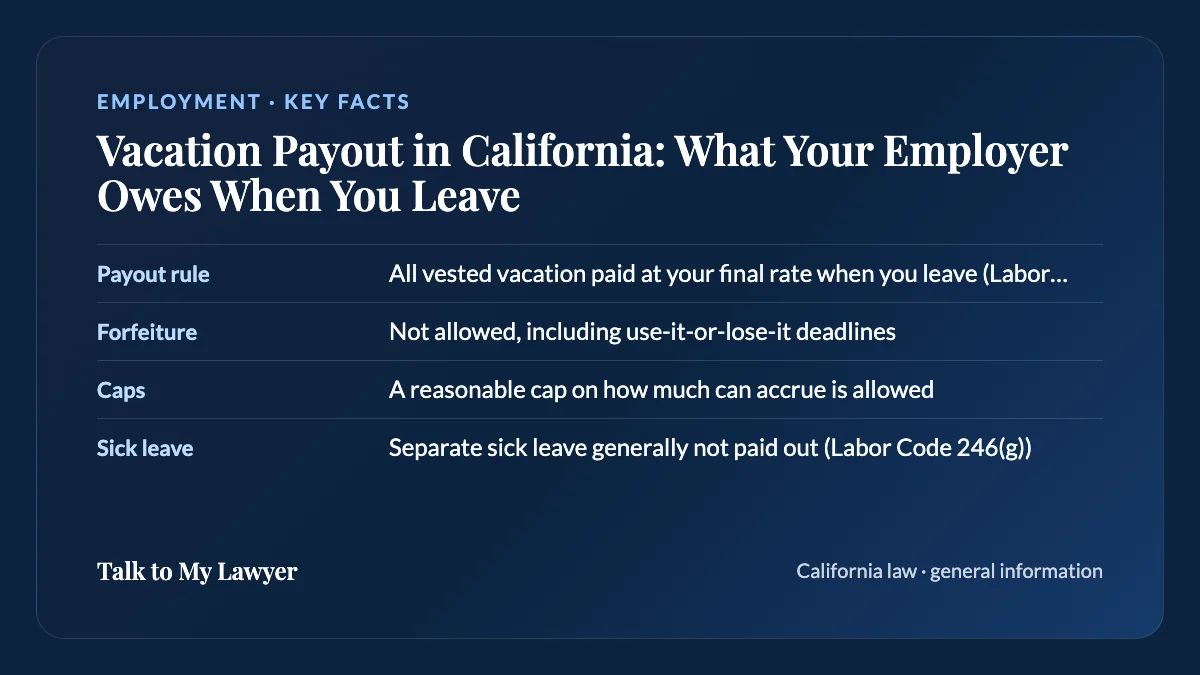
- Payout rule
- All vested vacation paid at your final rate when you leave (Labor Code 227.3)
- Forfeiture
- Not allowed, including use-it-or-lose-it deadlines
- Caps
- A reasonable cap on how much can accrue is allowed
- Sick leave
- Separate sick leave generally not paid out (Labor Code 246(g))
- Timing
- Due with final wages: last day if fired, within 72 hours if you quit without notice
Does California require vacation payout when you leave a job?
Yes. If your employer offers paid vacation and you leave without having used your vested time, Labor Code section 227.3 requires that all of it be paid to you as wages at your final rate. The same section bars any contract or policy from providing for forfeiture of vested vacation when employment ends.
Vested means earned. The Labor Commissioner explains that vacation is earned, or vests, as labor is performed, citing the California Supreme Court's 1982 Suastez decision. If your policy gives 10 days a year, you have earned a share of those days for each day you worked, and the payout is prorated daily.
The statute is triggered when a contract of employment or employer policy provides for paid vacation. That is why the written policy, your offer letter and your pay stubs are the first documents to pull.
Is use-it-or-lose-it vacation legal in California?
No. The Labor Commissioner does not recognize a policy under which vacation not used by a set date is forfeited, because that would take away wages already earned. An employer can, however, limit how much you can bank.
| Policy feature | Allowed? | Why |
|---|---|---|
| Hours expire on December 31 | No | Forfeits vacation that already vested |
| Accrual stops at a cap, such as 120 hours | Yes, if reasonable | Limits future accrual without taking away earned time |
| No vacation earned during a first-90-days waiting period | Yes, if genuine | Nothing vests during a valid waiting period |
| Part-time staff excluded from the plan | Yes, if the plan says so clearly | Exclusions must be specific |
| Earned vacation cashed out each year | Yes | The Labor Commissioner permits paying off accrued time |
| Final check reduced for vacation taken in advance | No | Employers may not use self-help deductions from final wages |
A cap or a waiting period that is really a way to deny vacation, which the Labor Commissioner calls a subterfuge, will not be recognized.
Do PTO and unlimited time off plans get paid out?
A traditional PTO plan, where one bank covers vacation and other time off, follows the vacation rules. The Labor Commissioner says PTO vests daily, cannot be forfeited, may be capped and must be paid out if unused when you leave.
Unlimited time off is less settled. No California statute addresses it directly. In McPherson v. EF Intercultural Foundation (2020), the Court of Appeal held that section 227.3 applied to one employer's purported unlimited policy on the particular facts of that case, and stressed that it was not holding every unlimited policy creates a payout duty. If your plan was labeled unlimited but in practice had limits or expected amounts, describe how it actually worked in your letter.
Is unused sick leave paid out in California?
Generally no. Labor Code section 246(g) excuses employers from cashing out accrued, unused paid sick days at separation. The trade-off: come back to the same employer within a year and your old sick balance returns.
The distinction turns on how your employer set up its plan. A separate sick leave bank is not paid out. A combined PTO bank that you could use for vacation is treated as vacation and must be paid out. Your pay stub or a separate notice must show your available sick leave or PTO balance each payday (section 246(i)), which makes the label easy to check.
How to calculate your vacation payout
Multiply your vested, unused hours by your final rate of pay. A raise in your last months means all banked hours are paid at the higher rate, even hours earned years earlier.
Example (hypothetical): a dental office manager earned $31 an hour when she accrued most of her vacation, and $34 by her last day. Her final stub shows 62 unused hours.
| Item | Figure |
|---|---|
| Unused vested hours | 62 |
| Final rate of pay | $34.00 |
| Vacation owed (62 x $34) | $2,108 |
| If her employer paid at the old $31 rate | $1,922, leaving $186 short |
Vacation is due with the rest of your final wages: immediately if you are fired or quit with at least 72 hours' notice, and no later than 72 hours after an unannounced resignation, according to the Labor Commissioner. If the employer willfully pays late, waiting time penalties under Labor Code section 203 can add up to 30 days of wages. The guide to a final paycheck demand letter explains that penalty in detail.
How to request unpaid vacation pay in writing
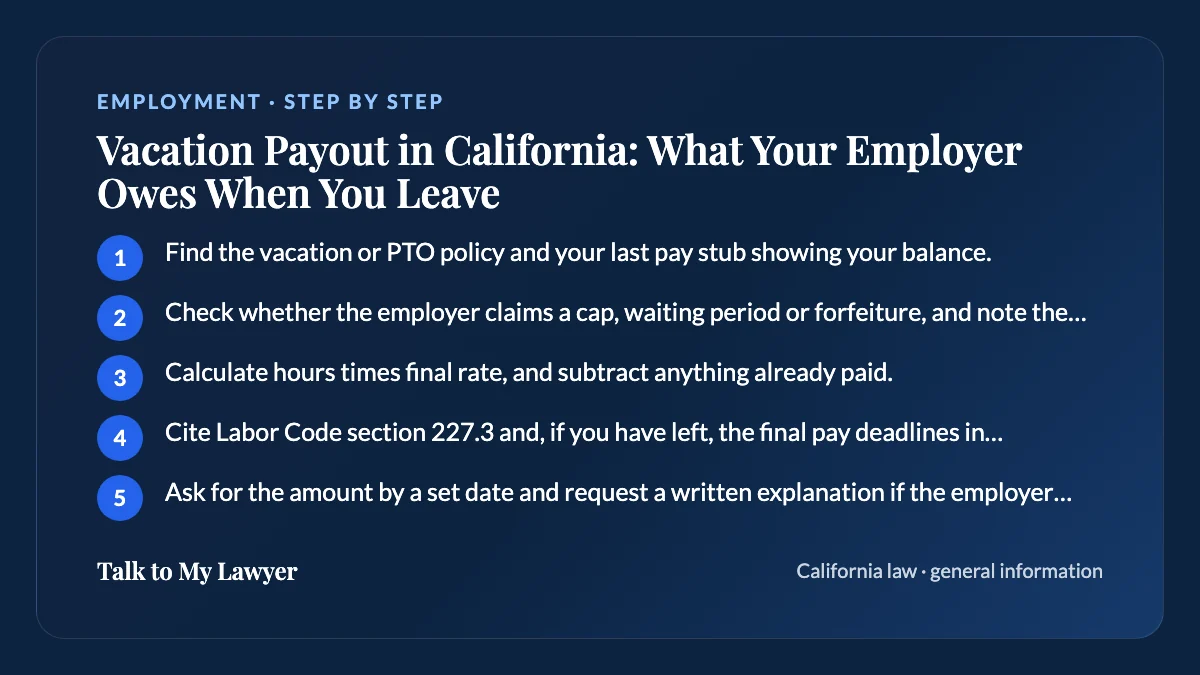
- Find the vacation or PTO policy and your last pay stub showing your balance.
- Check whether the employer claims a cap, waiting period or forfeiture, and note the policy language.
- Calculate hours times final rate, and subtract anything already paid.
- Cite Labor Code section 227.3 and, if you have left, the final pay deadlines in sections 201 and 202.
- Ask for the amount by a set date and request a written explanation if the employer disputes your balance.
- Send it to payroll or human resources and keep proof of when it was sent.
My employment ended on September 19. My final pay stub, dated September 12, shows 62 hours of accrued, unused vacation, and my final paycheck did not include payment for those hours. Under Labor Code section 227.3, vested vacation must be paid at my final rate of $34.00 per hour. Please pay $2,108 by October 3. If you believe my balance is different, please send the accrual records you are relying on.
If your vacation dispute is one part of a larger shortfall, the guide to unpaid commission in California and the guide to unpaid wages demand letters cover related claims.
When an attorney-written vacation pay letter makes sense
If your vacation balance is printed on your last stub and the employer simply left it off the final check, a polite note pointing to that line is a sensible first step. Disputes over forfeiture, an unlimited PTO label, years of contested accrual or a refused waiting time penalty are different. Those turn on how the policy reads against section 227.3.
With Talk to My Lawyer, a licensed California attorney writes your letter from your vacation policy, pay stubs and final paycheck and sends it on your behalf. If the employer pushes back, a lawyer can explain where a wage claim or court case would leave you.
Frequently asked questions
Can my employer refuse to pay out vacation if I was fired?
No. Section 227.3 applies whenever employment ends, whatever the reason, and the Labor Commissioner notes that vested vacation cannot be forfeited even on termination. If you were fired, earned vacation is due with your final wages on your last day. A policy saying employees fired for cause lose their vacation conflicts with the statute's ban on forfeiture.
Is a vacation cap legal in California?
Yes, if it is reasonable. A cap stops further accrual once you reach a set balance, so you stop earning more vacation until you use some. It does not take away time already earned. The Labor Commissioner will not recognize a cap that is a subterfuge to deny vacation, and any balance you reached before hitting the cap must still be paid out when you leave.
Does a union contract change the vacation payout rule?
It can. Section 227.3 begins with an exception for collective bargaining agreements, so a union contract may set different payout terms. If you are covered by a union contract, read its vacation article and talk with your union representative, since grievance procedures may apply before a wage claim or lawsuit.
What if my employer let me take vacation before I earned it?
The Labor Commissioner says an employer cannot deduct advanced, unearned vacation from your final paycheck, because employers may not use self-help to recover debts from wages. The employer may have other ways to seek repayment, but not by shorting final pay. If your final check was reduced for advanced vacation, include that deduction in your letter.
Is holiday pay or sick leave included in a California vacation payout?
Separate paid sick leave is generally not paid out under Labor Code section 246(g), though the balance comes back if the same employer rehires you within a year. A combined PTO bank usable for vacation is treated as vacation and is paid out. Holiday pay depends on the employer's policy, so check the policy to see whether holidays are a separate benefit.
Sources
Checked against these official sources on October 18, 2026.
- California Labor Code section 227.3 (California Legislative Information)
- Vacation frequently asked questions (California Labor Commissioner's Office)
- California Labor Code section 246 (California Legislative Information)
- Paydays, pay periods and final wages frequently asked questions (California Labor Commissioner's Office)
- California Labor Code section 203 (California Legislative Information)
- McPherson v. EF Intercultural Foundation, Inc. (2020), B290869 (California Court of Appeal (California Courts))
This guide explains California law in general terms as of October 2026. It is general information, not legal advice for your situation, and local rules can add to it.
Join the email list and get a lawyer letter started
With Talk to My Lawyer, a licensed California attorney writes your letter from your facts and documents and sends it on your behalf. Join the Talk to My Lawyer email list for letter checklists, document prompts, and reminders before you start your letter.