Quick answer
California car repossession laws let a lender take a car after default without going to court, as long as there is no breach of the peace (Commercial Code section 9609). For dealer-financed contracts, the lender must then give at least 15 days' written notice before selling, explaining your rights to redeem or reinstate (Civil Code section 2983.2), and a defective notice can bar any deficiency claim.
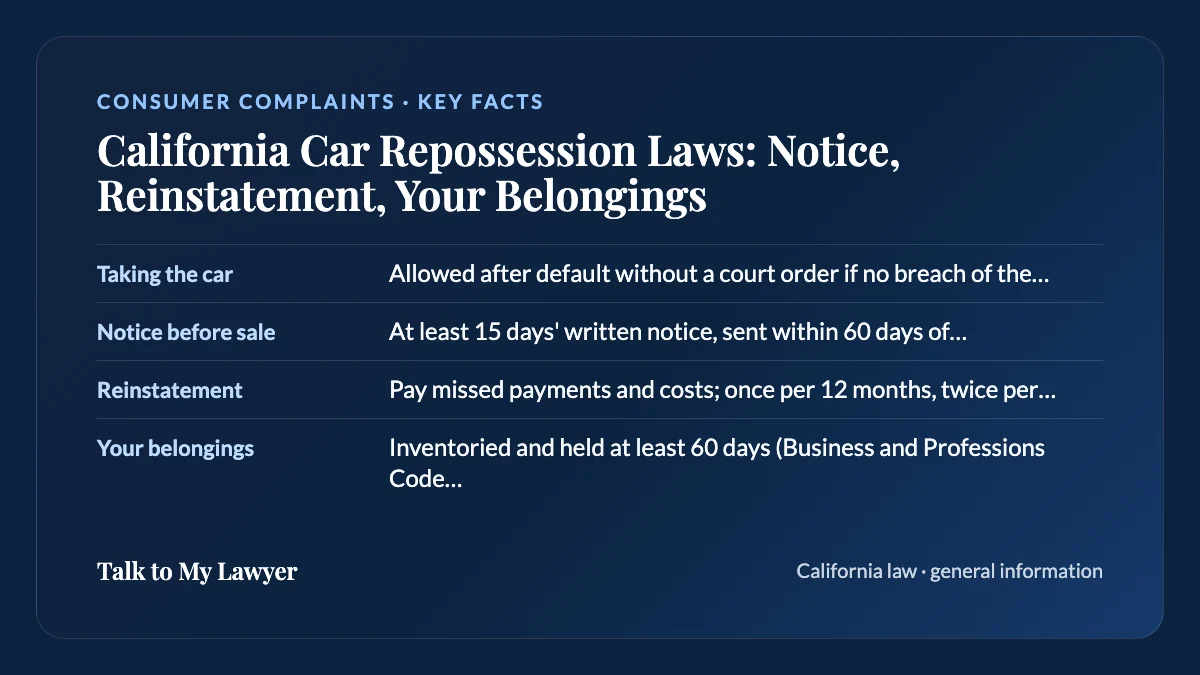
At a glance
- Taking the car
- Allowed after default without a court order if no breach of the peace (Commercial Code 9609)
- Notice before sale
- At least 15 days' written notice, sent within 60 days of repossession (Civil Code 2983.2)
- Reinstatement
- Pay missed payments and costs; once per 12 months, twice per contract (Civil Code 2983.3)
- Your belongings
- Inventoried and held at least 60 days (Business and Professions Code 7507.9)
- Deficiency
- Only if the notice and sale followed the law (Civil Code 2983.2, 2983.8)
- Servicemembers
- Court order needed in some cases (50 U.S.C. 3952)
Can a lender repossess your car without going to court in California?
Yes, once you are in default. California Commercial Code section 9609 lets a secured lender take its collateral after default either through the courts or without them, provided it proceeds without breach of the peace. The statute does not define that phrase, so whether a particular tow crossed the line depends on the facts.
The Automobile Sales Finance Act, often called the Rees-Levering Act, adds limits for cars bought on a conditional sale contract, the installment contract you sign with the dealer, even after the dealer assigns it to a bank or finance company:
- Without a default, the seller or holder of the contract may not repossess or speed up the balance (Civil Code section 2983.3(a)(1)).
- Filing for bankruptcy, or being a debtor in bankruptcy, is not a default by itself, and a contract clause saying otherwise is void (section 2983.3(a)(2)).
- The notice and reinstatement rules in sections 2983.2 and 2983.3 do not apply to a loan made by a lender licensed under the California Financing Law (Financial Code Division 9). Check who financed your car before relying on them.
What must the Notice of Intent to Sell say?
Civil Code section 2983.2 requires at least 15 days' written notice of intent to sell a repossessed or surrendered car, given to everyone liable on the contract. It must be personally served or mailed (certified or first-class) to the last known address. If the notice is mailed from, or addressed to, a place outside California, the period is 20 days.
To keep the right to collect a deficiency, the lender must send the notice within 60 days of the repossession, and it must:
- State your right to redeem by paying the contract balance in full before the 15 days end, with an itemization of the balance, any delinquency, collection or repossession costs, and any credit for unearned finance charges or canceled insurance.
- Say whether you have a conditional right to reinstate and list the conditions, or explain why there is no right to reinstate.
- Tell you that on written request the period will be extended by another 10 days, and include a form for asking.
- Give the place the car will be returned and the name and address for payment.
- Explain that you can ask for a written accounting of the sale.
- Warn, in bold type, that you may be sued if the sale does not cover what is owed.
Reinstating vs. redeeming: what is the difference?
Reinstating puts the contract back in place by catching up; redeeming ends it by paying it off. Both must happen inside the notice period, plus any 10-day extension you request in writing.
| Point | Reinstate (Civil Code 2983.3) | Redeem (Civil Code 2983.2) |
|---|---|---|
| What you pay | Missed payments, delinquency charges and reasonable repossession and collection costs | The full balance of the contract, less any credit for unearned finance charges |
| Result | You get the car back and keep making payments | You own the car outright |
| Limits | Once in any 12-month period and twice during the contract | None stated in the statute |
| When it can be refused | False credit application, hiding the car, damage to it, violence or threats, or certain criminal seizures | Not applicable |
If the lender refuses reinstatement, it carries the burden of proving the refusal was reasonable and made in good faith. If it cannot, section 2983.3(e) says it is not entitled to a deficiency.
How do you get your belongings back from a repossessed car?
Ask the repossession agency, which has specific duties under Business and Professions Code section 7507.9. Apart from anything you took out yourself at the scene, it must remove your personal effects, make a complete and accurate inventory, label them and store them securely for at least 60 days.
- The inventory must reach you within 48 hours after the recovery, or 72 or 96 hours when a weekend or postal holiday falls in that window.
- It must list the agency's name, address, business hours and phone number, plus every removal and storage charge it will make.
- It must warn that unclaimed items will be disposed of 60 days after the notice.
- The agency may not sell your personal effects and pass the money to the lender.
- If someone else will pick up your things, the agency needs your written authorization.
If the agency is unsure whether something attached to the car, such as an aftermarket stereo, is yours or part of the car, it notes that on the inventory, and you take the question up with the lender. Make your own list of everything that was in the car while the details are fresh.
When can a lender collect a deficiency after the sale?
A deficiency is the gap between what you owed and what the car sold for, after sale costs. For contracts covered by the Act, you are liable for it only if a notice meeting section 2983.2 was given within 60 days of the repossession. Civil Code section 2983.8(b) adds that no deficiency judgment may be entered unless a court finds the sale complied with the Act and the Commercial Code's disposition rules, including sections 9610 through 9615 and 9626.
You can also ask for the numbers. Unless the lender sends one automatically within 45 days after the sale, it must provide a written accounting within 45 days of your written request, if you ask within one year of the sale. The accounting itemizes gross sale proceeds and the expenses of retaking, storing, preparing and selling the car. If the sale produced a surplus, the lender must send the accounting anyway and return the surplus within 45 days.
Example (hypothetical): a buyer owed $14,800 when the car was taken. It sold at auction for $8,200, and the lender added $1,150 in towing, storage and auction costs, then demanded $7,750. The lender never sent a Notice of Intent. If the contract is covered by the Act, section 2983.2 makes the buyer liable for a deficiency only when a compliant notice was given within 60 days of the repossession, so on these facts the $7,750 demand would have no footing under that section.
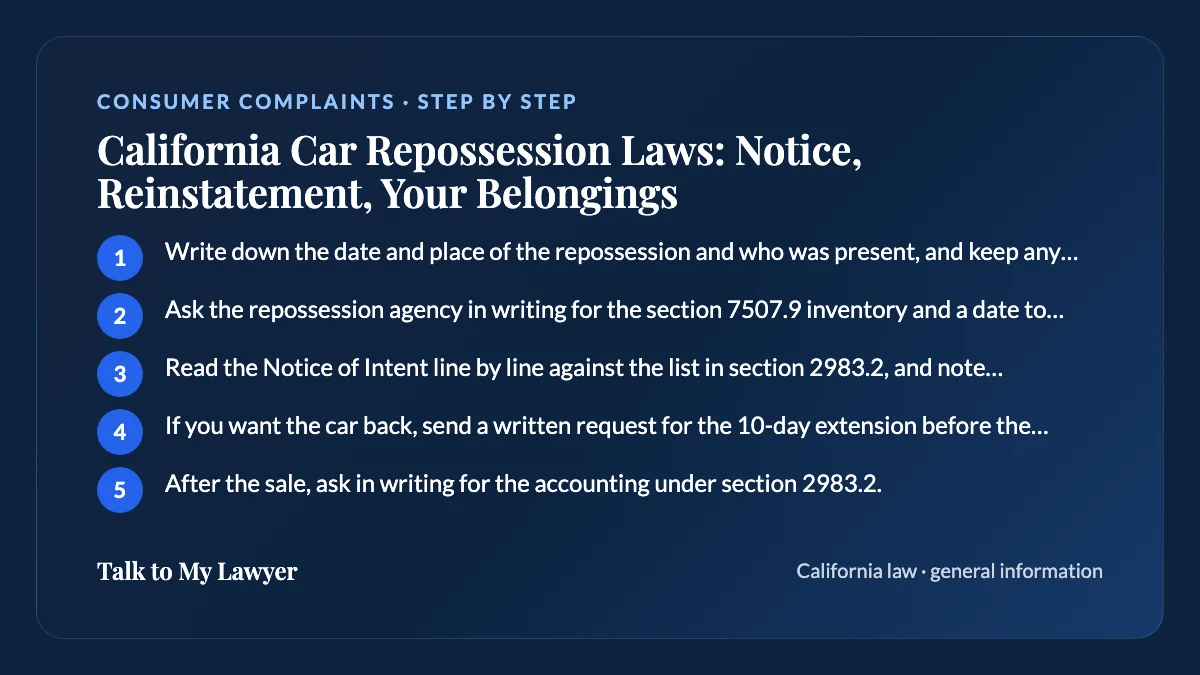
Writing a letter after repossession: what to ask for
- Write down the date and place of the repossession and who was present, and keep any police or agency paperwork.
- Ask the repossession agency in writing for the section 7507.9 inventory and a date to collect your belongings.
- Read the Notice of Intent line by line against the list in section 2983.2, and note the date it was mailed.
- If you want the car back, send a written request for the 10-day extension before the first period ends, using the lender's form and method.
- After the sale, ask in writing for the accounting under section 2983.2(b).
- If a deficiency demand arrives, reply in writing, explaining which notice or sale requirement was not met.
My 2021 sedan, financed under a retail installment contract dated May 3, 2023, was repossessed on August 14, 2026. No notice of intent to dispose of the vehicle was given to me within 60 days of the repossession, as Civil Code section 2983.2 requires. Under that section, I am not liable for a deficiency. Please withdraw your demand for $7,750, confirm in writing that the account shows a zero balance, and provide the accounting described in section 2983.2(b).
If the trouble started at the dealership, for example a contract with terms you never agreed to, our guide to car dealer fraud demand letters covers those claims. A tow from a private lot is a different situation, covered in our guide to towing company disputes.
When a lawyer's letter about a repossession is worth it
Repossession disputes turn on paperwork: the date a notice was mailed, what it listed, and how the car was sold. An attorney-written letter fits when a lender demands a deficiency after a notice that looks late or incomplete, refuses a reinstatement you offered on time, or when an agency will not return tools, documents or other belongings.
Through Talk to My Lawyer, a licensed California attorney writes your letter from your contract, the lender's notices and your timeline, and sends it on your behalf. For a deficiency lawsuit or a question about bankruptcy, talk to a lawyer about your facts.
Frequently asked questions
How many days do you have to get your car back after repossession in California?
For dealer-financed contracts under the Automobile Sales Finance Act, the lender must give at least 15 days' written notice before selling, or 20 days if the notice is mailed to or from outside California. You can redeem or, if eligible, reinstate during that time, and a written request extends the period by 10 more days. Check your notice for the exact dates.
Can a repo agent take my car from my driveway?
California Commercial Code section 9609 lets a lender take the car after default without a court order, as long as it does so without breach of the peace. The statute does not list what counts as a breach of the peace, so whether a particular repossession crossed that line depends on what happened. If you think it did, write down the details and witnesses right away.
How long does a repo company have to keep my personal property?
At least 60 days. Business and Professions Code section 7507.9 requires the repossession agency to remove, inventory, label and securely store your personal effects, and to send you the inventory within 48 hours of the recovery, with longer windows around weekends and holidays. The inventory lists the agency's contact details and any storage charges, and warns that unclaimed items may be disposed of after 60 days.
Do I still owe money after my car is repossessed and sold?
Possibly. If the sale brings in less than the balance and costs, the lender may claim a deficiency. Under the Automobile Sales Finance Act, it can do so only if it sent a proper Notice of Intent within 60 days of the repossession, and a court must find the sale complied with the law before a deficiency judgment is entered (Civil Code sections 2983.2 and 2983.8).
Can I reinstate my car loan after repossession in California?
For contracts covered by the Automobile Sales Finance Act, generally yes. Civil Code section 2983.3 gives a right to reinstate by paying the missed payments, delinquency charges and reasonable repossession costs, limited to once in any 12-month period and twice during the contract. A lender may refuse in listed situations, such as a false credit application or hiding the car, but must prove the refusal was reasonable.
Sources
Checked against these official sources on October 18, 2026.
- California Civil Code section 2983.2 (California Legislative Information)
- California Civil Code section 2983.3 (California Legislative Information)
- California Civil Code section 2983.8 (California Legislative Information)
- California Commercial Code section 9609 (California Legislative Information)
- California Business and Professions Code section 7507.9 (California Legislative Information)
- 50 U.S. Code section 3952 (Legal Information Institute, Cornell Law School)
This guide explains California law in general terms as of October 2026. It is general information, not legal advice for your situation, and local rules can add to it.
Join the email list and get a lawyer letter started
With Talk to My Lawyer, a licensed California attorney writes your letter from your facts and documents and sends it on your behalf. Join the Talk to My Lawyer email list for letter checklists, document prompts, and reminders before you start your letter.