Quick answer
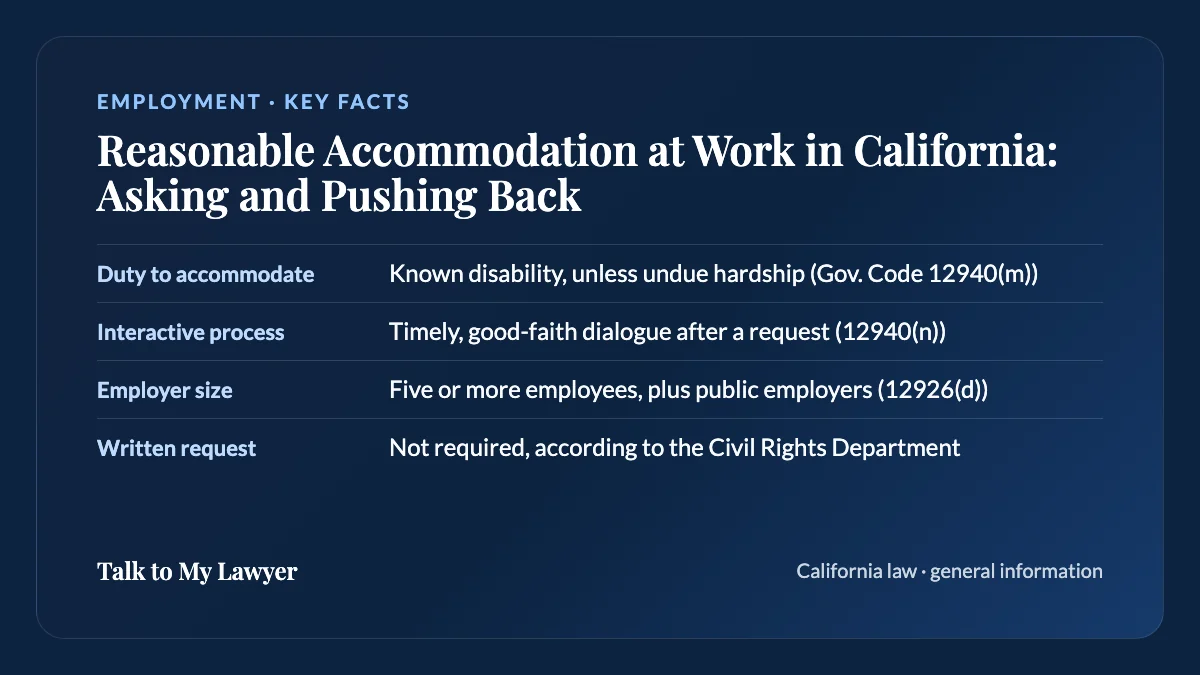
California employers with five or more employees must provide reasonable accommodation at work for an employee's known physical or mental disability unless it would cause undue hardship (Government Code section 12940(m)). They must also engage in a timely, good-faith interactive process when you ask (section 12940(n)). The request does not have to be in writing, and retaliation for asking is unlawful.
At a glance
- Duty to accommodate
- Known disability, unless undue hardship (Gov. Code 12940(m))
- Interactive process
- Timely, good-faith dialogue after a request (12940(n))
- Employer size
- Five or more employees, plus public employers (12926(d))
- Written request
- Not required, according to the Civil Rights Department
- Retaliation
- Unlawful whether or not the request was granted (12940(m)(2))
What does California require for reasonable accommodation at work?
An employer covered by California's Fair Employment and Housing Act (FEHA) must make reasonable accommodation for the known physical or mental disability of an employee or applicant, unless the employer shows that it would cause undue hardship (Gov. Code section 12940(m)). Separately, it must engage in a timely, good-faith interactive process to find an effective accommodation once you ask (section 12940(n)).
The statute lists these as two separate unlawful practices, so ignoring a request or letting it stall can be a violation in its own right. FEHA generally applies to private employers with five or more employees and to public employers.
The Civil Rights Department (CRD) notes that a disability can qualify even if it is in remission, comes and goes (such as migraines), is controlled by medication, or is temporary, like a back injury, as long as it limits a major life activity.
How do you ask for an accommodation?
You ask by telling the employer you need a change at work because of a medical condition. The CRD's July 2026 fact sheet says employers cannot require the request to be in writing or to use specific words, and there is no limit on when or how often you can ask.
You do have to explain the link between your disability-related need and the change you want, meaning how it would help you do your job. Writing the request down is not required, but it creates a dated record that helps if the process breaks down later.
Because of a medical condition, my doctor has advised that I not stand for more than two hours at a time. I am requesting a sit-stand stool at the register and a 10-minute seated break every two hours. I can provide a note from my provider confirming these limits. Please let me know when we can meet to discuss this request.
What medical information can an employer demand?
Only what the job justifies. Under section 12940(f), an employer may make medical inquiries of current employees only when they are job related and consistent with business necessity.
- When the disability or need is not obvious, the employer may ask for documentation, such as a provider's note or certification form.
- When the disability or need is obvious, the CRD says the employer cannot ask for medical documentation.
- Employer forms cannot demand more than the law allows, which the CRD says includes medical records, specific diagnoses or the cause of the disability.
- Many kinds of providers can supply documentation, including doctors, psychologists, marriage and family therapists and clinical social workers.
If the note is unclear, the CRD says the interactive process continues. A vague note is a reason to ask follow-up questions, not a reason to close the file.
Examples of accommodations, including leave
Section 12926(p) lists job restructuring, part-time or modified schedules, reassignment to a vacant position, equipment, adjusted training materials or policies, readers and interpreters, and accessible facilities. The CRD adds remote work, service animals and transfers to other sites.
| Hypothetical need | Possible accommodation |
|---|---|
| Chronic back condition limits standing | Stool, sit-stand desk, rotating tasks |
| Anxiety disorder worsened by open-office noise | Quieter workspace, headphones, partial remote work |
| Chemotherapy every third Friday | Modified schedule or intermittent leave |
| Recovery from surgery | Temporary leave beyond other leave entitlements, then light duty |
| Permanent lifting restriction in a warehouse role | Reassignment to a vacant position the employee is qualified for |
Leave can itself be an accommodation. Under the CRD's regulation at California Code of Regulations, title 2, section 11068(c), holding a job open or extending leave beyond CFRA, FMLA or company policy may be reasonable if the leave is likely to let you return and does not cause undue hardship. Employers are not required to give indefinite leave. If you are still within CFRA leave, see our guide to CFRA leave denials.
If you can no longer do your own job even with accommodation, section 11068(d) says the employer must look, through the interactive process, for vacant positions you are qualified for.
When can an employer deny an accommodation request?
The CRD lists four grounds for denial: the person does not have a disability recognized by law, the accommodation would take away one of the job's core functions, it would cause undue hardship, or it would endanger the health or safety of the person or others.
Undue hardship means significant difficulty or expense, judged by factors such as the cost of the accommodation, the size and resources of the facility and the business, and the type of operations (section 12926(u)). The employer must consider your preference, but it may choose among accommodations that are equally effective. Even after showing hardship, the CRD says the employer must keep looking for an alternative.
What to do when the process stalls or you are denied
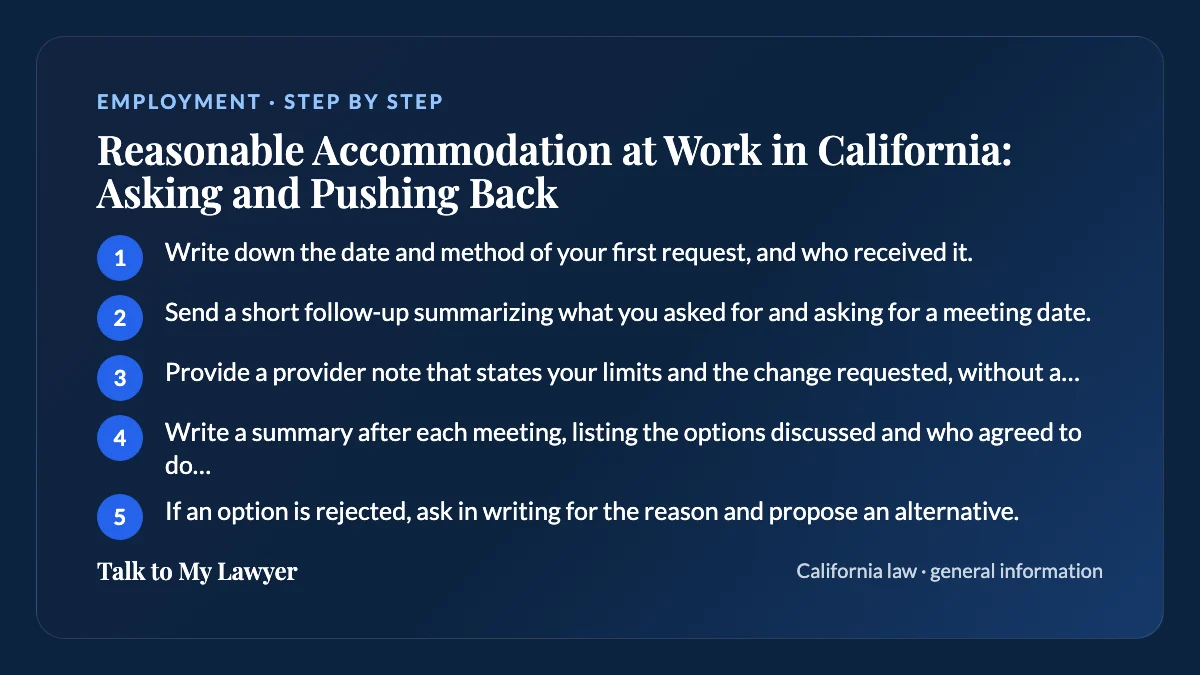
Delay is a problem the CRD addresses directly: it says employers cannot ignore or delay a request to avoid granting it. These steps keep the record clear:
- Write down the date and method of your first request, and who received it.
- Send a short follow-up summarizing what you asked for and asking for a meeting date.
- Provide a provider note that states your limits and the change requested, without a diagnosis unless needed.
- Write a summary after each meeting, listing the options discussed and who agreed to do what, and email it to HR.
- If an option is rejected, ask in writing for the reason and propose an alternative.
- Track any change in discipline, schedule or pay after you asked. Under section 12940(m)(2), retaliation for requesting accommodation is unlawful whether or not the request was granted.
If the denial or delay continues, you can file with the CRD. The intake form is due within three years of the violation (Gov. Code section 12960). For job losses that follow a request, our guides to workplace retaliation and employment discrimination explain the claims.
When it helps to have an attorney write the accommodation letter
An accommodation letter has to share enough medical information to support the request, and no more. An attorney can strike that balance for you when the employer has rejected a request, demanded full records, put you on unpaid leave you did not ask for, or let weeks pass without a meeting. If you are weighing a CRD complaint or a lawsuit, a lawyer can advise you on your own facts.
Through Talk to My Lawyer, a licensed California attorney writes your letter from your facts and documents (your requests, provider notes and the employer's replies) and sends it on your behalf.
Frequently asked questions
Does my accommodation request have to be in writing?
No. The Civil Rights Department says employers cannot require accommodation requests to be in writing or to use particular words. Telling a supervisor that you need a change at work because of a medical condition can be enough to start the process. A written follow-up is still useful because it records the date and what you asked for.
Can my employer ask for my diagnosis?
Generally, the employer can ask for documentation that you have a disability and need an accommodation when that is not obvious. The CRD says employer forms must not request more than the law allows, including medical records, specific diagnoses or the cause of the disability. When the disability or need is obvious, the employer cannot ask for documentation.
Can I be fired for asking for a reasonable accommodation?
Retaliating against someone for requesting accommodation is unlawful under Government Code section 12940(m)(2), whether or not the request was granted. That covers firing, demotion, cut hours or other adverse treatment. The employer can still make decisions for legitimate reasons unrelated to the request, which is why the timeline and the stated reasons matter.
Is extra medical leave a reasonable accommodation in California?
It can be. The CRD's regulation says holding a job open or extending leave beyond CFRA, FMLA or company policy may be a reasonable accommodation if the leave is likely to let you return to work and does not create undue hardship. Employers are not required to provide indefinite leave, and they cannot force leave when another accommodation would let you keep working.
What is the interactive process?
It is the back-and-forth between you and the employer to find an effective accommodation. Section 12940(n) requires it to be timely and in good faith. In practice that means meeting, sharing appropriate information, considering options and responding promptly. Section 12940 lists failure to engage as its own unlawful practice, separate from failure to accommodate.
Sources
Checked against these official sources on October 18, 2026.
- California Government Code section 12940 (California Legislative Information)
- California Government Code section 12926 (California Legislative Information)
- Disability Accommodations at Work Fact Sheet (July 2026) (California Civil Rights Department)
- Cal. Code Regs., tit. 2, section 11068 (Legal Information Institute, Cornell Law School)
- California Government Code section 12960 (California Legislative Information)
This guide explains California law in general terms as of October 2026. It is general information, not legal advice for your situation, and local rules can add to it.
Join the email list and get a lawyer letter started
With Talk to My Lawyer, a licensed California attorney writes your letter from your facts and documents and sends it on your behalf. Join the Talk to My Lawyer email list for letter checklists, document prompts, and reminders before you start your letter.