Quick answer
If your CFRA leave was denied in California, check eligibility first. Under Government Code section 12945.2, an employer with five or more employees must grant up to 12 workweeks of family or medical leave in a 12-month period to an employee with more than 12 months of service and at least 1,250 hours in the past year. Refusing, interfering with or retaliating for that leave is unlawful.
At a glance
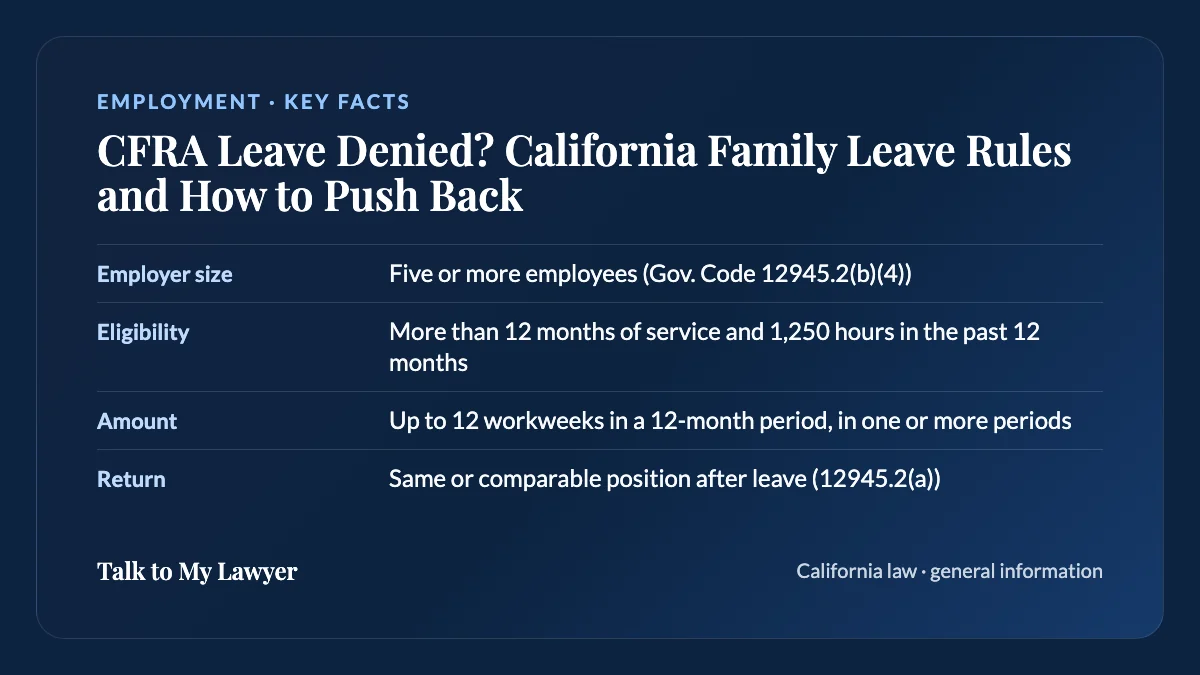
- Employer size
- Five or more employees (Gov. Code 12945.2(b)(4))
- Eligibility
- More than 12 months of service and 1,250 hours in the past 12 months
- Amount
- Up to 12 workweeks in a 12-month period, in one or more periods
- Return
- Same or comparable position after leave (12945.2(a))
- CRD deadline
- Within 3 years of the violation (Gov. Code 12960)
Who qualifies for CFRA leave in California?
You qualify if three things are true (Gov. Code section 12945.2(a) and (b)(4)):
- Your employer directly employs five or more people, or is a public employer.
- You have more than 12 months of service with that employer.
- You worked at least 1,250 hours for that employer in the previous 12 months. Separate rules apply to airline flight crews.
If you meet those tests, the employer must grant up to 12 workweeks of leave in a 12-month period. The leave can be taken in one block or in more than one period, which covers recurring treatment appointments. CFRA leave runs at the same time as federal FMLA leave when both apply.
What reasons and family members does CFRA cover?
CFRA covers four reasons: bonding with a new child (by birth, adoption, or a placement in your care), your own serious health condition, caring for a family member with a serious health condition, and a qualifying military exigency involving a spouse, domestic partner, child or parent.
The family members you can care for are a child, parent (including a parent-in-law), grandparent, grandchild, sibling, spouse, domestic partner or designated person. A designated person is anyone related by blood or whose association with you is the equivalent of a family relationship. You can name that person when you request leave, and the employer may limit you to one designated person per 12-month period.
A serious health condition means an illness, injury, impairment or condition involving inpatient care or continuing treatment or supervision by a health care provider.
What can the employer ask for before approving leave?
The employer can ask for reasonable advance notice when the need is foreseeable, and a certification from the health care provider. It cannot demand your relative's full medical file.
For a family member's condition, the certification is sufficient if it gives the date the condition began, its probable duration, an estimate of the time you are needed, and a statement that the condition warrants a family member's participation in care (section 12945.2(i)). For your own condition, it must state that you cannot perform the functions of your position. If the employer doubts your own certification, it can require a second opinion at its expense.
CFRA leave does not have to be paid, though you may choose, or be required, to use accrued vacation or other paid time off. The employer must keep your group health coverage in place for up to 12 workweeks of leave.
When is a CFRA denial unlawful?
A denial is unlawful when you qualify and the leave is for a covered reason. Section 12945.2 also makes three related acts unlawful:
- Interference: restraining or denying the exercise of, or the attempt to exercise, a CFRA right (section 12945.2(q)). The rule covers attempts to take leave, not only leave already underway.
- Retaliation: discharging, fining, suspending or discriminating against someone for taking CFRA leave or for giving information about it (section 12945.2(k)).
- Failure to restore: leave is not treated as granted unless the employer gives a promise of the same or a comparable position on return, meaning similar duties and pay at a similar location.
If a denial was followed by discipline or termination, our guide to workplace retaliation explains how timing evidence is used, and the guide to wrongful termination in California covers firings more broadly.
How to respond when your CFRA leave is denied
You can answer a denial in writing before anyone files a complaint. Work through these steps in order:
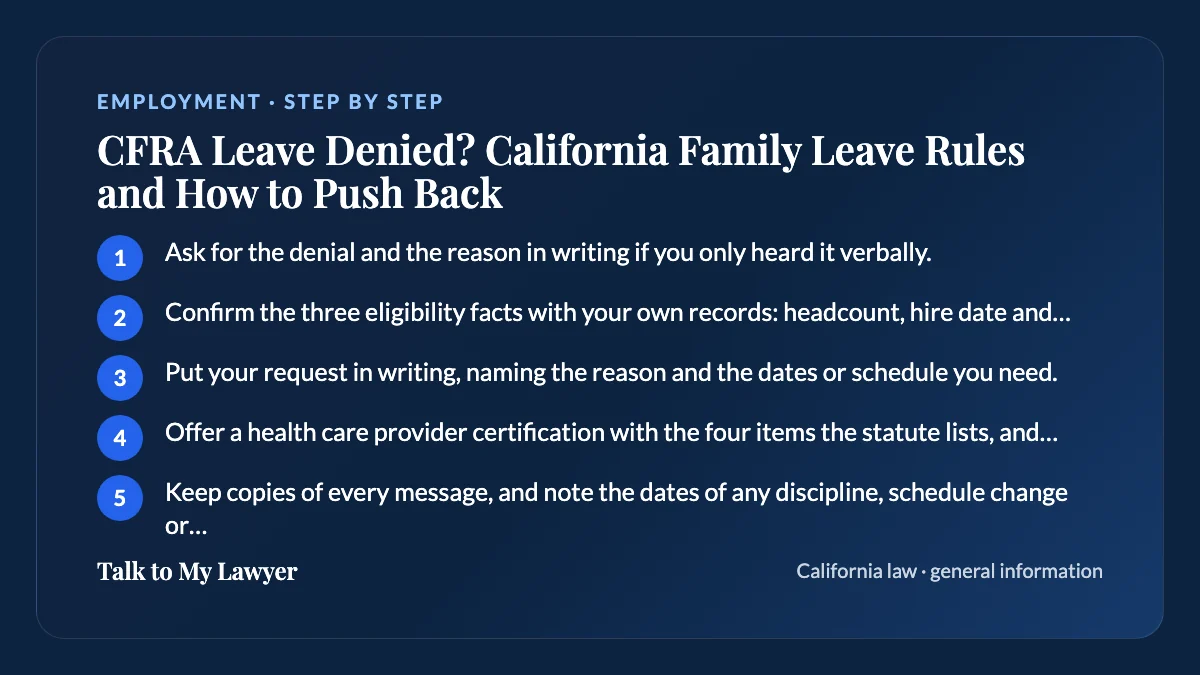
- Ask for the denial and the reason in writing if you only heard it verbally.
- Confirm the three eligibility facts with your own records: headcount, hire date and hours in the last 12 months (pay stubs show hours).
- Put your request in writing, naming the reason (for example, care for a parent with a serious health condition) and the dates or schedule you need.
- Offer a health care provider certification with the four items the statute lists, and nothing more.
- Keep copies of every message, and note the dates of any discipline, schedule change or attendance points after the request.
- Send a short follow-up letter citing section 12945.2 and asking for a written answer by a set date.
I have worked for the company since June 2024 and have worked more than 1,250 hours in the last 12 months. On September 2, I asked for intermittent leave to care for my mother, who is receiving continuing treatment for a serious health condition. On September 5, my request was denied because of staffing. Under Government Code section 12945.2, an eligible employee is entitled to up to 12 workweeks of leave for this purpose. I have enclosed a certification from her provider. Please confirm in writing by September 19 that my leave is approved and that my position will be held.
What if the employer still says no?
CFRA claims are enforced through the Civil Rights Department (CRD). You must submit an intake form within three years of the violation (Gov. Code section 12960), and you need a right-to-sue notice before filing your own lawsuit on the claim. After the notice, you generally have one year to file in court.
The CRD can investigate, and it may require mediation before any lawsuit it files. If you were fired after asking for leave, other claims and deadlines may also apply, and a lawyer can sort out which ones fit.
When an attorney-written leave letter makes sense
A CFRA request is tied to a date that will not move: the surgery, the due date, the funeral. Having an attorney write your response can help when the employer disputes your eligibility, when HR has stopped answering, when you were disciplined after asking, or when you need to return to work and the job is gone. If the leave involves your own medical condition, our guide to disability accommodation at work covers leave as an accommodation once CFRA time runs out.
With Talk to My Lawyer, a licensed California attorney writes your letter from your facts and documents (your leave request, pay records and the employer's replies) and sends it on your behalf.
Frequently asked questions
Can my employer deny CFRA leave because we are short-staffed?
The statute does not include a staffing exception for eligible employees. If you qualify and the leave is for a covered reason, section 12945.2 makes refusal an unlawful employment practice. For foreseeable planned treatment, you must give reasonable advance notice and make a reasonable effort to schedule it to avoid disrupting operations, subject to the approval of the provider.
Who can be a designated person under CFRA?
Anyone related to you by blood, or whose association with you is the equivalent of a family relationship. A close friend you live with and care for, or a relative not otherwise listed, such as an aunt, can qualify. You may identify the person when you ask for leave, and the employer may limit you to one designated person in a 12-month period.
Is CFRA leave paid in California?
CFRA itself does not require pay. You may choose, or your employer may require you, to use accrued vacation or other paid time off during the leave. For your own serious health condition, accrued sick leave can also be used. Using sick leave for bonding or family care requires mutual agreement. What CFRA does provide is job protection and continued group health coverage for up to 12 workweeks.
Do I get my job back after CFRA leave?
Yes, if you return within your entitlement. The statute treats leave as granted only if the employer promises employment in the same or a comparable position, meaning similar duties and pay at a similar location. You keep your seniority, and the leave is not a break in service. Discipline or demotion for taking the leave is unlawful retaliation.
How much bereavement leave do California employees get?
Up to five days after the death of a spouse, child, parent, sibling, grandparent, grandchild, domestic partner or parent-in-law, under Government Code section 12945.7. You must have worked for the employer for at least 30 days, the days need not be consecutive, and they must be used within three months of the death. The employer may ask for documentation within 30 days.
Sources
Checked against these official sources on October 18, 2026.
- California Government Code section 12945.2 (California Family Rights Act) (California Legislative Information)
- California Government Code section 12945 (California Legislative Information)
- California Government Code section 12945.7 (California Legislative Information)
- California Government Code section 12945.6 (California Legislative Information)
- California Government Code section 12960 (California Legislative Information)
- Complaint Process (California Civil Rights Department)
This guide explains California law in general terms as of October 2026. It is general information, not legal advice for your situation, and local rules can add to it.
Join the email list and get a lawyer letter started
With Talk to My Lawyer, a licensed California attorney writes your letter from your facts and documents and sends it on your behalf. Join the Talk to My Lawyer email list for letter checklists, document prompts, and reminders before you start your letter.