Quick answer
Santa Monica rent control, set by Article XVIII of the City Charter, covers most rental units built before April 10, 1979. Each unit has a maximum allowable rent (MAR) set by the Rent Control Board. For 2026, the general adjustment is 2.6 percent, capped at $70 a month for MARs of $2,674 or more, effective 30 days after notice and not before September 1, 2026.
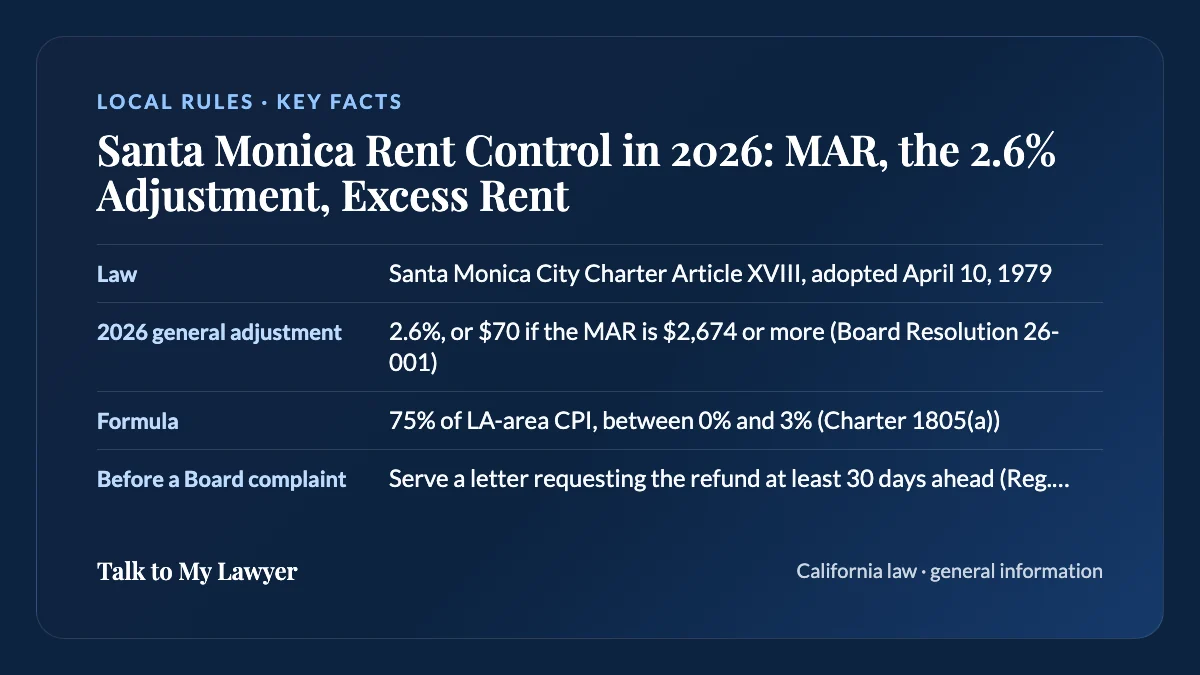
At a glance
- Law
- Santa Monica City Charter Article XVIII, adopted April 10, 1979
- 2026 general adjustment
- 2.6%, or $70 if the MAR is $2,674 or more (Board Resolution 26-001)
- Formula
- 75% of LA-area CPI, between 0% and 3% (Charter 1805(a))
- Before a Board complaint
- Serve a letter requesting the refund at least 30 days ahead (Reg. 8022)
- Court remedy
- Excess rent plus fees; treble civil penalty for willful conduct (Charter 1809(a))
- Contact
- Rent Control Board, (310) 458-8751, 1685 Main Street, Room 202
Which units does Santa Monica rent control cover?
The charter covers all residential rental units in Santa Monica, including mobile homes, unless an exemption applies (Charter section 1801(c)). The main exemptions are:
- Units built after the law was adopted on April 10, 1979, other than units created by converting existing space.
- Owner-occupied buildings with three or fewer units, where an owner with at least a 50 percent interest lives on the property.
- Single-family homes that were not rented on July 1, 1984, and homes later exempted after two years of owner occupancy (section 1815).
- Hotel rooms rented to transient guests for under 14 days, and certain institutional and government housing.
Exemptions are not automatic. The owner must apply and the Board must grant them. The Rent Control office at (310) 458-8751 can tell you the status and the current MAR for your unit.
How do the maximum allowable rent and general adjustment work?
Your maximum allowable rent (MAR) is the most the landlord can charge for the unit. Under state law, an owner may generally set the starting rent for a new tenancy (Civil Code section 1954.53), and from then on the MAR rises only through the Board's annual general adjustment or an approved petition.
The general adjustment equals 75 percent of the rise in the Los Angeles area Consumer Price Index for the 12 months ending in March, and can be no less than 0 percent and no more than 3 percent. The Board may also impose a dollar cap (Charter section 1805(a) and (b)).
For 2026, the Board's form notice sets the adjustment at 2.6 percent, or a flat $70 if the old MAR is $2,674 or more. The increase takes effect 30 days after the owner serves the notice, and not before September 1, 2026. Conditions apply:
- It does not apply to a tenancy that started on or after September 1, 2025.
- The owner must certify that 2026-27 registration fees and any past fees and penalties are paid.
- The unit and common areas must have no uncorrected housing, health or safety citations.
- On top of the MAR, the owner may pass through $10 a month of the registration fee, and, for tenancies that began before March 1, 2018 on property not reassessed since then, certain property tax surcharges capped at $35 or 4 percent of the MAR, whichever is less.
Example: applying the 2026 adjustment
Example (hypothetical): two tenants in the same Ocean Park building each receive a 2026 notice.
| Unit 1 | Unit 4 | |
|---|---|---|
| 2025-26 MAR | $2,100 | $3,000 |
| 2.6% of MAR | $54.60 | $78.00 |
| Adjustment allowed | $54.60 (under the $2,674 line) | $70 (cap applies) |
| New 2026-27 MAR, rounded | $2,155 | $3,070 |
| Plus registration pass-through | $10 | $10 |
If Unit 4's landlord charged $3,078 by applying the full percentage, the extra $8 a month would be excess rent. Small amounts add up: the Board can dismiss a complaint seeking less than $100, but it can be refiled once the total grows.
How can you recover excess rent in Santa Monica?
The charter gives tenants a choice between court and an administrative complaint with the Board (section 1809):
| Civil lawsuit | Board complaint | |
|---|---|---|
| What you can recover | The excess rent, plus attorney fees and costs | The excess rent, plus up to $500 for costs, damages and penalties |
| Extra penalty | Treble the excess if the landlord acted willfully or with oppression, fraud or malice | No treble amount |
| Look-back | Set by the court's limitation rules | Generally excess received in the three years before filing (Reg. 8023) |
| How it is paid | Judgment | The Board can let you deduct the award from future rent |
Once a Board hearing starts taking evidence, you generally cannot also sue for damages over the same period (Regulation 8021). A tenant cannot use a Board complaint for excess rent that is the subject of a civil lawsuit (Regulation 8023). For a statewide view of overcharge letters, see our rent overcharge demand letter guide.
The 30-day letter you must send before a Board complaint
Board Regulation 8022 requires you to serve the landlord a letter asking for reimbursement at least 30 days before filing a complaint. The letter must state the period and the amount of excess rent. If the landlord repays that amount, you cannot file a complaint for it.
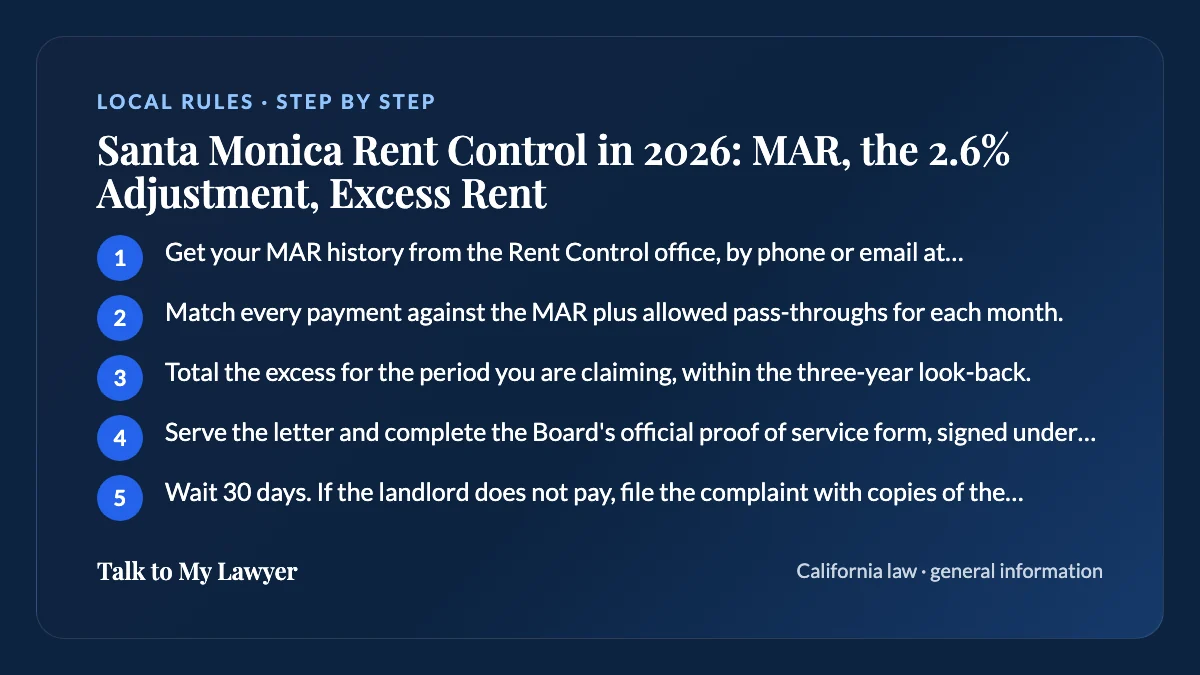
- Get your MAR history from the Rent Control office, by phone or email at rentcontrol@santamonica.gov.
- Match every payment against the MAR plus allowed pass-throughs for each month.
- Total the excess for the period you are claiming, within the three-year look-back.
- Serve the letter and complete the Board's official proof of service form, signed under penalty of perjury.
- Wait 30 days. If the landlord does not pay, file the complaint with copies of the letter, proof of service, leases, rent notices and receipts.
- Check the file is complete. A complaint missing required information or attachments can be dismissed (Regulation 8022), and the Rent Control office at (310) 458-8751 answers questions.
I rent Unit 4 at 2900 Third Street. The Rent Control Board lists the 2026-27 MAR for my unit as $3,070. Since October 1, 2026, you have charged $3,078 plus the $10 registration pass-through. Under Santa Monica Rent Control Regulation 8022, I request reimbursement of excess rent of $8 per month for October 1, 2026 through the date of this letter, and a corrected rent going forward.
What happens if the landlord never registered the unit?
A landlord who has not properly registered a controlled unit may not raise the rent at all until it does (Charter section 1803(q)). If the Board finds after a hearing that the failure was willful, it can authorize the tenant to withhold some or all of the rent until the unit is registered. Tenants can file a non-registration complaint with the Board, separate from an excess rent claim.
Evictions, owner move-ins and relocation fees
A landlord may evict from a controlled unit only for a reason listed in Charter section 1806, such as unpaid rent, an uncured lease violation, an owner or close relative move-in, or withdrawal under the Ellis Act. An owner move-in requires a natural person with at least 50 percent ownership, a good-faith move-in within 60 days, and two years of occupancy. It is barred against a tenant of five or more years who is 62 or older or disabled, or a tenant certified as terminally ill, unless the person moving in meets the same test.
The landlord must file a copy of any termination notice, other than a three-day notice to pay or quit, with the Board within three days. Attempting an eviction that violates the charter exposes the landlord to actual and punitive damages and attorney fees.
| Unit type | Permanent relocation fee (from July 1, 2026) | With a senior, disabled or minor household member |
|---|---|---|
| Single | $20,500 | $21,450 |
| One bedroom | $28,300 | $30,200 |
| Two or more bedrooms | $39,350 | $41,900 |
These fees under Municipal Code section 4.36.040 are updated each July 1. Statewide rules are covered in our relocation assistance guide. Two proposed charter amendments are on the November 3, 2026 ballot and are not law as of this writing. Measure RR would bar evictions for unpaid rent unless the amount owed exceeds a fair market rent threshold. Measure GG would affirm the city's just cause rules and change Board terms, the registration fee cap and petition timelines. Check the certified election result before relying on either.
When an attorney-written Santa Monica excess rent letter makes sense
A Santa Monica excess rent claim can involve years of MAR records, surcharges that may or may not be allowed for your tenancy, and a choice between the Board's capped remedy and a lawsuit with possible treble damages. An attorney-written letter can serve as the Regulation 8022 reimbursement request while setting out the month-by-month calculation and preserving your court options.
Through Talk to My Lawyer, a licensed California attorney writes your letter from your facts and documents (the Board's MAR history for your unit, your lease and your payment history) and sends it on your behalf. Before choosing between a Board complaint and court, talk to a lawyer about your facts.
Frequently asked questions
How much can rent go up in Santa Monica in 2026?
For rent-controlled units, the 2026 general adjustment is 2.6 percent of the maximum allowable rent, or $70 a month if the MAR is $2,674 or more. It takes effect 30 days after the landlord serves the notice, and not before September 1, 2026. It does not apply to tenancies that began on or after September 1, 2025.
Is my Santa Monica apartment rent controlled?
Probably, if the building was constructed before April 10, 1979 and no exemption has been granted. Common exemptions include owner-occupied buildings with three or fewer units, many single-family homes and newer construction. Exemptions must be approved by the Rent Control Board, and the Rent Control office can confirm your unit's status and MAR.
Do I have to write to my landlord before filing an excess rent complaint?
Yes. Rent Control Board Regulation 8022 requires a letter requesting reimbursement, stating the period and amount, served at least 30 days before you file. You must attach a copy of the letter and the Board's proof of service form to the complaint. If the landlord pays the amount requested, you cannot file a complaint for it.
Can I get triple damages for excess rent in Santa Monica?
In a lawsuit, yes, if the landlord acted willfully or with oppression, fraud or malice. Charter section 1809(a) then requires a civil penalty of three times the excess, on top of the excess and attorney fees. The Board's administrative process is limited to the excess plus up to $500, and once a hearing starts it generally replaces a lawsuit for that period.
How much is the Santa Monica relocation fee in 2026?
From July 1, 2026, the permanent relocation fee under Municipal Code section 4.36.040 is $20,500 for a single, $28,300 for a one-bedroom and $39,350 for two or more bedrooms. Households with a senior, disabled person or minor receive $21,450, $30,200 or $41,900. The amounts are updated each July 1 based on inflation.
Sources
Checked against these official sources on October 18, 2026.
- Notice of Change in Terms of Tenancy 2026 (Santa Monica Rent Control Board)
- Rent Control Charter Amendment (Article XVIII) and Regulations (City of Santa Monica)
- Chapter 8: Administrative Remedies for Rent Overcharges (effective December 6, 2024) (Santa Monica Rent Control Board)
- Santa Monica Housing Office: Tenant Relocation Fee (City of Santa Monica)
- Measure RR, General Election November 3, 2026 (City of Santa Monica)
- California Civil Code section 1954.53 (California Legislative Information)
This guide explains California law in general terms as of October 2026. It is general information, not legal advice for your situation, and local rules can add to it.
Join the email list and get a lawyer letter started
With Talk to My Lawyer, a licensed California attorney writes your letter from your facts and documents and sends it on your behalf. Join the Talk to My Lawyer email list for letter checklists, document prompts, and reminders before you start your letter.