Quick answer
LA County rent control applies only in unincorporated areas, through the Rent Stabilization and Tenant Protections Ordinance (County Code Chapter 8.52). For fully covered units, generally multi-unit buildings approved for occupancy on or before February 1, 1995, the maximum increase for the July 2026 to June 2027 rent year is 1.919 percent, or 2.919 percent for qualifying small landlords and 3.919 percent for luxury units.
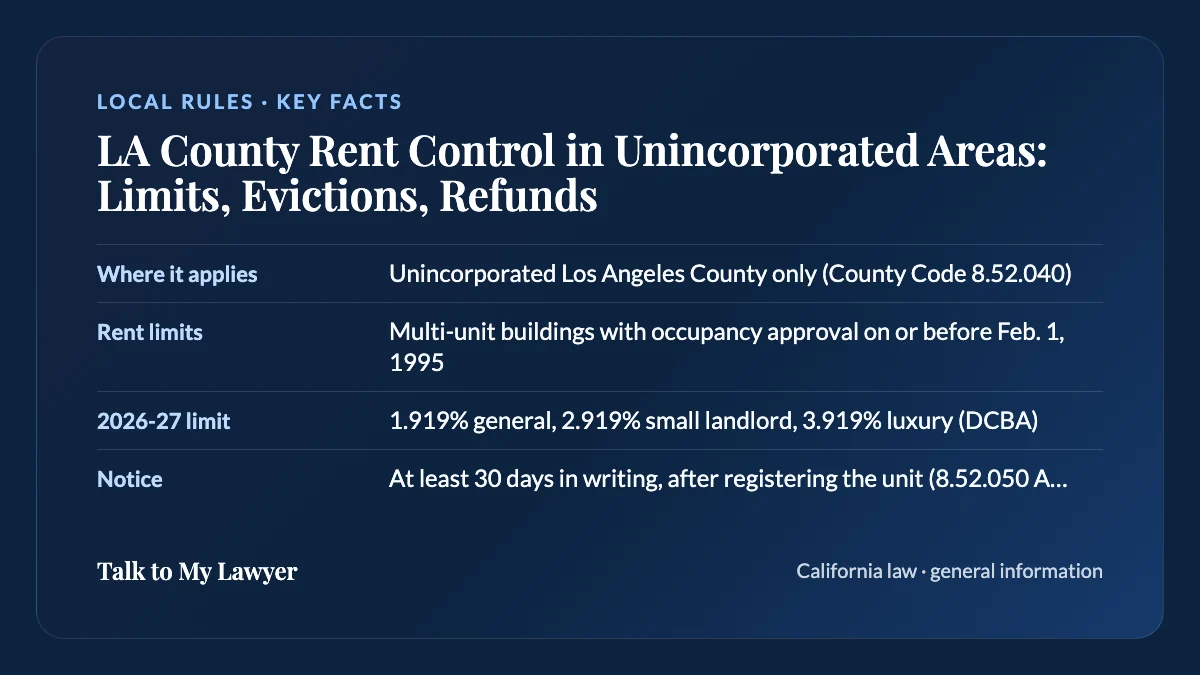
At a glance
- Where it applies
- Unincorporated Los Angeles County only (County Code 8.52.040)
- Rent limits
- Multi-unit buildings with occupancy approval on or before Feb. 1, 1995
- 2026-27 limit
- 1.919% general, 2.919% small landlord, 3.919% luxury (DCBA)
- Notice
- At least 30 days in writing, after registering the unit (8.52.050 A, B)
- Nonpayment eviction
- Only if rent owed exceeds two months of HUD fair market rent (8.52.090 D)
- Agency
- DCBA Rent Stabilization Program, 800-593-8222
Does LA County rent control apply where you live?
Only if your home is in an unincorporated part of Los Angeles County, meaning land outside any city's limits, such as East Los Angeles, Altadena or Marina del Rey. A mailing address that says Los Angeles does not settle it. The Department of Consumer and Business Affairs (DCBA) suggests the Registrar-Recorder's district map lookup, and its Rent Registry lets you search an address or parcel number to check coverage.
Tenants inside a city follow that city's rules instead. The City of Los Angeles has its own Rent Stabilization Ordinance, and Santa Monica runs a separate charter-based system. Cities without rent control generally fall under the statewide cap explained in our rent increase notice guide.
Fully covered or partially covered: what is the difference?
The ordinance sorts rentals into two groups (County Code section 8.52.030):
| Fully covered | Partially covered | |
|---|---|---|
| Which units | Buildings with two or more units whose occupancy approval was issued on or before February 1, 1995, plus mobilehomes rented out by their owner | Units approved after February 1, 1995, and units that can be sold separately, such as single-family homes and condominiums |
| Rent limit | Yes | No county limit |
| Just cause for eviction | Yes | Yes |
| Relocation for no-fault evictions | Yes | Yes |
Some housing is fully exempt, including owner-occupied homes where the landlord or a family member lives, transient hotel rooms, institutional housing and government-owned units (section 8.52.040). Mobilehome spaces are covered by a separate ordinance, Chapter 8.57, which allows 3 percent for the year ending June 30, 2027.
How much can rent go up under the county ordinance?
Since January 1, 2025, the annual limit for fully covered units is 60 percent of the change in the regional Consumer Price Index, capped at 3 percent (section 8.52.050 D). DCBA calculates and publishes the figure:
| Period | General | Small property landlord | Luxury unit |
|---|---|---|---|
| July 2025 to June 2026 | 1.930% | 2.930% | 3.930% |
| July 2026 to June 2027 | 1.919% | 2.919% | 3.919% |
A small property landlord has the homeowners' property tax exemption on the property, or owns one rental property with no more than 10 units, or up to three properties totaling no more than 10 units (counting property outside the county). Real estate investment trusts and corporations do not qualify. That landlord must file a self-certification with DCBA every year and say so in the rent increase notice. A luxury unit has two bedrooms or fewer, sits in a building of 25 or more units, and rented for at least $4,000 a month as of September 11, 2018, which the notice must also state.
The landlord must register the unit and pay the registry fee before any increase, give at least 30 days' written notice, and raise rent only once in 12 months. An increase skipped this year is waived, not banked. Once a tenant moves out voluntarily or is evicted for an at-fault reason, the next tenancy can start at any rent (section 8.52.050 I).
What if you already paid an illegal increase?
The landlord must reimburse the overpayment, either in one lump sum by the time the next rent is due or as a credit spread over six months, starting with the next rent payment (section 8.52.050 H). A tenant may also refuse to pay an increase that violates the ordinance (section 8.52.050 K).
Example (hypothetical): a tenant in a 1970s triplex in unincorporated Lennox paid $2,000 a month. In August 2026 the landlord, who is not a small property landlord, raised the rent 5 percent to $2,100. The lawful rent was $2,038.38 (a 1.919 percent increase), so the tenant overpaid $61.62 a month. After four months, the refund owed is $246.48, and the rent going forward should drop to $2,038.38.
Tenants can also file an Application for Adjustment with DCBA to seek a rent decrease for improper increases, reduced services or habitability problems, online through the Rent Registry, by email to RSUEnforcement@dcba.lacounty.gov, by mail, or in person at 320 West Temple Street, Room G-10.
Just cause and the two-month nonpayment threshold
Both fully and partially covered tenants can be evicted only for an at-fault or no-fault reason listed in section 8.52.090. At-fault reasons include unpaid rent above the threshold, a material lease violation, nuisance or illegal use, and refusing to sign a substantially similar lease. No-fault reasons include an owner or family move-in, withdrawal from the rental market and government or court orders.
For nonpayment, the unpaid rent must be more than two months of HUD fair market rent for the unit's bedroom count. DCBA says this two-month threshold took effect April 16, 2026, replacing a one-month threshold. The notice must state the fair market rent figure and the number of bedrooms. DCBA lists revised FY 2026 fair market rents effective May 21, 2026, for example $2,328 for a one-bedroom and $2,903 for a two-bedroom. The landlord must also send DCBA a copy of any termination notice, with proof of service, within five days of serving it.
Relocation assistance in unincorporated areas
A no-fault eviction requires permanent relocation assistance, served at the same time as the termination notice (section 8.52.110). The county sets the amounts by unit size, starting from three times the countywide median rent and adding moving, utility, storage and application costs. Households that include someone 62 or older, disabled or terminally ill, children under 18, or a lower-income tenant receive a higher amount. DCBA sets and updates the dollar amounts, so ask its Rent Stabilization Program for the schedule in effect when the notice is served.
The landlord must also hire a relocation specialist at its own expense. Tenants displaced temporarily for repairs receive a per-diem payment for stays of 30 days or less, and either a per-diem or comparable housing for displacements of 31 days or more. The right to relocation money cannot be waived.
Steps to enforce the county rent ordinance
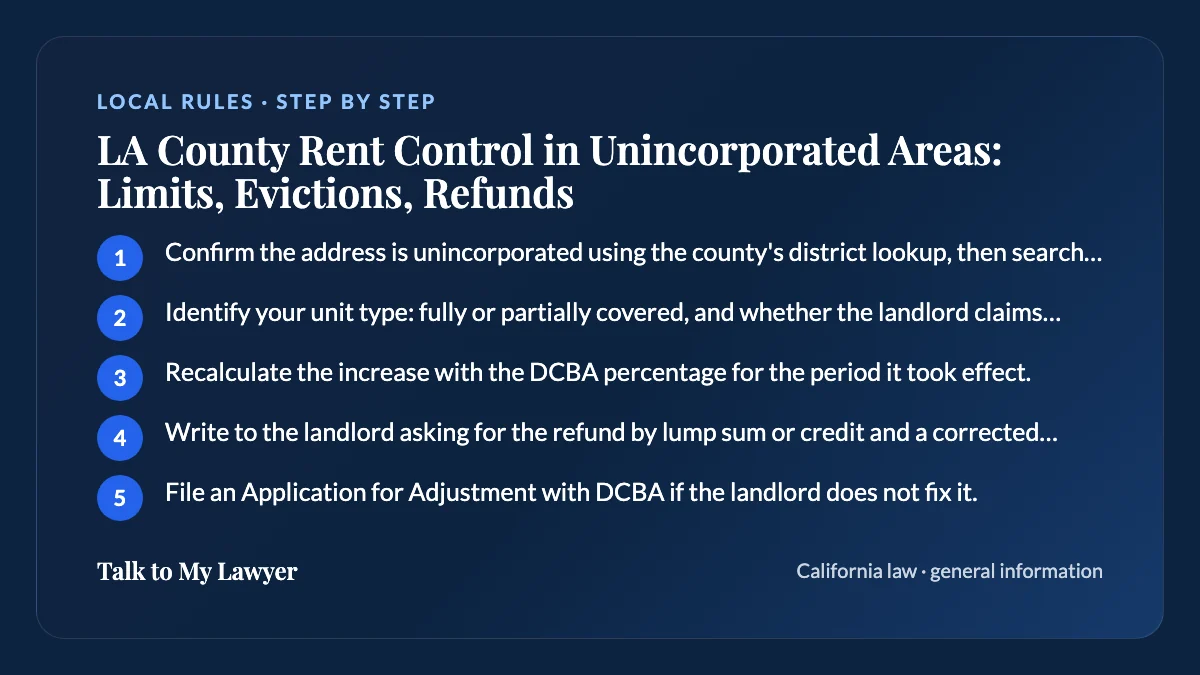
- Confirm the address is unincorporated using the county's district lookup, then search the Rent Registry for coverage and registration.
- Identify your unit type: fully or partially covered, and whether the landlord claims small property or luxury status in the notice.
- Recalculate the increase with the DCBA percentage for the period it took effect.
- Write to the landlord asking for the refund by lump sum or credit and a corrected rent, with a response date.
- File an Application for Adjustment with DCBA if the landlord does not fix it.
- Consider court. Section 8.52.170 allows a civil action for restitution, civil penalties of up to $1,000 per violation and attorney fees.
My unit at 1182 West 104th Street, Unit B, is a fully covered rental unit under Los Angeles County Code Chapter 8.52. Your August 1, 2026 notice raised my rent by 5 percent and did not state that you are a small property landlord. DCBA's maximum for increases taking effect in the 2026-27 year is 1.919 percent. Under section 8.52.050 H, please refund $246.48 and confirm my rent is $2,038.38 by December 15, 2026.
When an attorney-written letter about a county rent overcharge makes sense
A county overcharge dispute can hinge on a label: whether the landlord truly qualifies as a small property landlord, whether the unit is a luxury unit, or whether the building is fully or only partially covered. An attorney-written letter can ask the landlord to back up the label with its DCBA self-certification and registry record, and calculate the refund under each scenario.
Through Talk to My Lawyer, a licensed California attorney writes your letter from your facts and documents, including the rent notices, payment history and Rent Registry record, cites Chapter 8.52, and sends it on your behalf. If you have received an eviction notice, talk to a lawyer about your facts as soon as you can.
Frequently asked questions
What is the LA County rent increase limit for 2026?
For fully covered units in unincorporated Los Angeles County, DCBA set the maximum at 1.919 percent for the year that runs through June 30, 2027. Qualifying small property landlords may add 1 percent, for 2.919 percent, and luxury units may add 2 percent, for 3.919 percent. The landlord must give at least 30 days' written notice and may raise rent only once in 12 months.
Does LA County rent control cover single-family homes?
Not for rent limits. Single-family homes, condominiums and units approved after February 1, 1995 are partially covered, which means they get the county's just cause eviction and relocation protections but no county cap on increases. State law may still limit their rent increases, depending on the owner and the property.
How do I know if I live in unincorporated LA County?
Your city name on a mailing address is not reliable. DCBA recommends the Los Angeles County Registrar-Recorder's district map lookup by address. You can also search the county Rent Registry by address or parcel number to see whether your property is covered by the Rent Stabilization and Tenant Protections Ordinance.
Can my landlord evict me for being behind on rent in unincorporated LA County?
Only if the unpaid rent is more than two months of HUD fair market rent for a rental with your number of bedrooms. The notice must state that figure and the number of bedrooms. The rent is still owed even below the threshold, and DCBA offers mediation to help tenants and landlords agree on a repayment plan.
Where do I file an LA County rent complaint?
With DCBA's Rent Stabilization Program. You can submit an Application for Adjustment online through the Rent Registry, by email to RSUEnforcement@dcba.lacounty.gov, by mail, or in person at 320 West Temple Street, Room G-10, Los Angeles. The phone number is 800-593-8222. Retaliation claims must go to court rather than to DCBA.
Sources
Checked against these official sources on October 18, 2026.
- Rent Stabilization Program (Los Angeles County Department of Consumer and Business Affairs)
- Los Angeles County Code Chapter 8.52 Rent Stabilization and Tenant Protections (Los Angeles County (Municode))
- Relocation Assistance FAQs (Los Angeles County Department of Consumer and Business Affairs)
- California Civil Code section 1947.12 (California Legislative Information)
This guide explains California law in general terms as of October 2026. It is general information, not legal advice for your situation, and local rules can add to it.
Join the email list and get a lawyer letter started
With Talk to My Lawyer, a licensed California attorney writes your letter from your facts and documents and sends it on your behalf. Join the Talk to My Lawyer email list for letter checklists, document prompts, and reminders before you start your letter.