Quick answer
Section 8 discrimination is illegal in California. Since January 1, 2020, state fair housing law has treated housing subsidies such as Section 8 vouchers as protected source of income (Government Code section 12955). A landlord may not refuse a voucher holder, advertise 'no Section 8', or apply an income test to the full rent instead of the tenant's share. Civil Rights Department complaints are generally due within one year.
At a glance
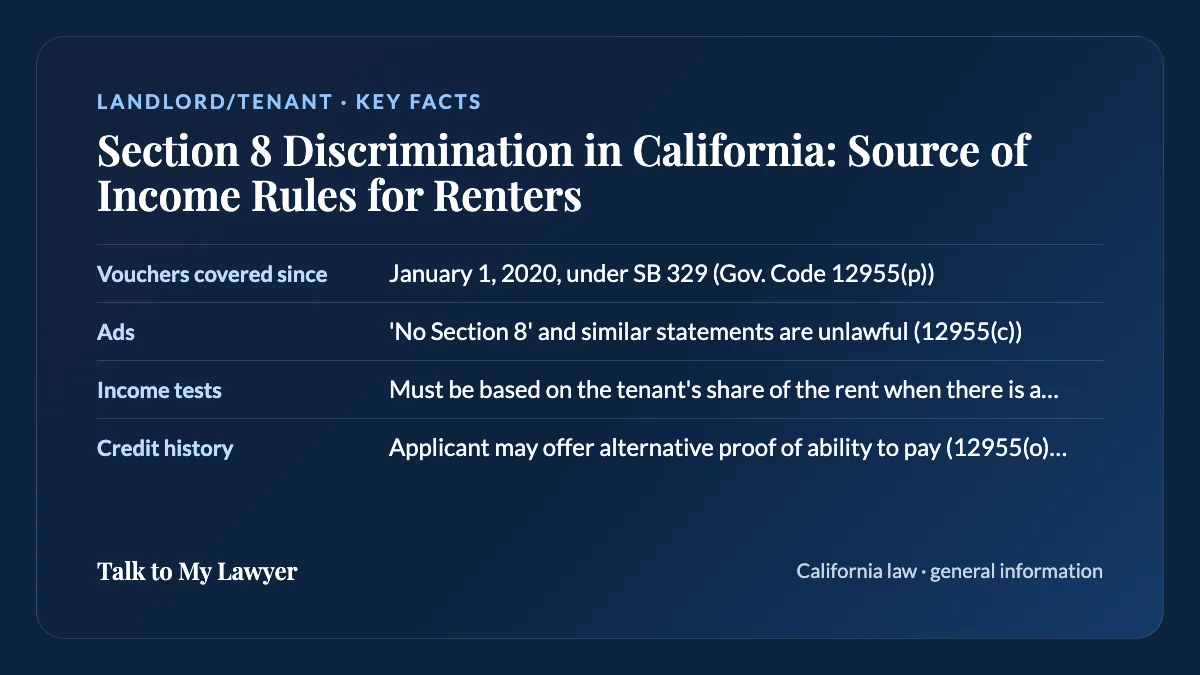
- Vouchers covered since
- January 1, 2020, under SB 329 (Gov. Code 12955(p))
- Ads
- 'No Section 8' and similar statements are unlawful (12955(c))
- Income tests
- Must be based on the tenant's share of the rent when there is a subsidy (12955(o))
- Credit history
- Applicant may offer alternative proof of ability to pay (12955(o), from January 1, 2024)
- CRD complaint
- Generally within one year; court within two years
Is it illegal to refuse Section 8 in California?
Yes. Government Code section 12955(a) makes it unlawful for a housing owner to discriminate against anyone because of source of income. SB 329 (Chapter 600, Statutes of 2019) expanded the definition so that, from January 1, 2020, it covers income paid to the landlord on the tenant's behalf.
As of October 2026, section 12955(p) defines source of income as lawful, verifiable income paid to a tenant, to a tenant's representative, or to the landlord for the tenant, including:
- Federal, state or local public assistance.
- Federal, state or local housing subsidies, including Section 8 Housing Choice Vouchers.
- HUD Veterans Affairs Supportive Housing (VASH) vouchers.
Several parts of section 12955 can apply to the same conduct: discriminating against a person (subdivision (a)), publishing a discriminatory notice or ad (subdivision (c)), and otherwise making a dwelling unavailable (subdivision (k)). The law also covers a perception that you receive a subsidy, or your association with someone who does.
What Section 8 discrimination looks like in practice
Outright refusal is the clearest case, but the California Civil Rights Department (CRD) lists quieter forms too:
- Refusing to comply with a housing subsidy program's requirements, such as refusing to fill out paperwork, provide needed documents, or allow inspections.
- Applying different terms to voucher holders, such as a higher security deposit or no access to the pool or other amenities.
- Advertising a preference or limitation, such as a listing that says 'No Section 8'.
- Screening, including through a tenant screening company, in a way that discriminates based on a protected characteristic.
Softer phrases such as 'not set up for programs' or 'owner does not do vouchers' can raise the same problem under section 12955(c), which bars any statement that indicates a preference or limitation based on source of income.
What screening can a landlord still use with a voucher holder?
Landlords can still screen. Section 12955 sets the boundaries:
| Landlord practice | Allowed? | Rule |
|---|---|---|
| Asking about the level or source of your income | Yes | 12955(p)(2) |
| Verifying employment, checking landlord references, confirming identity | Yes | 12955(o)(2) |
| Requiring income of a multiple of the full rent when a subsidy pays part | No | Income test must be based on the tenant's portion (12955(o)(1)(A)) |
| Rejecting for credit history without offering an alternative | No | Applicant may choose to provide other proof of ability to pay (12955(o)(1)(B)) |
| Counting income of people applying together differently from a married couple's | No | 12955(n) |
The credit-history rule came from SB 267 and took effect January 1, 2024. If there is a government rent subsidy, the landlord must let you offer lawful, verifiable alternative evidence of your ability to pay your share, such as government benefit payments, pay records or bank statements. The landlord must give you reasonable time to provide it and reasonably consider it instead of your credit history.
Example (hypothetical): a unit rents for $2,800 a month. The voucher covers $2,100 and the tenant's share is $700. A landlord who requires income of 2.5 times the rent must apply that to $700, which means $1,750 a month, not to $2,800, which would mean $7,000.
Does federal fair housing law protect voucher holders?
Not by name. The federal Fair Housing Act (42 U.S.C. section 3604) lists race, color, religion, sex, familial status, national origin and handicap (disability), but not source of income. That makes California's statute the main protection for voucher holders here.
According to CRD, a complaint filed with CRD that alleges facts violating the federal Fair Housing Act is automatically filed with HUD as well, and a complaint filed with HUD is automatically filed with CRD. If your situation also involves disability, our guide to requesting a reasonable accommodation from a landlord covers the federal and state rules that apply.
How long do you have to file a Section 8 discrimination complaint?
The general CRD deadline for a housing complaint is one year from the date of the discriminatory act. You may also go straight to court without filing with CRD first; the court deadline is two years, and time CRD spends processing a complaint does not count against it.
CRD lists these remedies available under state law:
- Recovery of out-of-pocket losses.
- An order stopping the unlawful practice.
- Access to the housing that was denied.
- Damages for emotional distress.
- Civil penalties or punitive damages.
- Attorney's fees.
One narrow exception: CRD notes that an owner who lives in the home and rents to one additional person may exclude applicants on protected characteristics, but still may not publish discriminatory ads or statements.
Steps to document source of income discrimination
Listings get edited and calls are not recorded, so capture what you can as it happens:
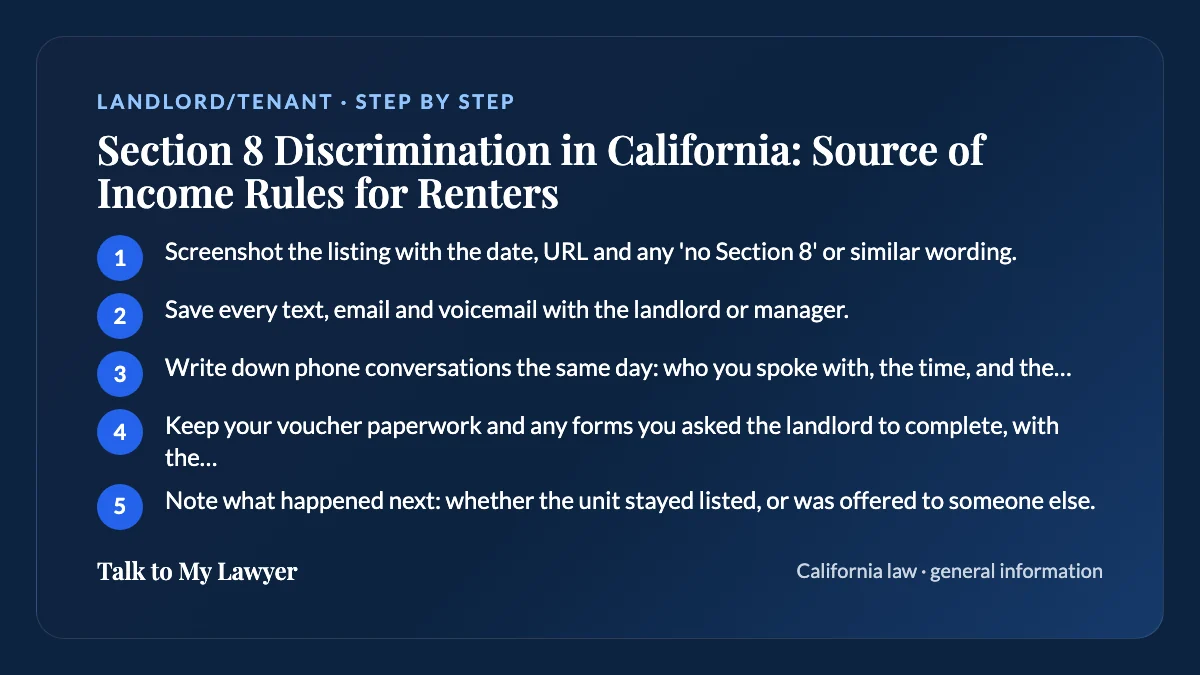
- Screenshot the listing with the date, URL and any 'no Section 8' or similar wording.
- Save every text, email and voicemail with the landlord or manager.
- Write down phone conversations the same day: who you spoke with, the time, and the exact words used about your voucher.
- Keep your voucher paperwork and any forms you asked the landlord to complete, with the dates you asked.
- Note what happened next: whether the unit stayed listed, or was offered to someone else.
- Ask in writing for the reason your application was denied, and keep the answer.
If the landlord turns hostile after you raise the issue, California also bars retaliation for opposing housing discrimination (Government Code section 12955(f)); our guide to retaliatory eviction in California explains how retaliation claims are built.
What a letter about Section 8 discrimination should say
A letter to the landlord or property manager can correct a policy before a complaint is needed. It should describe what happened, cite the statute, and ask for something specific: processing your application, completing the program paperwork, or removing the ad.
On June 9 I applied for 340 Harbor Avenue, Unit 2, and told your office that I hold a Housing Choice Voucher. On June 11 your leasing agent told me by phone that the owner does not accept vouchers. Under California Government Code section 12955, source of income, including Section 8 vouchers, is protected, and an income requirement must be based on my share of the rent. Please process my application on that basis and complete the housing authority's paperwork by June 25.
When an attorney's letter about voucher discrimination helps
If your housing authority gave you a set period to find a unit, the days spent waiting on one landlord come out of it. When a landlord or management company keeps a 'no programs' policy in place after you point out the law, or denies you under an income rule that ignores your subsidy, a letter that names the exact subdivisions of section 12955 puts the rule in front of the person who makes the decision.
Through Talk to My Lawyer, a licensed California attorney writes your letter from your listing screenshots, messages and voucher paperwork, and sends it on your behalf to the landlord or property manager. Whether to file with CRD, HUD or a court is a separate decision to make with a lawyer who knows your facts.
Frequently asked questions
Can a California landlord say 'No Section 8' in an ad?
No. Government Code section 12955(c) makes it unlawful to publish a notice, statement or advertisement about renting housing that indicates a preference, limitation or discrimination based on source of income, which includes Section 8 vouchers. CRD lists a 'No Section 8' ad as an example of source of income discrimination. Save a dated screenshot of any such listing.
Can a landlord require three times the rent from a voucher holder?
Not on the full rent. When a government subsidy pays part of the rent, section 12955(o) bars using an income standard that is not based on the portion of the rent the tenant pays. A landlord can apply its multiplier to your share. With a $600 tenant share and a three-times rule, that means $1,800 a month.
Can a landlord refuse because they do not want housing authority inspections?
CRD lists refusing to comply with the requirements of a housing subsidy program, such as refusing to fill out paperwork or allow inspections, as a form of source of income discrimination. A landlord who declines a voucher holder only because of program requirements may be violating state law. Ask for the reason in writing.
What is the deadline to file a housing discrimination complaint in California?
The Civil Rights Department sets a general one-year limit, counted from the discriminatory act, for housing complaints filed with it. You can also file directly in court within two years, and the time CRD spends on a complaint does not count toward that two years. Filing with CRD first is not required for housing cases, unlike employment cases, which CRD says must be filed with CRD first.
Can a landlord ask how I will pay the rent?
Yes. Section 12955(p)(2) says it is not discrimination to make a written or oral inquiry about the level or source of income. Landlords may also verify employment, check landlord references and confirm identity. What they may not do is refuse, limit or treat you differently because the income comes from a voucher or other public assistance.
Sources
Checked against these official sources on October 18, 2026.
- California Government Code section 12955 (California Legislative Information)
- SB 329 Discrimination: housing: source of income (Chapter 600, Statutes of 2019) (California Legislative Information)
- Housing (California Civil Rights Department)
- 42 U.S. Code section 3604 (Legal Information Institute, Cornell Law School)
This guide explains California law in general terms as of October 2026. It is general information, not legal advice for your situation, and local rules can add to it.
Join the email list and get a lawyer letter started
With Talk to My Lawyer, a licensed California attorney writes your letter from your facts and documents and sends it on your behalf. Join the Talk to My Lawyer email list for letter checklists, document prompts, and reminders before you start your letter.