Quick answer
An employer keeping tips in California breaks Labor Code section 351. Every gratuity is the sole property of the employees it was left for. The employer cannot take any part of it, deduct it from wages or count it toward the minimum wage. Card tips must be paid in full, with no processing fee, by the next regular payday. Owners, managers and supervisors cannot share in a tip pool.
At a glance
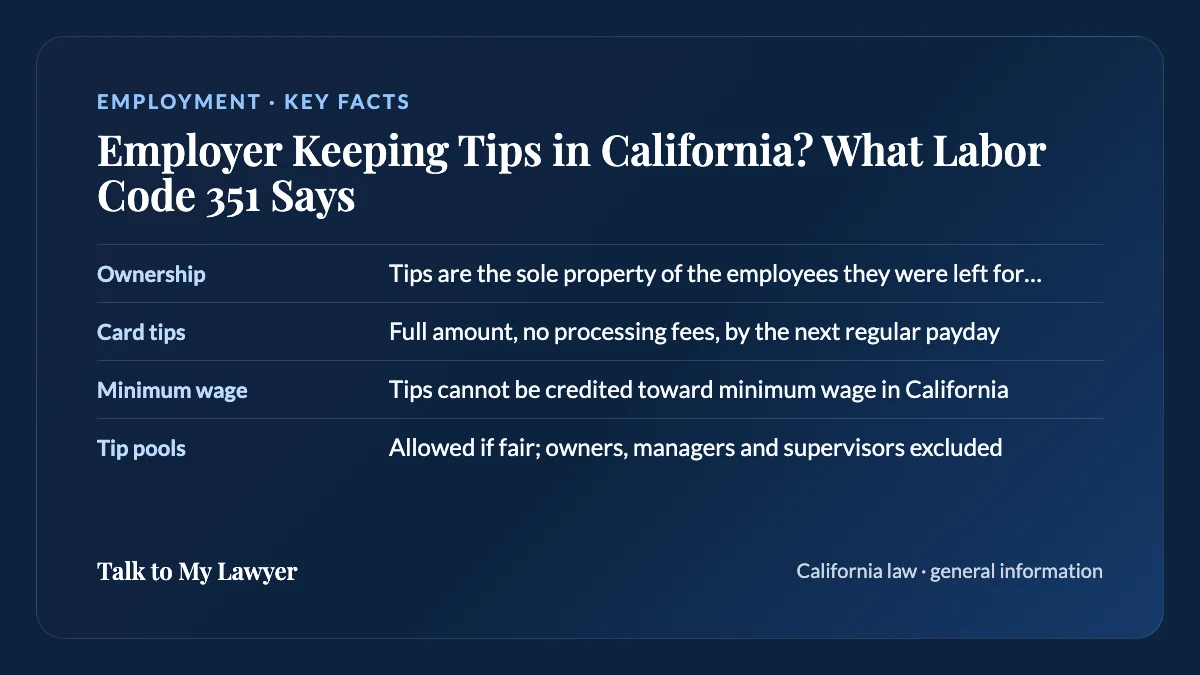
- Ownership
- Tips are the sole property of the employees they were left for (Labor Code 351)
- Card tips
- Full amount, no processing fees, by the next regular payday
- Minimum wage
- Tips cannot be credited toward minimum wage in California
- Tip pools
- Allowed if fair; owners, managers and supervisors excluded
- Enforcement
- Labor Commissioner may cite for withheld tips (351(b), since 2026)
Can an employer keep tips in California?
No. Labor Code section 351 says no employer or agent may collect, take or receive any part of a gratuity left for an employee. It also bars three workarounds: deducting money from wages because of tips, requiring tips to be credited against wages, and counting tips as part of the wages the employer owes.
The statute declares every gratuity the sole property of the employee or employees it was paid, given or left for. An agent includes anyone with authority to hire, fire or supervise employees (Labor Code section 350(d)), so a shift manager is covered too.
The Labor Commissioner adds that, unlike federal rules, California does not allow a tip credit. You must receive the full minimum wage plus your tips.
What are the rules for credit card tips?
When an employer lets customers tip by card, it must pay employees the full amount the customer wrote on the slip, with no deduction for card processing fees. Card tips are due no later than the next regular payday after the customer authorized the payment (section 351(a)).
Example (hypothetical): a customer leaves a $50 tip on a card that costs the restaurant a 3 percent fee. The server is owed $50, not $48.50. If the tip was authorized on a Tuesday and payday is Friday, it belongs in that Friday's pay.
Who can share in a tip pool?
California allows tip pools among employees, but the Labor Commissioner says the pool must be fair and reasonable and cannot be used to pay owners, managers or supervisors, even if they also serve customers. The Labor Commissioner notes that courts have approved pools that include employees in the chain of service, meaning workers whose jobs relate to the customer's overall experience.
| Pool arrangement | Likely status under the Labor Commissioner's guidance |
|---|---|
| Servers share a set percentage with bussers and bartenders | Generally permitted if the split is fair and reasonable |
| Owner who works the floor takes a share | Not permitted |
| Shift supervisor with authority over staff takes a share | Not permitted |
| Pool split is so lopsided it rewards staff who barely touched service | Can be unfair and unreasonable |
| Employer keeps undistributed pool money | Conflicts with section 351 |
Section 353 requires employers to keep accurate records of all gratuities received, open to state inspection. If you suspect a pool is being skimmed, those records are the first thing to ask about.
Is a service charge a tip?
Not automatically. Section 350(e) defines a gratuity as money left by a patron over and above the actual amount due the business. A mandatory charge on the bill is part of the amount due, so it is usually not a tip in that sense.
The Labor Commissioner says a service charge could still be a gratuity in some cases, depending on whether customers perceive and intend it as a tip, and points to a 2019 appellate decision holding that mandatory charges on food and beverages could qualify.
Example: adding up withheld tips
Example (hypothetical): a server tracks four Saturday shifts using the end-of-shift tip report and finds three problems affecting the staff who share the pool.
| Issue | Amount per shift | Four shifts |
|---|---|---|
| 3 percent card fee taken from the shift's $500 in card tips | $15 | $60 |
| Floor manager takes 10 percent of the staff's $640 pool | $64 | $256 |
| Card tips held until the month-end check | Timing violation | Paid late, not short |
| Total withheld from the staff | $79 | $316 |
Over 52 Saturdays, the same pattern would take $4,108 from the staff, split among everyone in the pool. Your own shift notes, kept alongside the employer's reports, let you check each line.
How to claim tips your employer kept
Start with records and a written request. The tip report the employer already generates can be the key document.
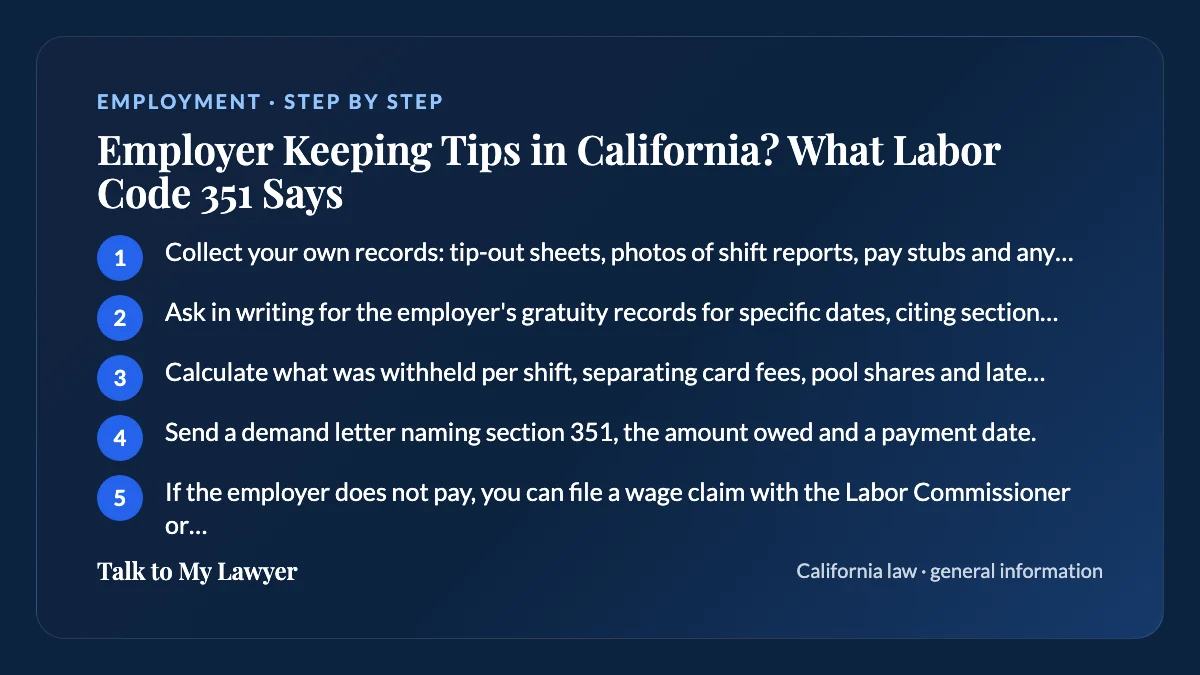
- Collect your own records: tip-out sheets, photos of shift reports, pay stubs and any written tip pool policy.
- Ask in writing for the employer's gratuity records for specific dates, citing section 353.
- Calculate what was withheld per shift, separating card fees, pool shares and late payments.
- Send a demand letter naming section 351, the amount owed and a payment date.
- If the employer does not pay, you can file a wage claim with the Labor Commissioner or talk to a lawyer about a court claim.
- Keep notes of any schedule cuts or discipline after you raise the issue.
From March 1 through May 31, a 3 percent processing fee was deducted from my credit card tips, and the floor manager received a share of the tip pool on each shift I worked. Labor Code section 351 requires card tips to be paid in full without processing fees and prohibits managers and agents from taking any part of a gratuity. Based on the shift reports, $1,112 was withheld. Please pay that amount by June 20 and provide the gratuity records for those dates required by Labor Code section 353.
Since January 1, 2026, section 351(b) lets the Labor Commissioner investigate, issue citations or file a civil action for gratuities taken or withheld (SB 648). The Labor Commissioner also accepts retaliation complaints from workers punished for raising pay problems. Our guides to unpaid wages and workplace retaliation cover both routes.
Should an attorney write your tip demand?
Tip disputes are counted in shifts and slips, and the employer holds most of the records. Having an attorney write the demand can help when several workers are affected, when a manager or owner is in the pool, when the employer disputes its own records, or when tips are tied up in a final paycheck after you left. Whether to file with the Labor Commissioner or in court is worth discussing with an employment lawyer.
With Talk to My Lawyer, a licensed California attorney writes your letter from your facts and documents (your shift reports, pay stubs and tip policy) and sends it on your behalf.
Frequently asked questions
Can my manager take part of the tip pool in California?
No. The Labor Commissioner says a tip pool cannot be used to compensate owners, managers or supervisors, even when they also serve customers. Section 351 bars any employer or agent from taking part of a gratuity, and an agent includes anyone with authority to hire, discharge, supervise or direct employees. A shift lead without that authority may be a different question.
Can my employer deduct credit card fees from my tips?
No. Labor Code section 351 requires an employer that accepts card tips to pay employees the full amount the customer indicated on the slip, without deducting any processing fee or cost the card company charges the employer. The tip must also be paid by the next regular payday after the customer authorized the charge.
Do tips count toward minimum wage in California?
No. The Labor Commissioner says California employers cannot use tips as a credit toward their minimum wage obligation, unlike the federal rule. You must receive at least the full minimum wage for every hour worked, plus all the tips customers leave for you.
Does a mandatory service charge have to go to the staff?
The tip statute does not automatically treat a mandatory charge as a tip, because a gratuity is money left over and above the amount due. The Labor Commissioner says a charge can still be a gratuity depending on whether customers understand it as one. Some cities have local rules on service charges, so check your city's ordinance as well.
What can I do if my employer keeps my tips?
You can ask in writing for payment and for the employer's gratuity records, file a wage claim with the Labor Commissioner, or bring a court claim with a lawyer's help. Since January 1, 2026, the Labor Commissioner can also issue citations for tips taken or withheld. Retaliation for complaining about pay can be reported to the Labor Commissioner as well.
Sources
Checked against these official sources on October 18, 2026.
- California Labor Code section 351 (California Legislative Information)
- California Labor Code section 350 (California Legislative Information)
- California Labor Code section 353 (California Legislative Information)
- Tips and gratuities FAQ (California Labor Commissioner's Office (DIR))
- California Civil Code section 1770 (California Legislative Information)
This guide explains California law in general terms as of October 2026. It is general information, not legal advice for your situation, and local rules can add to it.
Join the email list and get a lawyer letter started
With Talk to My Lawyer, a licensed California attorney writes your letter from your facts and documents and sends it on your behalf. Join the Talk to My Lawyer email list for letter checklists, document prompts, and reminders before you start your letter.