Quick answer
If your employer wants you to pay back training costs in California, the signing date matters. As of October 2026, the stay-or-pay ban in Business and Professions Code section 16608 covers only contracts entered on or after January 1, 2027, after AB 1697 delayed it. For earlier agreements, Labor Code rules still limit wage deductions and require employers to cover necessary job expenses.
At a glance
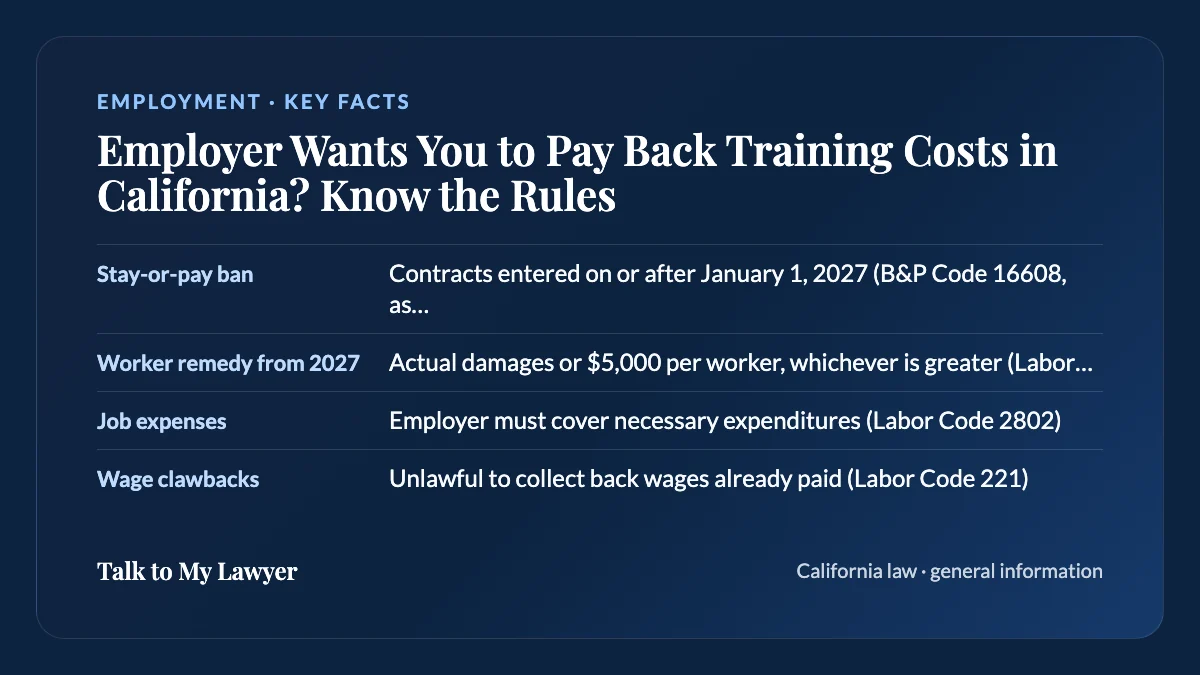
- Stay-or-pay ban
- Contracts entered on or after January 1, 2027 (B&P Code 16608, as amended by AB 1697)
- Worker remedy from 2027
- Actual damages or $5,000 per worker, whichever is greater (Labor Code 926)
- Job expenses
- Employer must cover necessary expenditures (Labor Code 2802)
- Wage clawbacks
- Unlawful to collect back wages already paid (Labor Code 221)
- Final paycheck
- Only one loan installment may be deducted, per the Labor Commissioner
Can an employer make you pay back training costs in California?
Sometimes, and the answer depends on three things: when you signed, what the training was, and how the employer is trying to collect. A stay-or-pay clause is a contract term that makes you pay a fee, or repay a cost, if you leave a job before a set date.
California passed a ban on most of these clauses in October 2025 (AB 692). In September 2026, an urgency bill, AB 1697, moved the start date back a year. As of October 2026, the ban covers only contracts entered into on or after January 1, 2027. Agreements signed before then are judged under the older rules described below.
What changed in 2025 and 2026
| Date | Event | Effect |
|---|---|---|
| October 13, 2025 | AB 692 (Stats. 2025, ch. 703) adds Business and Professions Code section 16608 and Labor Code section 926 | Ban on stay-or-pay terms set to apply to contracts from January 1, 2026 |
| January 1, 2026 | Original start date | Later made inoperative for all of 2026 |
| September 30, 2026 | AB 1697 takes effect as an urgency statute (Stats. 2026, ch. 889) | Ban moved to contracts entered on or after January 1, 2027; new exceptions added |
| January 1, 2027 | New start date | Covered terms in new contracts are void, and workers may sue |
AB 1697 also says liability does not accrue for acts between January 1, 2026 and its effective date, and that pending claims based on that period are moot. So a training agreement signed during 2026 is not voided by section 16608 under the current text, though the older rules below still apply to it.
What the stay-or-pay ban prohibits from 2027
For contracts entered into on or after January 1, 2027, section 16608(b) makes it unlawful to require a worker to sign a term that does any of the following when the job ends:
- Requires the worker to pay an employer, training provider or debt collector for a debt.
- Lets them start or resume collecting a debt, or end a payment pause.
- Imposes a penalty, fee or cost, such as a replacement hire fee, retraining fee, quit fee, liquidated damages or lost profit.
Exceptions include government loan-forgiveness and grant-funded retention programs, state-approved apprenticeships, certain bonus agreements, residential property contracts, and advance paid time off of up to 40 hours. Tuition for a transferable credential is also excepted if the contract is separate from the job offer, the credential is not a condition of employment, the amount is stated upfront and capped at the employer's cost, repayment is prorated, and you owe nothing if you are fired other than for misconduct.
A worker subjected to a prohibited term may sue for actual damages or $5,000 per worker, whichever is greater, plus attorney fees and an injunction (Labor Code section 926(c)).
Which rules protect you right now?
Several long-standing Labor Code sections still limit training repayment demands, whatever the contract date. Section 16608(d) also says the new rules do not limit an employer's obligations under section 2802.
- Labor Code section 2802: the employer must indemnify you for necessary expenditures or losses incurred in direct consequence of your job duties or the employer's directions. Section 2804 makes any agreement to waive that right void. Training the employer required you to take for your current job raises a question under these sections.
- Labor Code section 221: an employer may not collect or receive from an employee any part of wages already paid.
- Labor Code section 224: deductions from wages are limited to those required by law or expressly authorized in writing for specific purposes, such as insurance premiums.
- Final paycheck limits: the Labor Commissioner says that when a loan is repaid in authorized installments, only one installment can be taken from the final paycheck, and a lump-sum balloon deduction is not allowed even with written consent.
Final wages are due immediately on discharge, or within 72 hours if you quit without notice (Labor Code sections 201 and 202). Our guide to the final paycheck demand explains the penalty if training money is taken out of that check.
Questions to ask about your training agreement
- When did you sign it? Before or after January 1, 2027?
- Was the training required for the job you already had, or optional schooling you chose?
- Is the credential a degree from an outside accredited school that you could use elsewhere, or in-house onboarding?
- Was the repayment term inside the offer letter or a separate document?
- Does the amount shrink for each month you stayed, or is it all-or-nothing?
- Did the employer take money from your paycheck, or is it sending you a bill?
- Is a collection agency now involved? Our guide to responding to a collection letter covers debt-collection rules.
Example: a $4,800 training bill
Example (hypothetical): a medical assistant signed a training agreement in March 2025 for a $4,800 in-house certification the clinic required for her role. The agreement says the full amount is owed if she leaves within 24 months. She resigns after 16 months, and the clinic deducts $1,200 from her final paycheck and bills her for $3,600.
The 2027 ban does not reach a 2025 contract. But the clinic's deduction raises questions under sections 221 and 224 and the Labor Commissioner's final paycheck guidance, and a required in-house training cost raises a section 2802 question. Her letter would ask the clinic to return the $1,200, explain the legal basis for the $3,600, and stop collection while the issue is reviewed.
How to respond to a training repayment demand
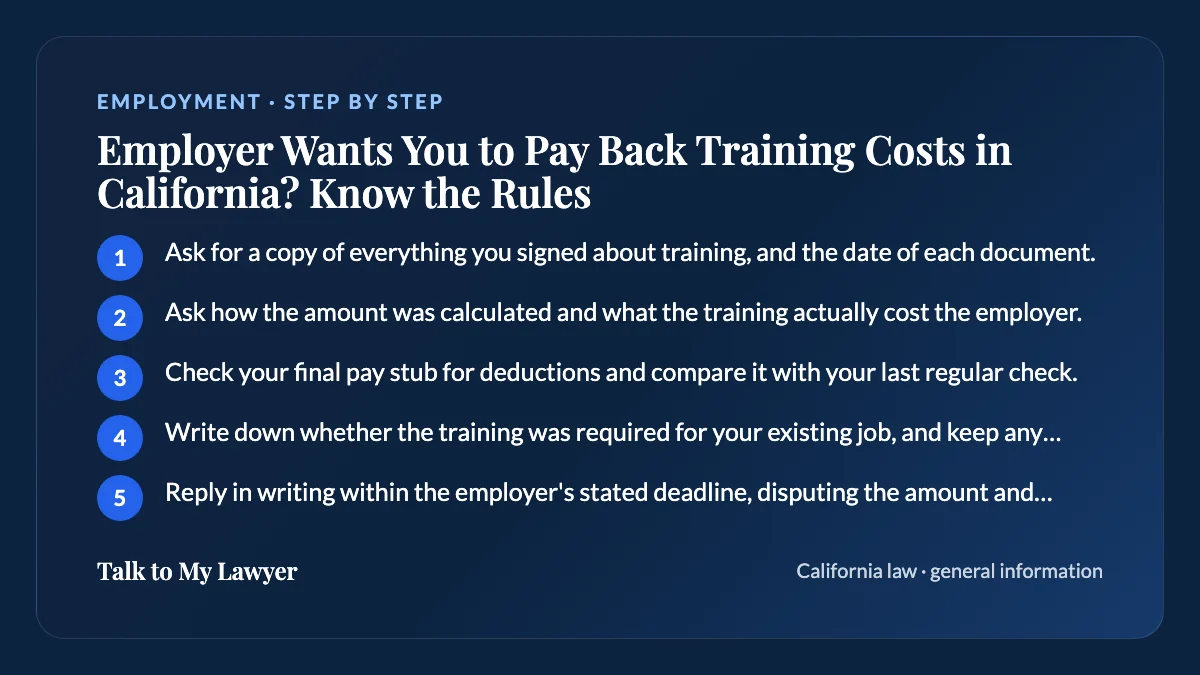
- Ask for a copy of everything you signed about training, and the date of each document.
- Ask how the amount was calculated and what the training actually cost the employer.
- Check your final pay stub for deductions and compare it with your last regular check.
- Write down whether the training was required for your existing job, and keep any emails saying so.
- Reply in writing within the employer's stated deadline, disputing the amount and asking for the legal basis.
- Do not sign a new payment plan or promissory note until you understand what it adds.
I received your letter dated October 2 requesting $4,800 for the certification course. The course was required for my existing position, and Labor Code section 2802 requires an employer to cover necessary expenditures incurred in carrying out job duties. In addition, $1,200 was deducted from my final paycheck without a written authorization permitting that deduction, which Labor Code sections 221 and 224 do not allow. Please return the $1,200 by October 30 and withdraw the remaining demand.
For more on answering a demand you think is wrong, see how to respond to a demand letter.
When an attorney should write your response
A training bill sits where contract terms, wage rules and a law with a newly moved start date overlap, so the right answer depends on the signing date and the documents. Having an attorney write your response can help when the amount is large, when money was taken from your final pay, when the employer threatens to sue or send the bill to collections, or when coworkers received the same demand. Before agreeing to any payment plan, you may want a lawyer's view on whether the agreement holds up.
With Talk to My Lawyer, a licensed California attorney writes your letter from your facts and documents (your agreement, pay stubs and the employer's demand) and sends it on your behalf.
Frequently asked questions
Is the California stay-or-pay ban in effect in 2026?
Not for new contracts during 2026. AB 692 originally applied the ban to contracts entered on or after January 1, 2026. AB 1697, effective September 30, 2026, changed that to January 1, 2027, made the 2026 version inoperative, and said pending claims based on acts during 2026 are moot. Other Labor Code protections continue to apply.
Can my employer take training costs out of my final paycheck?
Labor Code section 221 bars employers from collecting back wages already paid, and section 224 limits deductions to those required by law or authorized in writing for specific purposes. The Labor Commissioner says that when a loan is repaid in authorized installments, only one installment may be taken from a final paycheck. A full lump-sum deduction raises serious problems under these rules.
What training repayment terms are still allowed after 2027?
Section 16608 lists exceptions, including government loan-forgiveness programs, approved apprenticeships, and tuition for a transferable credential, meaning an accredited outside degree not required for your job. The tuition agreement must be separate from the job contract, state the amount upfront, prorate repayment and require nothing if you are fired other than for misconduct. Some bonus agreements also qualify.
Does Labor Code 2802 cover training costs?
Section 2802 requires employers to indemnify employees for necessary expenditures or losses incurred in direct consequence of their duties or the employer's directions, and section 2804 voids agreements to waive that right. Whether a specific training cost is a necessary job expense depends on facts, such as whether the employer required it for your current role. An attorney can assess your agreement.
Sources
Checked against these official sources on October 18, 2026.
- California Business and Professions Code section 16608 (California Legislative Information)
- AB 1697 Employment contracts: stay-or-pay provisions: contract date (Stats. 2026, ch. 889) (California Legislative Information)
- California Labor Code section 926 (California Legislative Information)
- California Labor Code section 2802 (California Legislative Information)
- California Labor Code section 221 (California Legislative Information)
- Deductions From Wages FAQ (California Labor Commissioner's Office (DIR))
This guide explains California law in general terms as of October 2026. It is general information, not legal advice for your situation, and local rules can add to it.
Join the email list and get a lawyer letter started
With Talk to My Lawyer, a licensed California attorney writes your letter from your facts and documents and sends it on your behalf. Join the Talk to My Lawyer email list for letter checklists, document prompts, and reminders before you start your letter.