Quick answer
An unpaid bonus in California can be recovered as wages when it was promised for meeting set conditions, such as hours, production, sales targets or staying employed, and you met them. The Labor Code defines wages to include pay set by any method of calculation (section 200). A truly discretionary gift, not tied to measurable criteria, is not owed. Earned bonuses are due with final pay when you leave.
At a glance
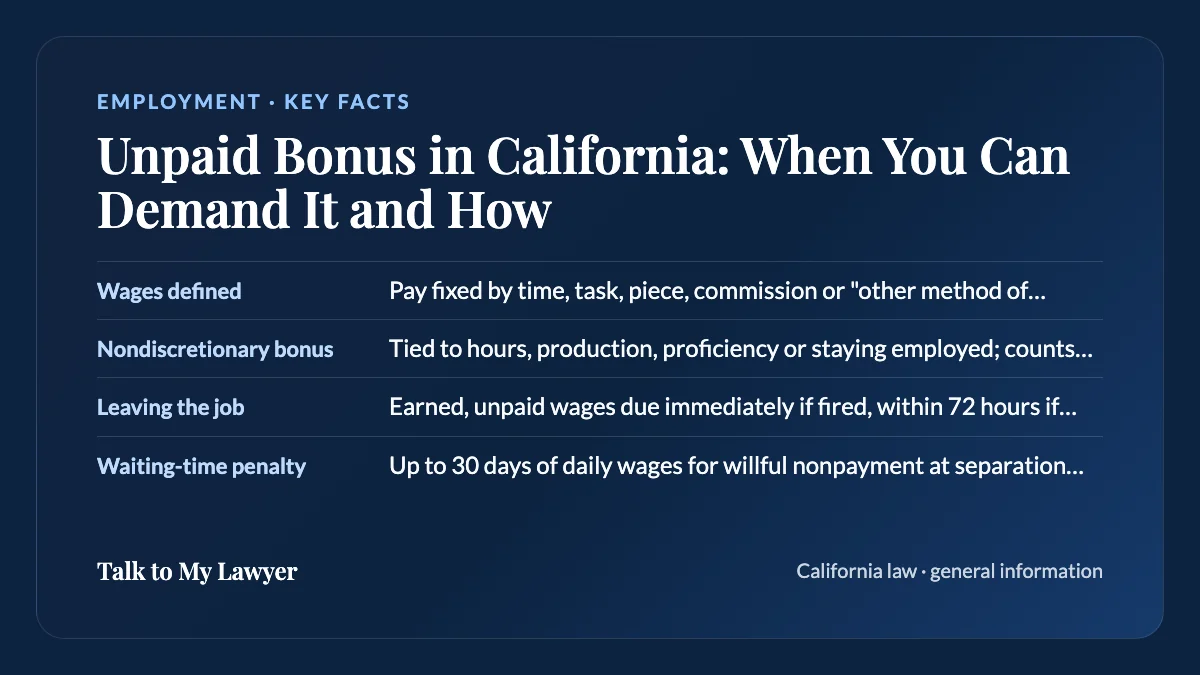
- Wages defined
- Pay fixed by time, task, piece, commission or "other method of calculation" (Labor Code 200)
- Nondiscretionary bonus
- Tied to hours, production, proficiency or staying employed; counts toward overtime
- Leaving the job
- Earned, unpaid wages due immediately if fired, within 72 hours if you quit without notice (201, 202)
- Waiting-time penalty
- Up to 30 days of daily wages for willful nonpayment at separation (203)
- Claim deadlines
- 2 years for an oral promise, 4 years for a written contract (Labor Commissioner)
Is an unpaid bonus considered wages in California?
It can be. Labor Code section 200 defines wages as all amounts for labor performed, whether fixed by time, task, piece, commission "or other method of calculation." A bonus promised in exchange for work or results fits that broad language once you have done what the promise required.
The Labor Commissioner draws the working line between two kinds of bonus in its overtime guidance. A nondiscretionary bonus is compensation for hours worked, production or proficiency, or an incentive to stay with the employer. A discretionary bonus is a gift for a holiday or special occasion, or a reward for good service, that is not measured by hours, production or efficiency.
Commissions follow a separate set of rules, including the written contract requirement in Labor Code section 2751. If your pay is a percentage of sales, our unpaid commission guide is the better fit.
Discretionary or earned? Questions that sort a bonus
The label in the handbook is a starting point, not the answer. Ask these questions about your bonus:
| Question | Points toward an earned bonus | Points toward a discretionary bonus |
|---|---|---|
| Was it announced in advance? | Yes, in an offer letter, plan or email before the work | No, it arrived as a surprise |
| Is there a formula or target? | A set amount or percentage for hitting a number | No criteria, or only general goodwill |
| Is it tied to hours, output or staying? | Attendance, production, quota, retention date | Holiday or special-occasion gift |
| Who decides the amount? | The plan does, once conditions are met | Management decides whether and how much, after the fact |
| Has it been paid the same way before? | Regularly, on the same criteria | Irregularly, with no stated basis |
Some plans mix features: a formula plus a clause reserving the right to change or cancel. How a reservation clause affects money already earned depends on its exact wording and timing, which is one place a lawyer's reading of the plan matters.
Do you get your bonus if you quit or are fired in California?
If the bonus was fully earned by your last day, it is part of the wages due at separation. Labor Code section 201 makes earned, unpaid wages due immediately when you are fired. Section 202 makes them due 72 hours after you quit, if you gave no notice, or on your last day if you announced your resignation 72 hours or more in advance.
The harder cases involve conditions. Some plans say a bonus is earned only if you are still employed on the payout date, or only after a year-end calculation. Whether you earned it by your last day depends on how the plan defines the earning event, so read the document closely and keep a copy.
If an employer willfully fails to pay wages due at separation, section 203 continues your daily wage as a penalty for every day the payment is late, to a maximum of 30 days. The Labor Commissioner notes that a good-faith dispute over the amount owed can defeat the penalty, but the employer must still pay whatever part is not in dispute. Our final paycheck guide explains the timing rules in full.
Does a bonus change your overtime rate?
Yes, for nonexempt (hourly or overtime-eligible) employees who receive a nondiscretionary bonus. According to the Labor Commissioner, that bonus must be included in the regular rate used to calculate overtime, and the extra overtime is due in the pay period after the bonus period ends.
- Flat-sum bonus: divide it by the maximum legal regular hours in the bonus period (not all hours), then pay 1.5 or 2 times the result for each overtime hour.
- Production bonus: divide it by every hour worked in the bonus period, then add 0.5 or 1 times the result for each overtime hour.
- A discretionary gift does not enter the regular rate.
So an unpaid bonus can mean unpaid overtime too. Our unpaid overtime guide walks through the arithmetic with pay records.
Example: totaling a bonus claim after a resignation
Example (hypothetical): a salaried exempt account manager earns $72,800 a year. A written plan pays $3,000 for each quarter in which she reaches quota, "earned at quarter end and paid within 45 days." She reaches her third-quarter quota by September 30, gives two weeks' notice, and leaves on October 15. The employer refuses to pay the bonus because she was not employed on the November payout date.
| Item | Amount | Basis |
|---|---|---|
| Third-quarter bonus | $3,000 | Plan says earned at quarter end, before her last day |
| Daily rate (assumed) | $280 | $72,800 divided by 260 workdays, an assumption for this example |
| Possible waiting-time penalty | Up to $8,400 | 30 days at $280, only if nonpayment is found willful (section 203) |
The plan's own wording ("earned at quarter end") is the key fact here. If the plan instead said the bonus is earned only by employees active on the payout date, the analysis would change, and an attorney should read the full plan.
Where can you file an unpaid bonus claim, and by when?
Two routes exist: a wage claim with the Labor Commissioner's Office, which accepts claims online, by email, by mail or in person, or a lawsuit. The Labor Commissioner gives these time limits:
- Two years when the promise was spoken rather than written and the pay is above minimum wage, such as a bonus promised in a meeting.
- Three years for violations of statutes such as overtime, which can include the overtime effect of a bonus.
- Four years when the promise is in a written agreement, such as a signed bonus plan or offer letter.
A suit for the section 203 penalty may be filed while the deadline for the wage claim itself is still open. A demand letter sent before any filing puts your calculation and documents in front of the person who can pay.
How to write an unpaid bonus demand letter
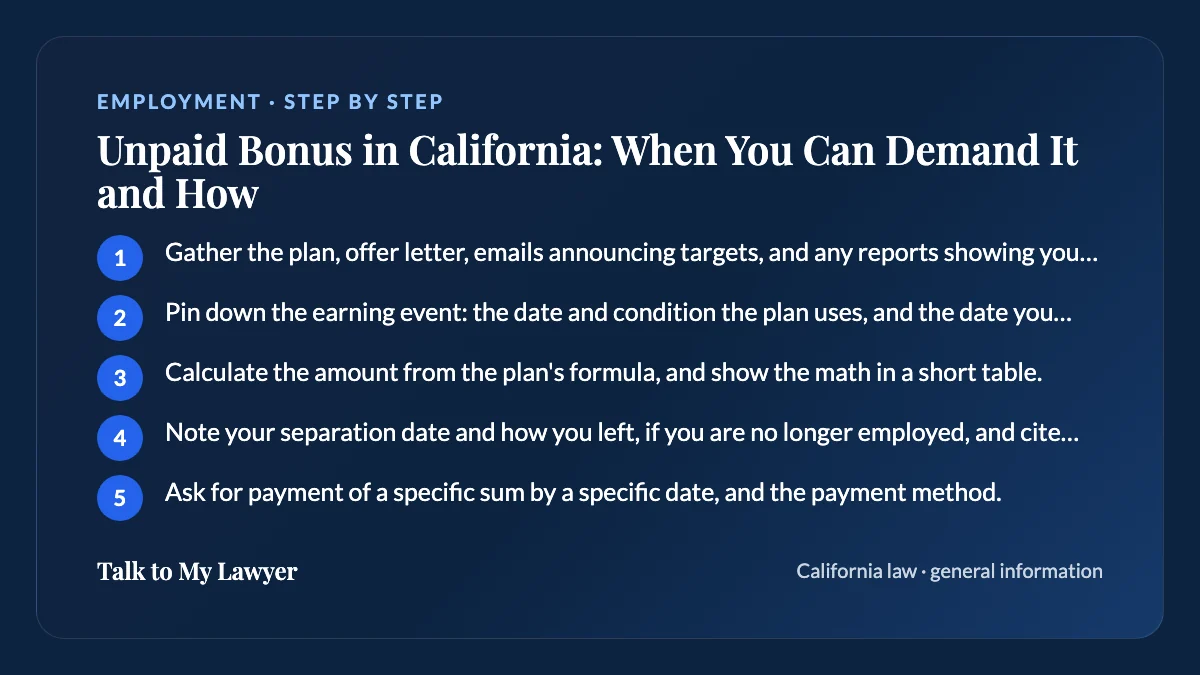
- Gather the plan, offer letter, emails announcing targets, and any reports showing you met them.
- Pin down the earning event: the date and condition the plan uses, and the date you satisfied it.
- Calculate the amount from the plan's formula, and show the math in a short table.
- Note your separation date and how you left, if you are no longer employed, and cite Labor Code sections 200 to 203.
- Ask for payment of a specific sum by a specific date, and the payment method.
- Send it to payroll or HR and the decision-maker, keep proof of delivery, and diary the claim deadlines above.
The 2026 Sales Incentive Plan, section 3, states that the quarterly bonus of $3,000 is earned at the end of any quarter in which the quota is met. My third-quarter results, attached, show 108 percent of quota as of September 30. My employment ended on October 15. Because the bonus was earned before my last day, it was due with my final wages under Labor Code section 202. Please pay $3,000 by direct deposit by November 20.
When an attorney-written bonus demand makes sense
A bonus fight can come down to one sentence in a plan document: the line that says when the money is earned. Having an attorney write the demand is worth considering when the plan has reservation or forfeiture clauses, when the bonus is large or tied to equity or retention, when you also have overtime or final pay issues, or when the employer has already given a written reason for refusing.
Through Talk to My Lawyer, a licensed California attorney writes your letter from your bonus plan, performance records and separation dates, states the amount and the Labor Code provisions involved, and sends it on your behalf. A lawyer can read the plan with you and help weigh a wage claim against a court case.
Frequently asked questions
Can my employer take back a bonus it already promised?
It depends on timing and the plan's wording. After you meet the stated conditions, the bonus may already be wages under Labor Code section 200. A clause saying the employer can cancel bonuses at any time may matter, so have a lawyer read the plan if a large amount is involved.
Is a holiday bonus required in California?
No. California law does not require holiday or year-end bonuses. The Labor Commissioner treats a gift for a holiday or special occasion, not measured by hours worked, production or efficiency, as a discretionary bonus. If the bonus was instead promised in advance on stated criteria and you met them, that is a different question, because it may be earned pay rather than a gift.
Do I get my bonus if I was laid off before the payout date?
If the plan treats the bonus as earned before your last day, it is part of the wages due when you are laid off, which in California is immediately at separation (Labor Code section 201). If the plan makes being employed on the payout date part of the earning condition, the answer depends on how that condition is worded and applied, and an attorney can assess it.
Does an unpaid bonus affect overtime for hourly workers?
Yes. A nondiscretionary bonus must be included in the regular rate of pay for overtime, according to the Labor Commissioner. If an hourly employee worked overtime during the bonus period, the employer owes additional overtime on the bonus, paid in the pay period after the bonus period ends. A missing bonus can therefore mean missing overtime as well.
How long do I have to claim an unpaid bonus in California?
The Labor Commissioner allows four years for a claim resting on a written agreement and two years for a spoken one. A signed bonus plan or offer letter generally points to the four-year window. Overtime owed because of a bonus falls under the three-year window for statutory violations. Deadlines can be complex, so check yours with a lawyer.
Sources
Checked against these official sources on October 18, 2026.
- California Labor Code section 200 (California Legislative Information)
- California Labor Code section 203 (California Legislative Information)
- California Labor Code section 202 (California Legislative Information)
- Overtime FAQ (California Labor Commissioner's Office)
- Paydays, pay periods, and the final wages (California Labor Commissioner's Office)
- How to File a Wage Claim (California Labor Commissioner's Office)
This guide explains California law in general terms as of October 2026. It is general information, not legal advice for your situation, and local rules can add to it.
Join the email list and get a lawyer letter started
With Talk to My Lawyer, a licensed California attorney writes your letter from your facts and documents and sends it on your behalf. Join the Talk to My Lawyer email list for letter checklists, document prompts, and reminders before you start your letter.