Quick answer
A medical malpractice notice of intent in California is the warning Code of Civil Procedure section 364 requires before suing a health care provider: at least 90 days' notice. It must state the legal basis of the claim and the type of loss, and describe the injuries with specificity. If it is served within 90 days of the filing deadline, section 364(d) extends the time to file.
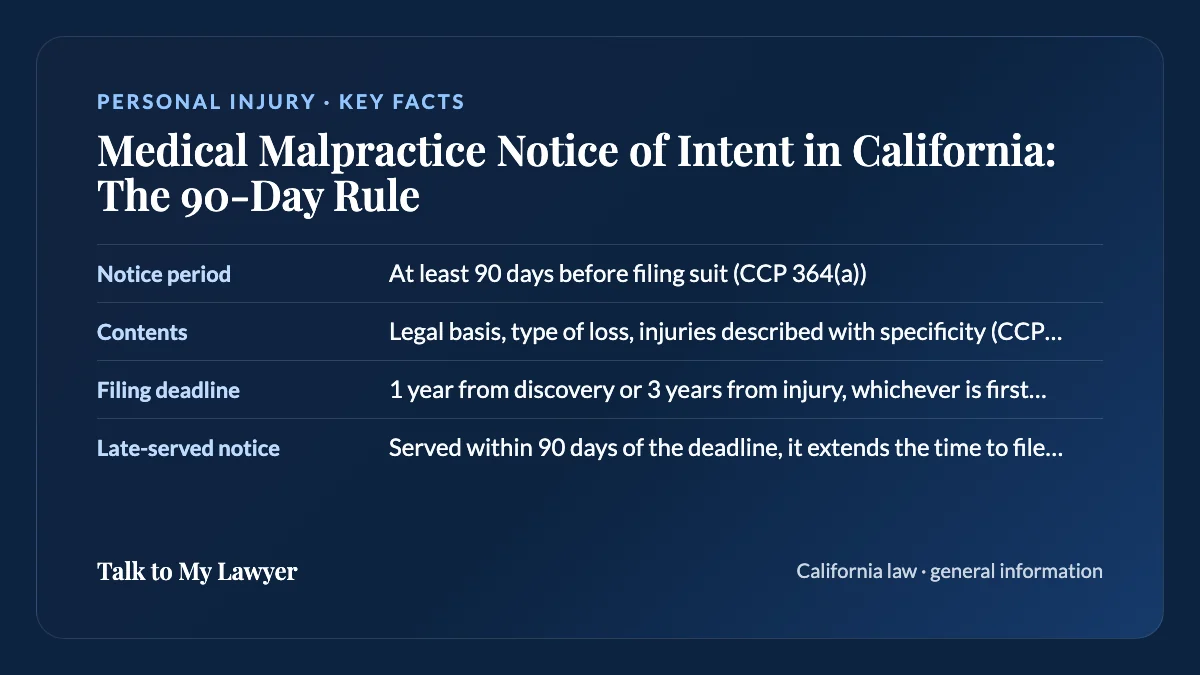
At a glance
- Notice period
- At least 90 days before filing suit (CCP 364(a))
- Contents
- Legal basis, type of loss, injuries described with specificity (CCP 364(b))
- Filing deadline
- 1 year from discovery or 3 years from injury, whichever is first (CCP 340.5)
- Late-served notice
- Served within 90 days of the deadline, it extends the time to file (CCP 364(d))
- Noneconomic damages limit
- $470,000 injury, $650,000 death for 2026 under the statute's schedule (Civil Code 3333.2)
- Your records
- Copies within 15 days of a request (Health and Safety Code 123110)
What is a medical malpractice notice of intent in California?
It is a written notice to a health care provider that you intend to sue for professional negligence, sent before the lawsuit. Code of Civil Procedure section 364(a) says no such action may be commenced unless the defendant has been given at least 90 days' prior notice of the intention to commence it.
The rule reaches a wide group. Section 364 defines a health care provider as anyone licensed or certified under Division 2 of the Business and Professions Code (physicians, nurses, dentists, pharmacists and other licensed health professions), osteopathic and chiropractic practitioners, and licensed clinics, health dispensaries and health facilities.
Professional negligence means a negligent act or omission in rendering professional services that is the proximate cause of a personal injury or wrongful death, where the services were within the scope of the provider's license. A dispute about a bill is a different matter; our guide to disputing a medical bill covers that.
What must the notice include?
Section 364(b) says no particular form is required, but the notice must tell the provider three things:
- The legal basis of the claim, such as negligent diagnosis, treatment or failure to treat.
- The type of loss sustained, such as additional medical costs, lost earnings or pain and suffering.
- The nature of the injuries, described with specificity: what happened to your body or health, and when.
The notice may be served by the methods in the Code of Civil Procedure's general notice provisions, which begin at section 1010 (section 364(c)). The notice must reach each defendant, so a hospital or clinic and each individual clinician you may name would each need one. The 90-day requirement does not apply to a defendant whose name you do not know when you file and who is sued under a fictitious name (section 364(e)).
How do the 340.5 deadlines and the 90-day extension fit together?
Code of Civil Procedure section 340.5 gives you three years after the date of injury or one year after you discovered (or reasonably should have discovered) the injury, whichever comes first. The three-year limit is extended only for fraud, intentional concealment, or a foreign body with no therapeutic or diagnostic purpose left inside the patient.
| Situation | Deadline | Rule |
|---|---|---|
| Adult patient | 1 year from discovery or 3 years from injury, whichever is first | CCP 340.5 |
| Minor, age 6 or older | 3 years from the date of the alleged wrongful act | CCP 340.5 |
| Minor under age 6 | 3 years, or before the 8th birthday, whichever is longer | CCP 340.5 |
| Notice served in the last 90 days before the deadline | Time to file is extended; the statute says 90 days from service, and a lawyer should count the new date | CCP 364(d) |
Example (hypothetical): a patient's surgery takes place on February 1, 2025, and on June 15, 2026, a second doctor tells her a complication was caused by the first procedure. Her one-year discovery deadline would be June 15, 2027, which comes before the three-year date of February 1, 2028. If she serves her notice on May 1, 2027, that is within 90 days of the June 15 deadline, so section 364(d) extends her time to file. The statute's words are 90 days from the service of the notice, and courts have interpreted how that extension is counted against the one-year period, so the new deadline in a real case is a date a lawyer should calculate.
Why get your medical records before writing the notice?
Because the notice must describe your injuries with specificity, and the chart is where the specifics are. California's patient access law, Health and Safety Code section 123110, gives you two ways to see it.
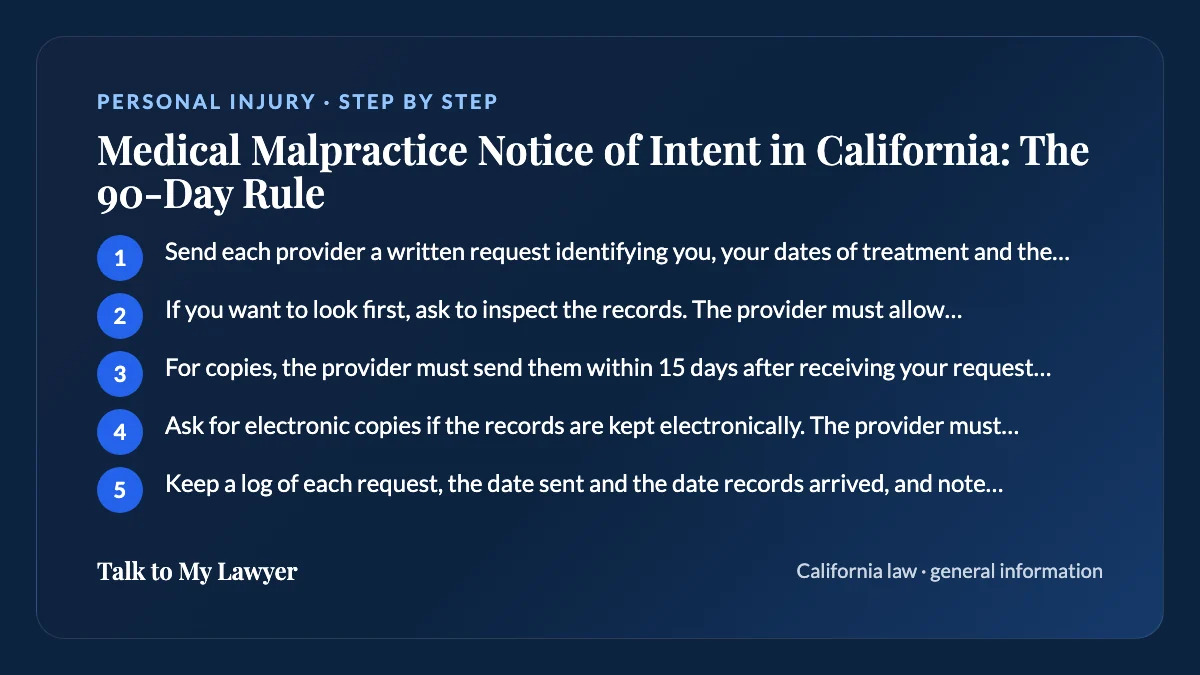
- Send each provider a written request identifying you, your dates of treatment and the records you want, including imaging reports, operative notes and nursing notes.
- If you want to look first, ask to inspect the records. The provider must allow inspection during business hours within five working days after receiving the request, and you may bring one other person.
- For copies, the provider must send them within 15 days after receiving your request, on payment of the reasonable copying costs the statute allows.
- Ask for electronic copies if the records are kept electronically. The provider must give them in the form you request if it is readily producible, or in another readable form you agree on.
- Keep a log of each request, the date sent and the date records arrived, and note anything missing.
A provider may ask for reasonable proof of identity, but section 123110(f) says that requirement may not be used to frustrate or delay compliance.
What are California's MICRA damage limits in 2026?
Civil Code section 3333.2, as rewritten by AB 35 (2022), limits noneconomic damages (pain, suffering, inconvenience, physical impairment, disfigurement) in professional negligence cases filed on or after January 1, 2023. It does not limit economic losses such as medical bills and lost earnings.
| Year | Injury (no death) | Wrongful death |
|---|---|---|
| 2023 starting amount | $350,000 | $500,000 |
| Yearly increase each January 1 for 10 years | +$40,000 | +$50,000 |
| 2026 amount under that schedule | $470,000 | $650,000 |
| Ceiling reached in 2033 | $750,000 | $1,000,000 |
| From January 1, 2034 | 2% yearly inflation adjustment | 2% yearly inflation adjustment |
Each amount can apply up to three times in one case: once for health care providers collectively, once for health care institutions collectively, and once for unaffiliated providers or institutions whose separate negligence happened at, or during medical transport to, an unaffiliated facility. No single defendant is liable in more than one of those categories. The amount in effect at the time of judgment, arbitration award or settlement is the one that applies.
Drafting the notice: structure and sample language
The notice is a formal step, not a negotiation. Keep it factual, specific and calm, and leave out any settlement demand unless a lawyer advises including one.
Please take notice under California Code of Civil Procedure section 364 that I intend to commence an action against you for professional negligence. On February 1, 2025, you performed a laparoscopic procedure on me at [facility]. During that procedure my bowel was perforated, and the injury was not identified before discharge. I was readmitted on February 4, 2025, underwent emergency surgery and remained hospitalized for nine days. My losses include medical expenses, lost earnings and pain, suffering and physical impairment.
If a public hospital or clinic run by a county, city or district was involved, a separate government claim process with its own short deadline may apply as well. Our guide to filing a government claim in California explains it.
When an attorney should prepare your notice of intent
A section 364 notice starts a 90-day countdown and can move your filing deadline, so the dates and the description of injuries need to be right. Talk to a malpractice lawyer about whether and when to serve a notice.
If you decide to serve one, you can have it prepared through Talk to My Lawyer: a licensed California attorney writes your notice from your medical records, treatment dates and account of what happened, and sends it on your behalf to each provider you identify.
Frequently asked questions
How long before suing a doctor in California must I give notice?
At least 90 days. Code of Civil Procedure section 364(a) bars filing a professional negligence lawsuit against a health care provider until the provider has had 90 days' prior notice of your intention to sue. The rule covers licensed clinicians and licensed clinics and health facilities. It does not apply to a defendant sued under a fictitious name because you did not know their identity.
Does a notice of intent extend the statute of limitations?
It can. If the notice is served within the last 90 days before the deadline under Code of Civil Procedure section 340.5, section 364(d) extends the time to file. The statute speaks of 90 days from service, and courts have interpreted how that period is counted. A notice served earlier does not trigger the extension. Because the new date depends on exact facts, a lawyer should do the calculation for your case.
What is the statute of limitations for medical malpractice in California?
Under Code of Civil Procedure section 340.5, an adult must file within three years after the injury or one year after discovering it, whichever comes first. The three-year limit can be extended only for fraud, intentional concealment, or a non-therapeutic foreign body left in the body. Minors have separate rules, including a special rule for children under six.
What is the MICRA cap in California in 2026?
Civil Code section 3333.2 sets the noneconomic damages limits. Starting from $350,000 for injury and $500,000 for wrongful death in 2023, they rise by $40,000 and $50,000 each January 1, which works out to $470,000 and $650,000 for 2026. Each limit can apply separately to providers, institutions and unaffiliated defendants, and the amount in effect at judgment or settlement controls.
How fast must a California provider give me my medical records?
Under Health and Safety Code section 123110, a provider must let you inspect your records within five working days after your request and must send copies within 15 days after receiving a request, on payment of the costs the law allows. You can ask for electronic copies when the records are kept electronically and readily producible in that form.
Sources
Checked against these official sources on October 18, 2026.
- California Code of Civil Procedure section 364 (California Legislative Information)
- California Code of Civil Procedure section 340.5 (California Legislative Information)
- California Civil Code section 3333.2 (California Legislative Information)
- California Health and Safety Code section 123110 (California Legislative Information)
This guide explains California law in general terms as of October 2026. It is general information, not legal advice for your situation, and local rules can add to it.
Join the email list and get a lawyer letter started
With Talk to My Lawyer, a licensed California attorney writes your letter from your facts and documents and sends it on your behalf. Join the Talk to My Lawyer email list for letter checklists, document prompts, and reminders before you start your letter.