Quick answer
California paid sick leave law (Labor Code sections 245 to 249) gives an employee who works 30 or more days in a year at least 40 hours or 5 days of paid sick leave a year, the minimum since SB 616 took effect on January 1, 2024. Leave accrues at one hour per 30 hours worked, is usable from day 90, and covers your own or a family member's health.
At a glance
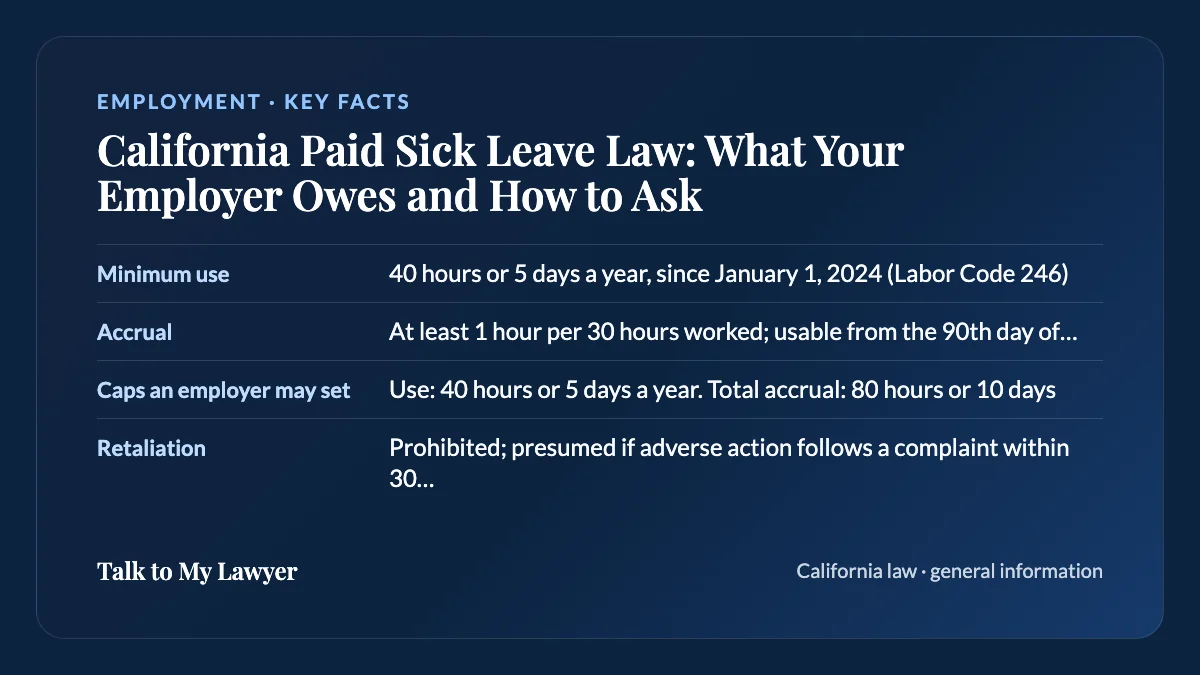
- Minimum use
- 40 hours or 5 days a year, since January 1, 2024 (Labor Code 246)
- Accrual
- At least 1 hour per 30 hours worked; usable from the 90th day of employment
- Caps an employer may set
- Use: 40 hours or 5 days a year. Total accrual: 80 hours or 10 days
- Retaliation
- Prohibited; presumed if adverse action follows a complaint within 30 days (246.5(c))
- Penalty for denied leave
- Three times the withheld pay or $250, whichever is more, up to $4,000 (248.5)
How much paid sick leave does California law require?
As of October 2026, an employer must let you use at least 40 hours or 5 days of paid sick leave each year, whichever gives you more time. SB 616 raised the minimum from 24 hours or 3 days, effective January 1, 2024 (Labor Code section 246).
You qualify once you work in California for the same employer for 30 or more days within a year from your start date. Part-time and temporary workers count. Section 245.5 carves out a few groups, including some employees under qualifying union contracts, certain airline flight crew and certain railroad workers. Outside construction, those union employees still have the protection of section 246.5, which sets the permitted uses and bars retaliation (section 246.5(d)).
Employers can meet the requirement in one of two ways:
| Method | How it works | Carryover |
|---|---|---|
| Accrual | At least one hour for every 30 hours worked, or another regular schedule giving 24 hours by day 120 and 40 hours by day 200 | Unused hours carry over, but the employer may cap total accrual at 80 hours or 10 days |
| Front-loading | The full 40 hours or 5 days is available at the start of each year | None required |
Either way, an employer may limit use to 40 hours or 5 days a year. Exempt salaried employees are treated as working 40 hours a week for accrual, unless their normal week is shorter. A paid time off policy can stand in for sick leave if it allows the same uses on the same conditions.
What can you use California paid sick leave for?
Section 246.5(a) requires an employer to provide paid sick days, on your oral or written request, for:
- Diagnosis, care or treatment of an existing health condition, or preventive care, for you or a family member.
- Time off related to a qualifying act of violence, such as domestic violence, sexual assault or stalking, for purposes listed in Government Code section 12945.8. At any employer this includes seeking a restraining order. At employers with 25 or more employees it also includes purposes such as medical care, counseling, safety planning and relocation, for you or to help a family member.
- Since January 1, 2025, serving on a jury, or appearing in court as a witness under a subpoena or court order.
- As of October 2026, attending judicial proceedings related to a crime of which you or a family member was a victim, such as a plea or sentencing hearing. AB 406 added this use for leave taken on or after January 1, 2026.
- For outdoor agricultural workers, avoiding smoke, heat or flooding conditions created by a declared state or local emergency.
"Family member" is broad: a child of any age, parent, parent-in-law, spouse, registered domestic partner, grandparent, grandchild, sibling, and one "designated person" you name when you request the leave (section 245.5(c)).
You decide how much to take, although the employer may set a minimum increment of no more than two hours (section 246(k)). An employer may not make you find a replacement worker as a condition of using sick days (section 246.5(b)).
Can a California employer require a doctor's note for sick leave?
Generally, no. The Labor Commissioner's FAQ says an employer may not deny paid sick leave solely because you lack a health care provider's certification; the leave is available on your oral or written request. It adds that asking for documentation may be reasonable in limited situations where the employer has information suggesting the leave is not for a valid purpose.
Your side of the bargain is notice. If the need is foreseeable, such as a scheduled appointment, give reasonable advance notice. If it is not, such as waking up sick, give notice as soon as practicable (section 246(m)).
Paid sick time must be paid by the next regular payday following the leave (section 246(n)). It is not paid out when you leave, unless your employer's policy says otherwise, but if you are rehired within one year, your unused balance must be restored.
Where should your sick leave balance appear?
On your pay stub, or on a separate written notice given with your pay on payday (section 246(i)). An employer with an unlimited policy may write "unlimited." This notice rule replaces the general pay stub penalties for this item, which is why a missing sick balance is handled under the sick leave article rather than as an ordinary pay stub violation.
Employers must keep records of hours worked and sick days accrued and used for at least three years. If they do not keep adequate records, the law presumes you are entitled to the maximum hours the article allows, unless the employer rebuts that with clear and convincing proof (section 247.5).
Is it illegal to punish you for using sick leave?
Yes. An employer may not deny accrued sick days, or fire, threaten, demote, suspend or otherwise discriminate against you for using or trying to use them, for complaining about a violation, or for cooperating in an investigation (section 246.5(c)(1)).
If any of those actions happens within 30 days after you file a complaint, cooperate in an investigation or oppose a prohibited practice, the law presumes retaliation, and the employer must rebut it. The Labor Commissioner's FAQ gives a concrete example: denying holiday pay because you used a sick day the day before or after a holiday may violate the anti-retaliation rule.
A retaliation complaint to the Labor Commissioner is generally due within one year of the violation, which can be extended for good cause (section 98.7). Our workplace retaliation letter guide covers that process in more depth.
What are the penalties for violating California paid sick leave law?
Section 248.5 puts enforcement in the hands of the Labor Commissioner, which can investigate, issue citations and order back pay, reinstatement, payment of the withheld sick days and an administrative penalty paid to the employee. The Labor Commissioner and the Attorney General can also sue on a worker's behalf.
| Violation | Penalty under section 248.5 |
|---|---|
| Paid sick days unlawfully withheld | Three times the dollar value withheld, or $250, whichever is greater, up to $4,000 in total |
| Other harm, such as being fired | $50 for each day the violation continues, up to $4,000 in total |
| Willful failure to post the sick leave poster | Up to $100 per offense (section 247) |
Interest is added to unpaid amounts. An isolated, unintentional payroll or notice error that is a clerical mistake does not trigger penalties. The Labor Commissioner lists three years as the filing window for a sick leave wage claim.
Example (hypothetical): a worker earning $24 an hour is refused two accrued 8-hour sick days and is not paid for them. The withheld amount is $384. Three times that is $1,152, which beats the $250 floor and sits under the $4,000 cap, so the administrative penalty the Labor Commissioner could order would be $1,152, on top of the $384 in withheld pay and interest.
How to raise a sick leave violation in writing
Some cities, including Los Angeles and San Francisco, have their own paid sick leave ordinances. The Labor Commissioner says an employer must follow both and give the more generous benefit, except on a few topics where state law controls, such as pay stub notice, how sick pay is calculated and when it is paid. Check the local rule first; our guides to Los Angeles and San Francisco worker rights cover those cities.
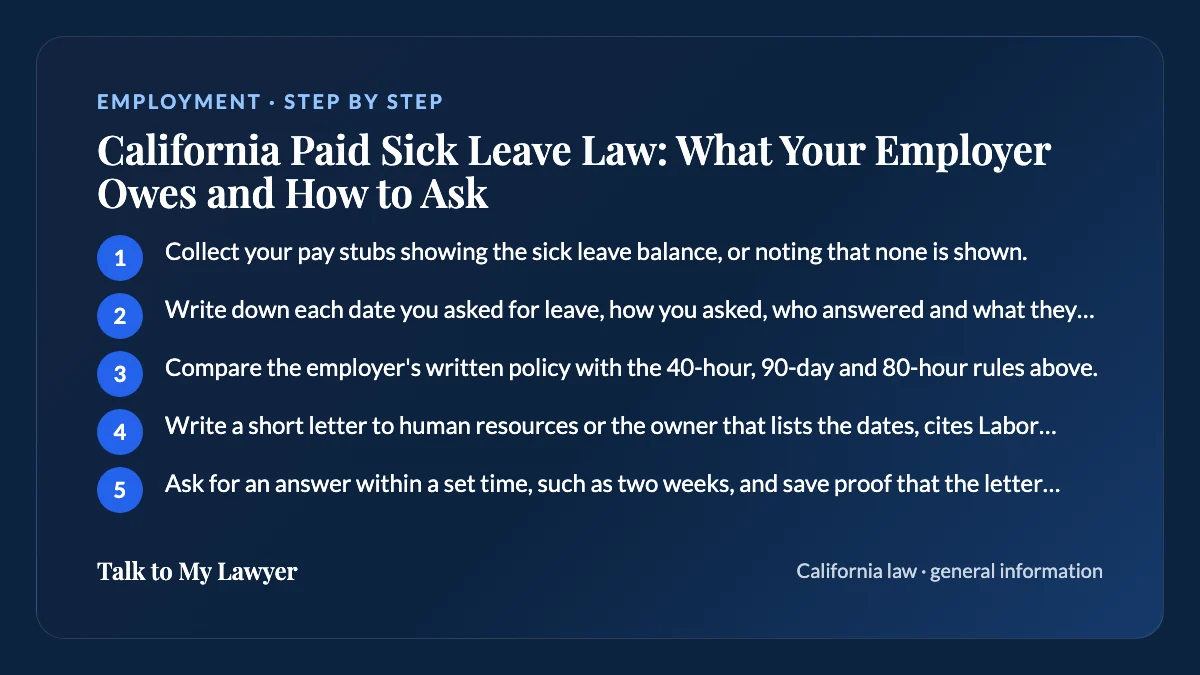
- Collect your pay stubs showing the sick leave balance, or noting that none is shown.
- Write down each date you asked for leave, how you asked, who answered and what they said. Save texts and emails.
- Compare the employer's written policy with the 40-hour, 90-day and 80-hour rules above.
- Write a short letter to human resources or the owner that lists the dates, cites Labor Code sections 246 and 246.5, and asks for the specific relief: restore the hours, pay the withheld days, correct the pay stub, or reverse a write-up.
- Ask for an answer within a set time, such as two weeks, and save proof that the letter arrived.
- If nothing changes, the route the statute sets out is a wage claim or retaliation complaint with the Labor Commissioner's Office, within the deadlines above.
On March 4 and March 5, I asked by text to use accrued paid sick leave to care for my daughter. My February 28 pay stub showed 26 hours available. My supervisor replied that I would be marked absent unless I found someone to cover, and both days were unpaid. Labor Code section 246.5 allows me to use accrued sick days for a family member's care and bars requiring a replacement worker. Please pay the 16 hours at my regular rate and remove the absence notes from my file by April 1.
When a sick leave letter from an attorney makes sense
A sick day refused at 6 a.m. can turn into a write-up by noon, and that is where a letter needs more than a polite reminder. A short note to HR fits a missing balance or a payroll slip. An attorney's letter is worth considering when you were disciplined or fired soon after asking for leave, when the employer insists its policy overrides the statute, or when sick leave is one of several wage problems in the same job.
Through Talk to My Lawyer, a licensed California attorney writes your letter from your pay stubs, texts and timeline, applies the paid sick leave article and any local ordinance to your dates, and sends it on your behalf. A lawyer can advise whether a Labor Commissioner claim or another route fits your situation.
Frequently asked questions
Does unused sick leave carry over in California?
Under an accrual policy, yes. Accrued, unused sick hours carry over to the next year, but the employer may cap your total bank at 80 hours or 10 days and may limit use to 40 hours or 5 days a year. Under a front-loaded policy, where the full 40 hours or 5 days is available at the start of each year, carryover is not required.
Does my employer have to pay out sick leave when I quit?
No, not under state law. Labor Code section 246(g) says unused paid sick days need not be paid at separation, unless your employer's own policy promises a payout. If you are rehired within one year, your unused sick balance must be reinstated, unless it was part of a paid time off bank that was paid out when you left.
How soon can a new employee use paid sick leave in California?
Accrual starts on your first day of work, and you can begin using accrued sick days on your 90th day of employment (Labor Code section 246(c)). You must also work in California for the same employer for at least 30 days within a year to be covered. An employer may let you use leave earlier but is not required to.
Can I use sick leave for a friend or roommate?
Possibly. California lets you name one "designated person" when you request paid sick leave, and that person counts as a family member for sick leave purposes. Employers can cap this at one designated person per 12-month period (Labor Code section 245.5(c)(8)).
How much should a sick day pay?
For nonexempt workers, either the regular rate of pay for the workweek in which you use the leave, or your total wages (excluding overtime premiums) divided by total hours worked in the full pay periods of the prior 90 days. Exempt employees are paid the same way the employer pays other paid leave (Labor Code section 246(l)).
Sources
Checked against these official sources on October 18, 2026.
- California Labor Code sections 245 to 249 (Paid Sick Days) (California Legislative Information)
- California Paid Sick Leave: Frequently Asked Questions (California Labor Commissioner's Office)
- California Government Code section 12945.8 (California Legislative Information)
- California Labor Code section 98.7 (California Legislative Information)
- How to File a Wage Claim (California Labor Commissioner's Office)
- Paid Sick Leave Ordinance (San Francisco Office of Labor Standards Enforcement)
This guide explains California law in general terms as of October 2026. It is general information, not legal advice for your situation, and local rules can add to it.
Join the email list and get a lawyer letter started
With Talk to My Lawyer, a licensed California attorney writes your letter from your facts and documents and sends it on your behalf. Join the Talk to My Lawyer email list for letter checklists, document prompts, and reminders before you start your letter.