Quick answer
An Uber accident claim in California depends on what the driver was doing. With a ride accepted or a passenger aboard, the company's insurance must provide $1,000,000 in primary liability coverage (Public Utilities Code section 5433). With the app on but no ride, limits are $50,000 per person, $100,000 per incident and $30,000 property damage, plus $200,000 excess. With the app off, the driver's own policy applies.
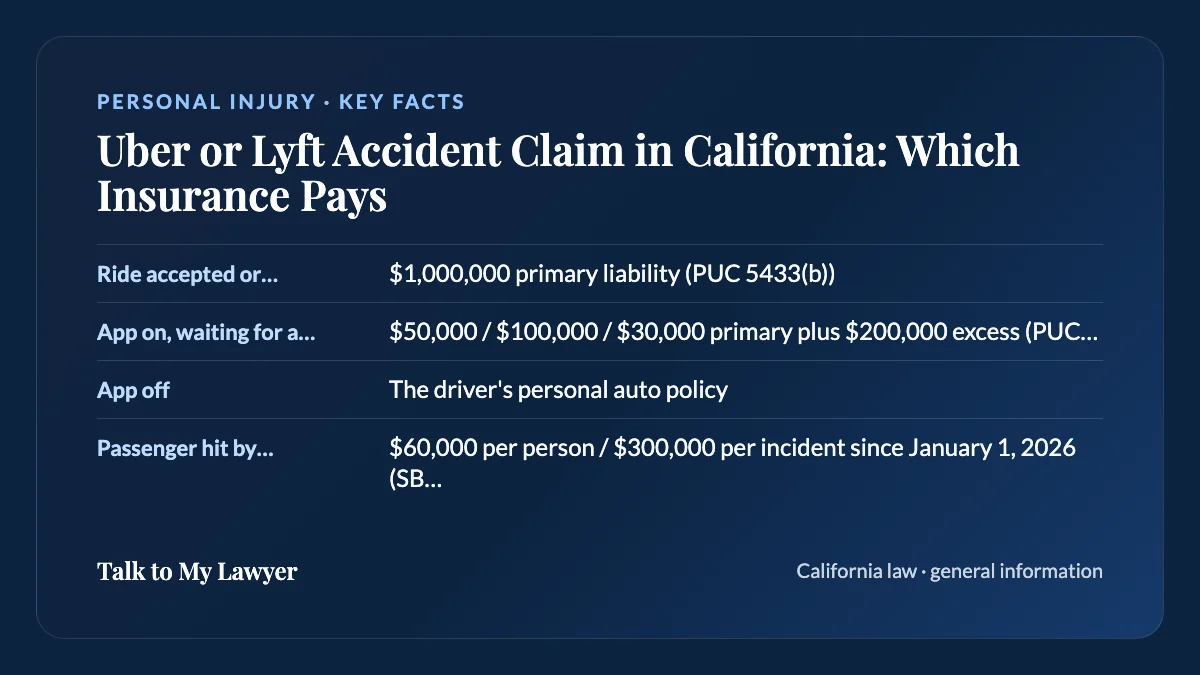
At a glance
- Ride accepted or passenger aboard
- $1,000,000 primary liability (PUC 5433(b))
- App on, waiting for a ride
- $50,000 / $100,000 / $30,000 primary plus $200,000 excess (PUC 5433(c))
- App off
- The driver's personal auto policy
- Passenger hit by uninsured driver
- $60,000 per person / $300,000 per incident since January 1, 2026 (SB 371)
- Injury deadline
- 2 years to sue (CCP 335.1)
- Accident report
- To DMV within 10 days if injury or over $1,000 damage (Vehicle Code 16000)
Who pays after an Uber or Lyft accident in California?
It depends on the driver's status in the app at the moment of the crash. California's rules for transportation network companies (the legal term for app-based ride services) set minimum insurance for each period in Public Utilities Code section 5433.
| Driver's status | Required coverage | Rule |
|---|---|---|
| App off | No rideshare coverage required; the driver's personal policy is the starting point | PUC 5433 periods start at log-on |
| Logged on, waiting for a request | Primary coverage of at least $50,000 per person and $100,000 per incident for injury or death, and $30,000 for property damage, plus at least $200,000 in excess coverage | PUC 5433(c) |
| Ride accepted, en route or passenger aboard, until the ride ends | Primary coverage of $1,000,000 for death, personal injury and property damage | PUC 5433(b)(1) |
| Passenger aboard, hit by an uninsured or underinsured driver | $60,000 per person and $300,000 per incident, provided by the company | PUC 5433(b)(2) |
Coverage can come from a policy the driver buys, one the company holds, or a mix. If a driver's rideshare policy has lapsed, the company must provide the coverage from the first dollar of the claim (section 5433(e)). And the rideshare insurer may not wait for a personal auto insurer to deny the claim first (section 5433(d)).
While the driver is logged on, section 5434 says a personal auto policy provides no coverage unless it expressly includes rideshare use or carries an endorsement for it. These are minimums; section 5433(f) says the article does not limit the company's liability above the required coverage.
What changed for rideshare passengers in 2026?
The uninsured and underinsured motorist coverage for passengers dropped sharply. Before 2026, section 5433 required $1,000,000 of that coverage from the moment a passenger got in until they got out. Senate Bill 371 (Chapter 314, Statutes of 2025), effective January 1, 2026, lowered it to $60,000 per person and $300,000 per incident. The bill could take effect only if Assembly Bill 1340 was also enacted; it was (Chapter 335, Statutes of 2025), and section 5433 now carries the new figures.
The same bill made that coverage solely the company's obligation and primary over any other uninsured motorist coverage that applies. The Legislature also ordered the Public Utilities Commission and the Department of Insurance to study the effect of the new limits and report by December 31, 2030.
As of October 2026, the uninsured motorist coverage the law requires the company to provide for a passenger is $60,000 per person and $300,000 per incident. Your own auto policy's uninsured motorist coverage may also be relevant, so check its terms. Our guide to uninsured motorist claims in California explains how those claims run.
Passenger, other driver or pedestrian: how does the claim differ?
- Passengers. You are inside the $1,000,000 period. If the rideshare driver caused the crash, the claim goes to the rideshare liability coverage. If another driver caused it, you claim against that driver's insurer, and the company's uninsured motorist coverage applies if that driver has too little or none.
- Other drivers. The coverage depends on the rideshare driver's status, which you may not know. Section 5435 requires the company and its insurer to cooperate in a coverage investigation, including giving the exact times the driver logged on and off.
- Pedestrians and cyclists. The same liability limits apply by period. A pedestrian struck by a driver with the app off looks first to the driver's personal policy.
- Rideshare drivers. A driver's own injuries raise separate questions about the company's policies and the driver's work status. Talk to a lawyer about those.
In every role, the liability coverage pays only if the insured driver is legally responsible. Fault is decided on the evidence.
What evidence should you gather after a rideshare crash?
Proof of the driver's app status lives on phones and company servers, so capture what you can early.
- The trip receipt and any in-app messages, plus screenshots of the trip history with times.
- The driver's name, license plate and vehicle as shown in the app, and their insurance information.
- Photos of the vehicles, the scene, road signs and your injuries, with the date and time.
- Names and phone numbers of witnesses, and the police report number.
- Medical records, bills and notes from every visit, and proof of missed work.
- Repair estimates and any rental car receipts.
Separately, Vehicle Code section 16000 requires a driver involved in a crash causing injury, death, or property damage over $1,000 to report it to the DMV within 10 days.
How long do you have to file an Uber accident claim in California?
A lawsuit for personal injury must generally be filed within two years (Code of Civil Procedure section 335.1). Property damage and claims against public agencies follow different deadlines; see our guide to California statutes of limitations.
California's fair claims regulations also put insurers on a clock once you make a claim:
- Within 15 calendar days of notice of a claim, the insurer must acknowledge it, provide the forms and instructions you need, and begin investigating (10 CCR 2695.5(e)).
- Within 40 calendar days after receiving proof of claim, it must accept or deny the claim in whole or in part, and a denial of a third-party claim must be in writing (10 CCR 2695.7(b)).
How to write a demand letter to the rideshare insurer
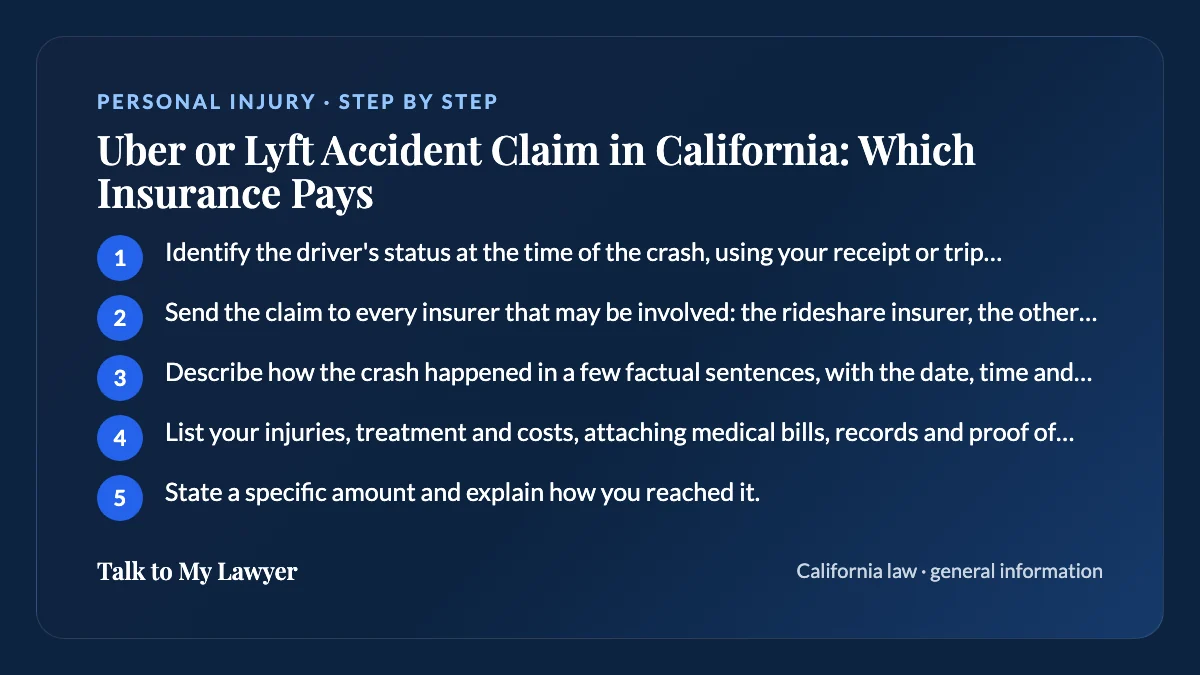
- Identify the driver's status at the time of the crash, using your receipt or trip times, and name the period that applies under section 5433.
- Send the claim to every insurer that may be involved: the rideshare insurer, the other driver's insurer and, if relevant, your own.
- Describe how the crash happened in a few factual sentences, with the date, time and location.
- List your injuries, treatment and costs, attaching medical bills, records and proof of lost income.
- State a specific amount and explain how you reached it.
- Ask for written acceptance or denial within the 40 days set by 10 CCR 2695.7(b), and keep proof of delivery.
On March 6, 2026, at 9:40 p.m., I was a passenger in a vehicle driven by a rideshare driver on a trip I booked through the app (receipt enclosed). At the intersection of Grand Avenue and 4th Street, a second vehicle ran a red light and struck the rear passenger door. Because I was a passenger on an active trip, the coverage in Public Utilities Code section 5433(b) applies. My medical expenses to date total $18,450, and I missed 11 days of work. I ask that you accept this claim in writing within 40 days of receiving this proof.
For more on valuing injuries and structuring the letter, see our guide to the personal injury demand letter in California.
When an attorney should write your rideshare injury demand
Rideshare claims add a question an ordinary crash does not raise: a dispute about which insurer, and which limit, applies. A lawyer's demand letter fits when the insurers point at one another, when the driver's app status is contested, or when your injuries may exceed the new $60,000 uninsured motorist limit.
Through Talk to My Lawyer, a licensed California attorney writes your demand from your trip receipt, medical records and photos, and sends it on your behalf. For serious injuries or a settlement offer that comes with a release, talk to a personal injury lawyer about your facts.
Frequently asked questions
Does Uber's insurance cover passengers in California?
Yes, during the trip. From the moment a driver accepts a ride until it is complete, Public Utilities Code section 5433 requires $1,000,000 in primary coverage for death, personal injury and property damage. If an uninsured or underinsured driver causes the crash, the company must also provide uninsured motorist coverage of $60,000 per person and $300,000 per incident, effective January 1, 2026.
What if the Uber driver was not carrying a passenger when they hit me?
If the driver was logged on and waiting for a request, section 5433(c) requires primary coverage of at least $50,000 per person, $100,000 per incident and $30,000 for property damage, plus $200,000 in excess coverage. If the app was off, the claim generally goes to the driver's personal auto policy. The company must share the driver's log-on and log-off times with insurers investigating coverage.
Can I sue Uber or Lyft directly after an accident?
Whether the company itself can be held liable depends on the facts and is a question for a lawyer. Section 5433(f) says the insurance article does not limit a company's liability in an action for damages above the required coverage. A claim generally starts with the insurer that provides the required coverage, so identifying the driver's app status is the first step.
How long do I have to make a rideshare accident claim in California?
A personal injury lawsuit must generally be filed within two years of the injury under Code of Civil Procedure section 335.1. Report the claim to the insurers well before then, since policies can set their own notice conditions. Once the insurer has your claim, California regulations require it to acknowledge it within 15 days and to accept or deny it within 40 days after proof of claim.
What changed with SB 371 for rideshare accidents?
Senate Bill 371, effective January 1, 2026, cut the uninsured and underinsured motorist coverage that protects rideshare passengers from $1,000,000 to $60,000 per person and $300,000 per incident. It also made that coverage solely the company's obligation and primary over other uninsured motorist coverage. The $1,000,000 liability coverage during trips did not change.
Sources
Checked against these official sources on October 18, 2026.
- California Public Utilities Code section 5433 (California Legislative Information)
- California Public Utilities Code section 5434 (California Legislative Information)
- SB 371 Transportation network companies: insurance coverage (Chapter 314, Statutes of 2025) (California Legislative Information)
- California Code of Civil Procedure section 335.1 (California Legislative Information)
- Cal. Code Regs. tit. 10, section 2695.7 (Legal Information Institute, Cornell Law School)
- California Vehicle Code section 16000 (California Legislative Information)
This guide explains California law in general terms as of October 2026. It is general information, not legal advice for your situation, and local rules can add to it.
Join the email list and get a lawyer letter started
With Talk to My Lawyer, a licensed California attorney writes your letter from your facts and documents and sends it on your behalf. Join the Talk to My Lawyer email list for letter checklists, document prompts, and reminders before you start your letter.