Quick answer
San Diego tenant protections come from the Residential Tenant Protections ordinance (San Diego Municipal Code Chapter 9, Article 8, Division 7), in effect since June 24, 2023. Inside city limits, landlords need just cause from the start of a tenancy, not after 12 months, and no-fault terminations require relocation of two months' rent, or three for seniors and disabled tenants. State caps govern rent increases.
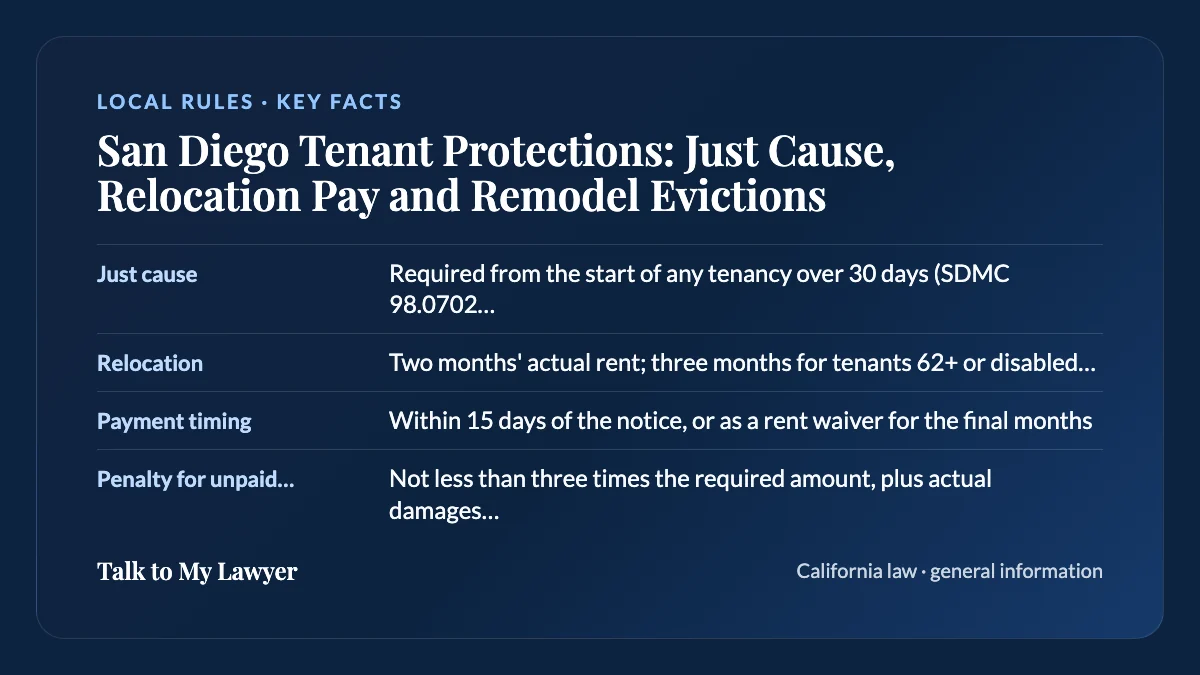
At a glance
- Just cause
- Required from the start of any tenancy over 30 days (SDMC 98.0702, 98.0704)
- Relocation
- Two months' actual rent; three months for tenants 62+ or disabled (SDMC 98.0706(c))
- Payment timing
- Within 15 days of the notice, or as a rent waiver for the final months
- Penalty for unpaid relocation
- Not less than three times the required amount, plus actual damages (SDMC 98.0709(e))
- Rent increases
- State cap: 8.2% for San Diego County increases starting August 1, 2026 to July 31, 2027
Does the San Diego ordinance cover your rental?
It covers most residential rentals inside the City of San Diego, including units rented to Section 8 voucher holders. Other cities in San Diego County, and unincorporated areas, are not governed by this city ordinance.
Section 98.0703 exempts these, among others:
- Hotel stays and short-term residential occupancy.
- Deed-restricted or subsidized affordable housing (but not Section 8).
- Rooms where you share a bathroom or kitchen with a landlord who lives there, and some owner-occupied single-family homes and two-unit buildings.
- Housing with a certificate of occupancy issued within the past 15 years.
- A house or condo that can be sold separately, owned by someone other than a corporation, REIT or LLC with a corporate member, but only if the lease contains the exact exemption notice set out in the ordinance (required in the lease for tenancies begun or renewed on or after January 1, 2024).
Landlords of covered units must give you a written notice of these protections, plus the San Diego Housing Commission's Tenant Protection Guide, in the lease or as a signed notice at signing (SDMC 98.0705).
How do San Diego tenant protections compare with state law?
California's Tenant Protection Act (Civil Code section 1946.2) sets a statewide floor. The city ordinance builds on it, and its rights are in addition to state and federal law.
| Issue | State law (Civil Code 1946.2) | City of San Diego (SDMC Div. 7) |
|---|---|---|
| When just cause starts | After 12 months of continuous, lawful occupancy | From the start of a tenancy longer than 30 days |
| No-fault relocation | One month's rent, or a waiver of the final month | Two months' actual rent; three for seniors (62+) or disabled tenants |
| Who decides the payment form | Owner chooses payment or final-month waiver | Owner chooses payment within 15 days or a rent waiver covering the full amount |
| Notice to a city agency | None | Landlord notifies the Housing Commission within three business days once its portal is in place |
| Right to return | If the move-in falls through | First offer if the unit is re-rented within five years after certain no-fault terminations |
What counts as just cause in San Diego?
At-fault causes in section 98.0704(a) track state law: unpaid rent, a material lease breach, nuisance, waste, criminal activity on the property, criminal threats, unauthorized subletting, refusing lawful entry, unlawful use, refusing to sign a substantially similar lease extension, and failing to leave after giving notice. Before terminating for a curable lease violation, the landlord must first give written notice describing it and a chance to fix it.
No-fault causes in section 98.0704(b) must be taken in good faith:
- Owner or close-relative move-in for at least 12 continuous months. For leases signed on or after June 24, 2023, this applies only if you agree in writing or the lease expressly allows it. The notice must name the intended occupant and their relationship, and you can ask for proof.
- Withdrawing the property from the rental market.
- Complying with a government or court order to vacate, including a habitability order requiring vacancy for at least 30 days.
- Demolition or a substantial remodel, defined narrowly below.
Under section 98.0710, a landlord's failure to comply with any provision of the division voids the termination notice.
How much relocation assistance does a San Diego landlord owe?
For any no-fault termination, the landlord must pay relocation regardless of your income or how long you have lived there. At the landlord's option, it is either a direct payment within 15 days of the notice or a waiver of rent for the final months of the tenancy (SDMC 98.0706(c)).
| Household | Required amount | Example at $2,600 rent |
|---|---|---|
| Standard | Two months of actual rent under the lease on the notice date | $5,200 |
| Tenant is 62 or older, or disabled | Three months of actual rent | $7,800 |
Relocation is separate from your security deposit, which must still be returned under state law. The termination notice itself has to state the amount, or the amount of rent waived. If a landlord fails to pay, section 98.0709(e) makes the landlord liable in a civil action for not less than three times the required relocation plus actual economic damages. Our guide to relocation assistance for no-fault evictions compares rules across California.
Can a San Diego landlord evict you to remodel?
Only for a substantial remodel: replacing or substantially modifying a structural, electrical, plumbing or mechanical system that needs a permit, or abating hazardous materials such as lead paint, mold or asbestos, where the work cannot be done safely with you in place and requires you to leave for at least 30 continuous days. Painting, decorating, minor repairs and other cosmetic work do not qualify.
Section 98.0704(b)(4) adds procedural steps. The landlord must post a copy of the permit application at the property within three business days of submitting it, and must obtain the permits before serving notice. The notice must be certified under penalty of perjury and include a description of the work and its expected duration, copies of the permits (or, for permit-free hazardous material abatement, the signed contractor agreement), why you cannot stay, and a statement of your right to re-rent at the same terms if the work is not started or completed.
Does San Diego limit rent increases?
The City of San Diego has no local rent control. Increases on most housing over 15 years old are limited by state law to 5% plus the change in the cost of living, up to 10%, in any 12 months, and no more than two increases in that period (Civil Code section 1947.12). The Attorney General lists the San Diego County cap as 8.2% for increases starting August 1, 2026 through July 31, 2027.
Notice is also governed by state law: 30 days for an increase of 10% or less and 90 days above that (Civil Code section 827). The city's required tenant notice repeats that state law limits increases. The timing rules for California rent increase notices cover service and effective dates in more detail.
What rules apply to buyout offers and retaliation?
Before making a buyout offer, a landlord must give each tenant a written disclosure stating that you can refuse, can consult an attorney, cannot be retaliated against for refusing, can block further offers for six months by written notice, and are eligible for a stated amount of relocation assistance (SDMC 98.0707). The agreement must be in writing with required statements in bold, at least 14-point type.
A buyout must be for more than the relocation assistance you would be owed. One for less violates the ordinance and is void, and its protections cannot be waived. Section 98.0708 separately bars retaliation against a tenant for using any right in the division.
Steps to take if you receive a no-fault notice in San Diego
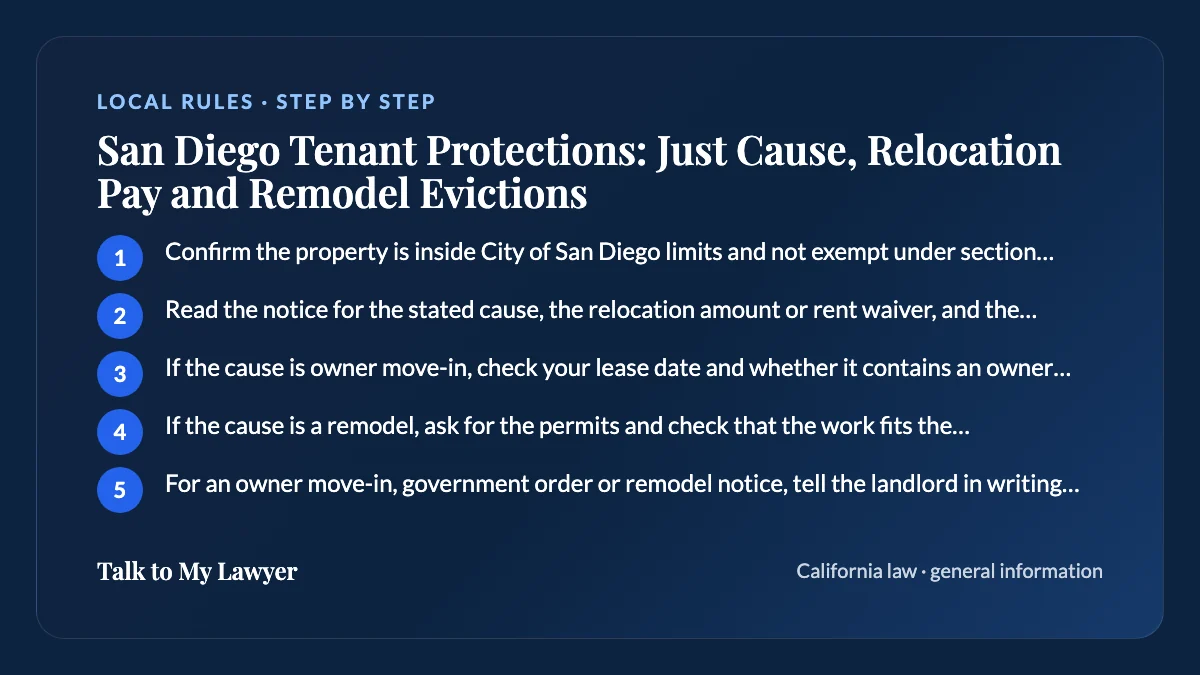
- Confirm the property is inside City of San Diego limits and not exempt under section 98.0703, checking your lease for an exemption notice.
- Read the notice for the stated cause, the relocation amount or rent waiver, and the statement of your right to an offer to return.
- If the cause is owner move-in, check your lease date and whether it contains an owner move-in clause, and ask in writing for proof of the occupant's relationship.
- If the cause is a remodel, ask for the permits and check that the work fits the ordinance's definition.
- For an owner move-in, government order or remodel notice, tell the landlord in writing within 30 days that you want an offer to renew if the unit is re-rented within five years, and give a mailing or email address.
- Track whether relocation arrives within 15 days of the notice, and keep copies of everything.
Your 60-day notice dated October 1, 2026 terminates my tenancy at 3820 Park Boulevard, Unit 2, for a substantial remodel. It does not include copies of the required permits or state the relocation assistance owed under San Diego Municipal Code section 98.0706(c). As I am 67, that amount is three months of my $2,600 rent, or $7,800. Please provide the permits and payment, and note that I request an offer to renew if the unit is offered for rent again.
When a San Diego no-fault eviction calls for an attorney letter
A remodel notice without permits, a move-in claim under a lease that never allowed one, or relocation money that never arrived can each void a termination under the ordinance, and the remedy for unpaid relocation is not less than three times the amount owed. Putting those defects in writing, with the section numbers, gives the landlord a chance to correct them and preserves your record if the case reaches court.
Through Talk to My Lawyer, a licensed California attorney writes your letter (based on your facts and the documents you share, including the lease, termination notice and rent records), then sends it on your behalf. The San Diego Housing Commission's guide explains the ordinance in general terms; an eviction defense lawyer can advise on deadlines that apply to your own notice.
Frequently asked questions
Does San Diego have rent control?
No. The City of San Diego does not cap rent increases by local ordinance. Most rentals over 15 years old are covered by the state cap in Civil Code section 1947.12, which the Attorney General lists at 8.2% for San Diego County increases starting August 1, 2026 through July 31, 2027. Newer housing and some single-family homes are exempt from the state cap.
How much relocation does a San Diego landlord have to pay?
For a no-fault termination inside city limits, two months of actual rent under your lease at the time of the notice, or three months if any tenant is 62 or older or disabled. The landlord either pays within 15 days of the notice or waives that much rent at the end of the tenancy. Income and length of tenancy do not matter.
Can I be evicted without cause in my first year in San Diego?
Not in a covered City of San Diego rental. The ordinance applies just cause to any tenancy of more than 30 days, apart from fixed-term leases of three months or less, so the state law's 12-month waiting period does not apply. The landlord must state an at-fault or no-fault cause listed in section 98.0704.
What happens if my San Diego landlord does not pay relocation assistance?
The termination notice can be void for failing to comply, and you can raise the violation as a defense in an eviction case. Section 98.0709(e) also lets you sue for not less than three times the required relocation plus actual economic damages. Courts may award attorney's fees when a landlord tries to recover possession in material violation of the ordinance.
Do the San Diego tenant protections apply in Chula Vista or unincorporated areas?
No. Division 7 of the San Diego Municipal Code applies only within the City of San Diego. Tenants in other cities and in unincorporated parts of the county rely on state law, such as Civil Code section 1946.2, unless their own city or the county has adopted separate protections. Check the local code for your address.
Sources
Checked against these official sources on October 18, 2026.
- San Diego Municipal Code Chapter 9, Article 8, Division 7: Residential Tenant Protections (City of San Diego)
- California Civil Code section 1946.2 (California Legislative Information)
- California Civil Code section 1947.12 (California Legislative Information)
- Limits on Rent Increases (California Attorney General)
- California Civil Code section 827 (California Legislative Information)
This guide explains California law in general terms as of October 2026. It is general information, not legal advice for your situation, and local rules can add to it.
Join the email list and get a lawyer letter started
With Talk to My Lawyer, a licensed California attorney writes your letter from your facts and documents and sends it on your behalf. Join the Talk to My Lawyer email list for letter checklists, document prompts, and reminders before you start your letter.