Quick answer
Under California's just cause eviction rule (Civil Code section 1946.2, part of the Tenant Protection Act), once a tenant has lawfully lived in a covered unit for 12 months, the owner may end the tenancy only for an at-fault or no-fault just cause stated in the written notice. No-fault reasons require one month's rent in relocation help or a rent waiver. A notice that does not comply is void.
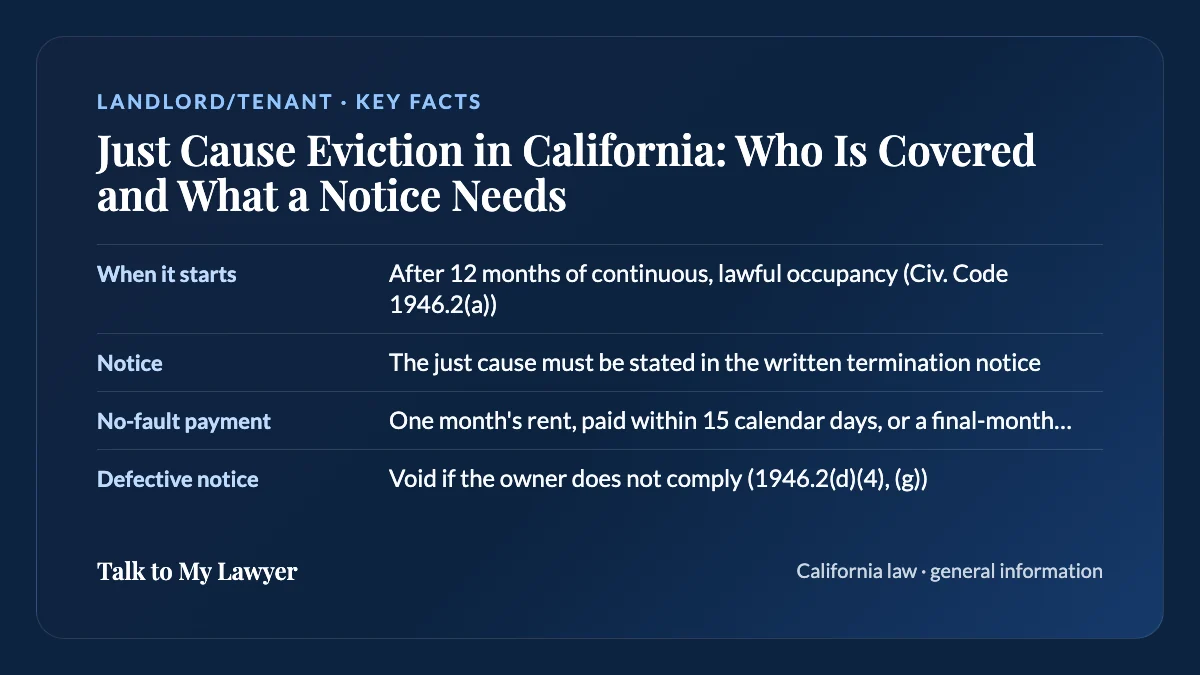
At a glance
- When it starts
- After 12 months of continuous, lawful occupancy (Civ. Code 1946.2(a))
- Notice
- The just cause must be stated in the written termination notice
- No-fault payment
- One month's rent, paid within 15 calendar days, or a final-month rent waiver
- Defective notice
- Void if the owner does not comply (1946.2(d)(4), (g))
- Penalties (SB 567)
- Actual damages, up to three times actual damages if willful, and punitive damages
- Expires
- Section 1946.2 is set to be repealed January 1, 2030 (1946.2(n))
When does just cause eviction protection start in California?
Protection starts once a tenant has continuously and lawfully occupied the unit for 12 months (Civil Code section 1946.2(a)). From then on, the owner may not terminate the tenancy without just cause, and the cause must be stated in the written notice.
Adding a roommate can reset part of that clock. If another adult tenant joins the lease before an existing tenant reaches 24 months, the rule applies only when one of these is true:
- Every tenant has lived there for 12 months or more, or
- At least one tenant has lived there for 24 months or more.
Example (hypothetical): Dana moved in 16 months ago and her partner joined the lease 5 months ago. Dana has not reached 24 months and her partner has not reached 12, so neither condition is met yet. In 7 more months, the partner reaches 12 months, every tenant has passed the 12-month mark, and the protection applies.
What counts as just cause: at-fault and no-fault reasons
The statute sorts every allowed reason into two groups. The group matters, because only no-fault reasons trigger relocation assistance.
| At-fault just cause (tenant's conduct) | No-fault just cause (owner's plans) |
|---|---|
| Not paying rent | Owner or a listed relative moving in for at least 12 months |
| Breaking a material lease term, including after a written notice to correct | Taking the property off the rental market |
| Nuisance, waste, or using the unit for an unlawful purpose | Complying with a government or court order, or a local ordinance, that requires vacating |
| Criminal activity on the property, or criminal threats aimed at the owner or agent | Demolishing or substantially remodeling the property |
The at-fault list also includes refusing a written renewal on similar terms after a lease ends, refusing entry the law allows, subletting in violation of the lease, an employee or licensee who stays after the job ends, and a tenant who gave notice to leave and then did not.
For a lease violation that can be fixed, section 1946.2(c) requires the owner to first give a notice to cure under Code of Civil Procedure section 1161(3). Only if the problem is not fixed in time may the owner serve a three-day notice to quit without a chance to cure.
What a no-fault notice has to include
A no-fault notice must tell you about your right to relocation assistance or a rent waiver equal to one month's rent, and any payment is due within 15 calendar days of service. Our separate guide on relocation money after a no-fault eviction walks through the payment itself. The two reasons with the longest list of conditions are owner move-in and substantial remodel:
- Owner move-in. The notice has to identify who will move in and how that person is related to the owner, and must say you can ask for proof of ownership or the family tie. The occupant must move in within 90 days after you leave and live there as a primary residence for at least 12 consecutive months. For leases entered into on or after July 1, 2020, this reason works only if you agree in writing or the lease has a clause allowing it.
- Owner move-in limits. It is not available if the intended occupant already lives in a unit on the property, or if a similar unit is already vacant there.
- Substantial remodel. The work must replace or substantially modify a structural, electrical, plumbing or mechanical system with a required permit, or abate hazardous materials such as lead paint, mold or asbestos, and must require you to be out for at least 30 consecutive days. Painting, decorating and minor repairs do not qualify.
- Remodel notice contents. The notice must describe the work and its expected length, attach the permit (or, for permit-free hazardous-material work, the signed contractor agreement), and include the statutory statement about your right to re-rent at the same rent if the work is not started or finished.
How SB 567 changed just cause evictions in 2024
SB 567 (Chapter 290, Statutes of 2023) took effect on April 1, 2024. It tightened the owner move-in and substantial remodel reasons and added new enforcement remedies. As of October 2026, an owner who tries to recover possession in material violation of section 1946.2 is liable for:
- Actual damages.
- Reasonable attorney's fees and costs, in the court's discretion.
- Up to three times actual damages if the owner acted willfully or with oppression, fraud or malice, plus possible punitive damages.
The Attorney General and the local city attorney or county counsel may also seek injunctive relief. If an owner move-in never happens, the owner must offer the unit back at the same rent and terms and reimburse reasonable moving expenses beyond any relocation money already paid.
A later amendment, AB 1529 (Chapter 203, Statutes of 2025, effective January 1, 2026), made a smaller change: the notice of tenant rights that owners must give under the act may now appear in the lease or rental agreement itself, as well as in an addendum or a separate notice the tenant signs. The section remains scheduled for repeal on January 1, 2030.
Which California rentals are exempt from just cause?
Section 1946.2(e) lists the exemptions. The ones that apply to everyday rentals:
- Housing with a certificate of occupancy issued within the previous 15 years (mobilehomes excepted).
- A single-family home or condo that can be sold separately, when the owner is not a real estate investment trust, a corporation, or an LLC with a corporate member, and the tenant received the exact statutory exemption notice. For tenancies begun or renewed on or after July 1, 2020, that notice must be in the rental agreement.
- An owner-occupied duplex, if the owner lived in one unit when the tenancy began and still does, and neither unit is an ADU or junior ADU.
- An owner-occupied single-family home where the owner rents out no more than two units or bedrooms, including an ADU.
- Sharing a bathroom or kitchen with an owner who lives there.
- Transient hotel stays, dormitories, certain care facilities, and deed-restricted affordable housing.
How to check a just cause termination notice
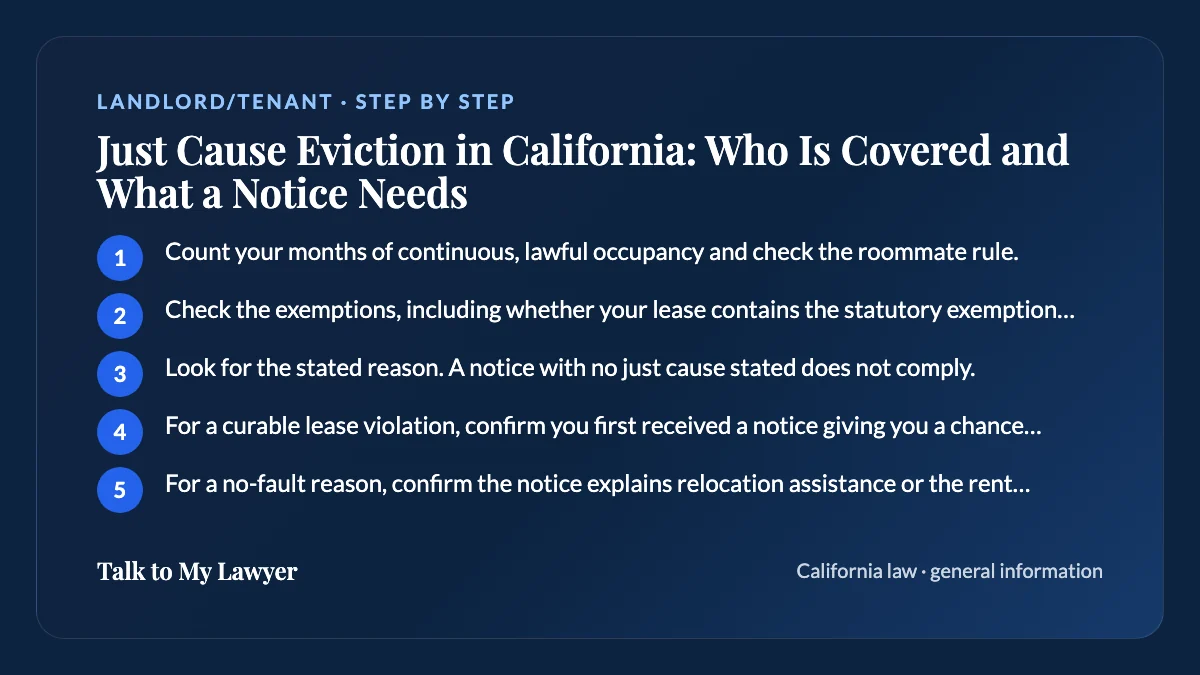
Work through the notice in this order. Each step can end the analysis, so write down the answer to each one.
- Count your months of continuous, lawful occupancy and check the roommate rule.
- Check the exemptions, including whether your lease contains the statutory exemption notice word for word.
- Look for the stated reason. A notice with no just cause stated does not comply.
- For a curable lease violation, confirm you first received a notice giving you a chance to fix it.
- For a no-fault reason, confirm the notice explains relocation assistance or the rent waiver, and note whether payment arrived within 15 calendar days.
- Check the timing. For a month-to-month tenancy, the California Courts self-help guide describes a 30-day notice when the tenant has rented for less than a year and a 60-day notice after a year or more.
- Check your city's rules, which may add requirements or replace the state rule entirely.
How to dispute an invalid notice in writing
A written response puts the defect on record before any court filing. It should identify the notice, explain which requirement is missing, and ask the owner to withdraw it. Avoid arguing about motives; stick to what the notice says and does not say.
On May 2 I received a 60-day notice to terminate my tenancy at 908 Alder Lane, Apt. 4, which I have occupied since January 2023. The notice states the owner intends to move in, but it does not name the intended occupant or their relationship to the owner, and it says nothing about relocation assistance. Civil Code section 1946.2 requires both, and a notice that does not comply is void. Please confirm in writing by May 16 that the notice is withdrawn.
If the notice came soon after you asked for repairs or complained to a housing inspector, our guide to retaliatory eviction in California explains the separate protection that may apply.
When an attorney should answer a termination notice for you
An owner move-in notice to a long-term tenant, a remodel notice without a permit attached, or a notice from a landlord who claims an exemption you doubt: in each of these, the gap between a valid notice and a void one can come down to a single missing sentence, so the reply has to be exact.
Through Talk to My Lawyer, a licensed California attorney writes your letter from your lease, notice and move-in dates, explains which parts of section 1946.2 or your local ordinance the notice misses, and sends it on your behalf. Once an unlawful detainer is on file, the response clock is short, so get advice from a lawyer or legal aid office about your deadline.
Frequently asked questions
Can a California landlord evict without cause after one year?
Not if the Tenant Protection Act covers the unit. After 12 months of continuous, lawful occupancy, Civil Code section 1946.2 requires an at-fault or no-fault just cause stated in the written notice. If the unit is exempt, for example housing issued a certificate of occupancy within the past 15 years, or if a local ordinance applies instead, different rules control, so check the exemptions and your city's law.
Does just cause eviction apply to single-family homes?
It can. The exemption for a house or condo has two parts: an owner that is not a REIT, a corporation or an LLC with a corporate member, and delivery to the tenant of the exemption statement written into the statute. For tenancies started or renewed on or after July 1, 2020, that statement must be in the rental agreement. Without it, the home is covered unless another exemption applies.
What happens if the owner never moves in after an owner move-in eviction?
If the intended occupant does not move in within 90 days after you leave, or does not live there for at least 12 consecutive months, section 1946.2 requires the owner to offer the unit back to you at the same rent and lease terms, and to reimburse reasonable moving expenses beyond any relocation money already paid. A material violation can also lead to damages under SB 567.
Can I sign away my just cause rights in a lease?
No. Section 1946.2(j) says any waiver of the rights in the section is void as contrary to public policy. A lease clause that says the tenancy can end for any reason does not override the statute for a covered unit. Owner move-in clauses are different: for leases from July 1, 2020 on, the statute expressly lets a lease include one.
How much notice does a landlord have to give to end a tenancy in California?
For a month-to-month tenancy, the California Courts self-help guide describes a 30-day notice when the tenant has lived there less than a year and a 60-day notice after a year or more. Notices for unpaid rent or curable violations run on shorter three-day timelines. Local ordinances and subsidized housing programs can require longer notice or extra content.
Sources
Checked against these official sources on October 18, 2026.
- California Civil Code section 1946.2 (California Legislative Information)
- SB 567 Termination of tenancy: no-fault just causes (Chapter 290, Statutes of 2023) (California Legislative Information)
- AB 1529 Housing omnibus (2025) (California Legislative Information)
- Types of notices (California Courts Self-Help Guide)
- California Code of Civil Procedure section 1161 (California Legislative Information)
This guide explains California law in general terms as of October 2026. It is general information, not legal advice for your situation, and local rules can add to it.
Join the email list and get a lawyer letter started
With Talk to My Lawyer, a licensed California attorney writes your letter from your facts and documents and sends it on your behalf. Join the Talk to My Lawyer email list for letter checklists, document prompts, and reminders before you start your letter.