Quick answer
San Jose rent control comes from the Apartment Rent Ordinance (San Jose Municipal Code Chapter 17.23). It covers apartments in buildings with three or more units built and occupied before September 7, 1979, and allows one increase of up to 5% in any 12-month period. Separately, the Tenant Protection Ordinance requires just cause to end most apartment tenancies from the first day.
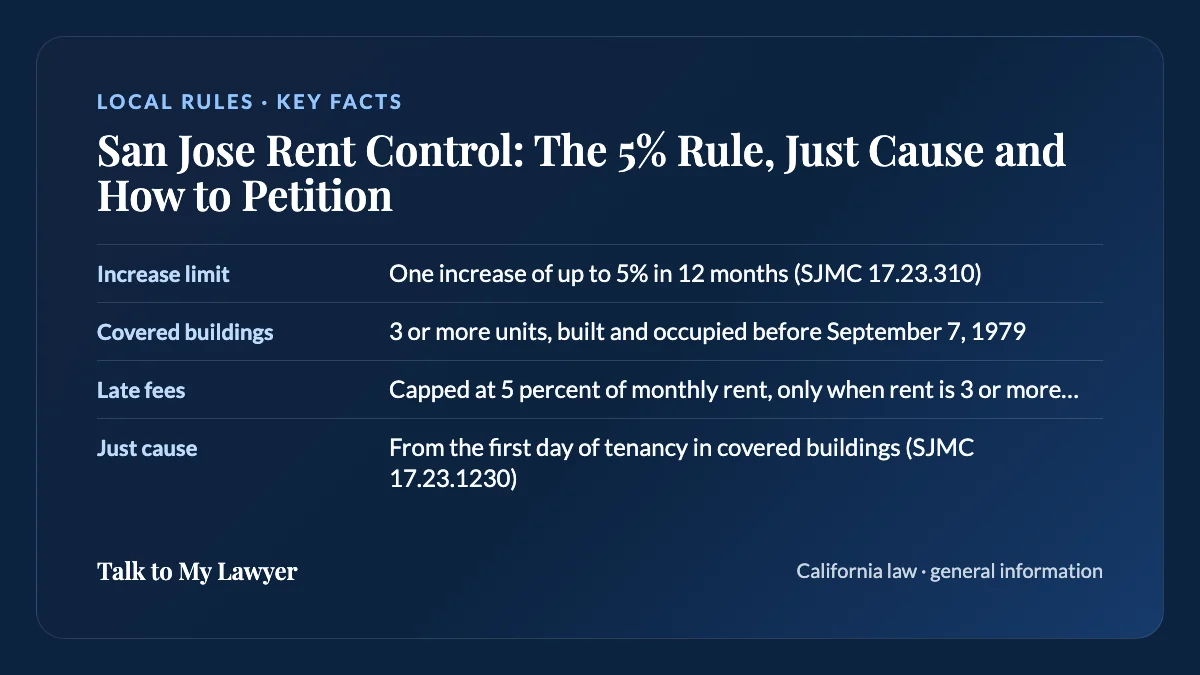
At a glance
- Increase limit
- One increase of up to 5% in 12 months (SJMC 17.23.310)
- Covered buildings
- 3 or more units, built and occupied before September 7, 1979
- Late fees
- Capped at 5 percent of monthly rent, only when rent is 3 or more days late (SJMC 17.23.315)
- Just cause
- From the first day of tenancy in covered buildings (SJMC 17.23.1230)
- Buyouts
- City disclosure form and 45 days to rescind (SJMC Part 7)
Which San Jose rental laws apply to your home?
Three sets of rules can stack on a San Jose rental, and the building type decides which ones reach you. The city's Rent Stabilization Program administers the first two.
| Law | What it does | Who it covers |
|---|---|---|
| Apartment Rent Ordinance (ARO) | Limits increases to one 5% increase in 12 months; petitions for bad increases and lost services | Apartments in buildings of 3 or more units built and occupied before September 7, 1979 |
| Tenant Protection Ordinance (TPO) | Requires one of 13 just causes to end a tenancy; relocation for no-fault causes | Rent-stabilized units, units in multifamily buildings, guesthouse rooms and unpermitted units |
| State Tenant Protection Act | Caps increases at 5% plus inflation, up to 10% | Most housing over 15 years old that has no stricter local cap (Civil Code 1947.12) |
For San Jose units that fall outside the ARO, the state cap for increases starting August 1, 2026 through July 31, 2027 is 8.6%, the Attorney General's figure for "all other counties," the group that includes Santa Clara County. The California rent increase notice rules guide walks through the state formula.
Is your apartment covered by San Jose rent control?
The ARO covers apartments with three or more units that were built and occupied before September 7, 1979, about 38,000 apartments by the city's count. Age and unit count both have to fit.
The city lists these as exempt from the ARO:
- Single-family homes, duplexes, condominiums and townhomes.
- In-law units, granny flats and accessory dwelling units.
- Hotels and boarding houses rented to transient guests for under 30 days, school dormitories and nonprofit homes for the aged.
- Units owned and operated by a government agency.
- Any unit first rented after September 7, 1979, and properties in unincorporated areas of San Jose.
If you cannot tell from the county assessor's records, the Rent Stabilization Program answers coverage questions at 408-975-4480 or RSP@sanjoseca.gov.
How is the 5% San Jose rent increase calculated?
SJMC section 17.23.310 limits the Annual General Increase to the monthly rent charged for the previous 12 months multiplied by 5%, and allows only one rent increase of any kind in a 12-month period. The section contains no provision for carrying unused increases into later years.
Example (hypothetical): rent on a covered one-bedroom has been $2,200 for the past 12 months. The most the landlord can add at the next increase is $110, for a new rent of $2,310. A notice raising rent to $2,354, a 7% increase, exceeds the limit by $44 a month.
- A landlord who has not substantially complied with the city's request to register the unit in the rent registry cannot raise the rent at all.
- The limit does not apply after a tenant moves out voluntarily or after a lawful eviction; the landlord can set the next tenant's starting rent.
- Written notice is still required under Civil Code section 827: at least 30 days for an increase of 10% or less.
What extra charges are allowed in a rent-stabilized apartment?
Section 17.23.315 bars passing charges through to tenants except as the chapter expressly allows, and it bars passing utility charges, such as water, sewer and refuse service, through to tenants, apart from submetered water, gas or electricity. It also caps several fees.
- Late fees cannot total more than 5 percent of the monthly rent, and only for a payment 3 or more days late.
- Bounced check charges cannot exceed the amount set in Civil Code section 1719(a)(1).
- Application screening fees cannot exceed the amount allowed by Civil Code section 1950.6(b).
Rent above 5% requires a landlord petition. A capital improvement passthrough cannot exceed 3 percent of the monthly rent, is not treated as rent, and covers only work finished within 12 months before the petition. A landlord can also petition for a fair return increase by showing that operating expenses exceed income.
How do you challenge an increase or lost services in San Jose?
Tenants in rent-stabilized units can file a petition with the Rent Stabilization Program over an invalid rent increase, health and safety problems, or service reductions. After filing, the program schedules a mediation or a hearing.
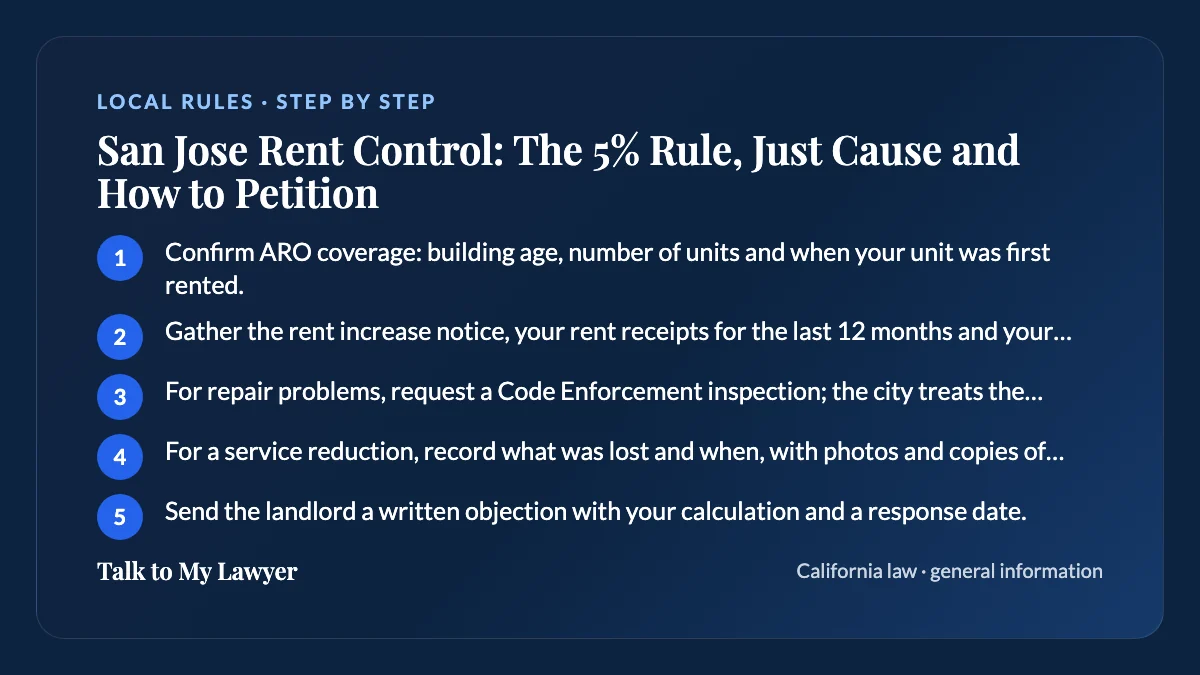
- Confirm ARO coverage: building age, number of units and when your unit was first rented.
- Gather the rent increase notice, your rent receipts for the last 12 months and your lease.
- For repair problems, request a Code Enforcement inspection; the city treats the inspection report as presumptive evidence.
- For a service reduction, record what was lost and when, with photos and copies of maintenance requests.
- Send the landlord a written objection with your calculation and a response date.
- If it is not resolved, download the Tenant Petition from the city's File a Petition page and submit it to the Rent Stabilization Program.
The tenant carries the burden of proof. If a service reduction is proven, the Hearing Officer can reduce or disallow an increase, credit rent already paid, or order a temporary or permanent rent reduction. Either side can appeal an administrative decision using the city's appeal form. For conditions problems, our landlord repair demand letter guide covers state habitability law.
Your notice raises my rent at 1450 Alum Rock Avenue, Unit 4, from $2,200 to $2,354 effective December 1, 2026. This building has six units and was occupied before September 7, 1979, so it is covered by the Apartment Rent Ordinance. Under San Jose Municipal Code section 17.23.310, the maximum increase is $110, for a rent of $2,310. Please send a corrected notice by November 10.
When can a San Jose landlord end your tenancy?
Under the Tenant Protection Ordinance (SJMC Part 12, sections 17.23.1200 and following), tenants in covered buildings have just cause protection starting on the first day of the tenancy, not after a year as under state law. The landlord must use one of 13 listed causes.
| Tenant-related causes | Landlord decisions or required actions |
|---|---|
| Nonpayment of rent; material or habitual lease violation; damage to the apartment; refusal to agree to a similar or new rental agreement | Substantial rehabilitation; removal from the rental market under the Ellis Act; owner move-in |
| Disorderly behavior; refusing lawful access; unapproved holdover subtenant; criminal activity | City code enforcement requiring a move-out; converting an unpermitted unit to a permitted use |
The written notice must state the cause and give the notice period required by state law, and the landlord must send a copy to the city within three days. For the five no-fault causes, relocation benefits based on unit size are owed, and the city tells landlords to provide them when the notice is served (SJMC 17.23.1250(B)). The city publishes the current amounts on its Tenant Protection Ordinance page, and they change over time, so check the figures in effect on the date of your notice.
What happens if a San Jose landlord breaks these rules?
Failure to follow the Tenant Protection Ordinance is an affirmative defense in an eviction case (SJMC 17.23.1280). A tenant or the city can also bring a civil action for actual and exemplary damages, injunctive relief, costs and reasonable attorneys' fees, with treble damages for a willful violation.
The ARO also bars retaliation for asserting your rights, including threats to evict, harassment, reduced services, rent increases or new deposits and charges. The city asks tenants to put retaliation complaints in writing to the Rent Stabilization Program. If a landlord offers money to move out, Part 7 requires the city's disclosure form and gives you 45 days after signing to rescind, subject to the conditions in the regulations. Our guide to tenant rights when a building is sold covers what changes, and what does not, under a new owner.
When an over-5% San Jose increase or TPO notice needs an attorney letter
San Jose's ordinance gives you section numbers to point to: an increase above the 5% line on a pre-1979 building, a water or trash charge added on top of rent, or a no-fault notice served without relocation money. A letter that does the math and cites Chapter 17.23 gives the landlord a defined amount to fix before a petition or court case.
Through Talk to My Lawyer, a licensed California attorney writes your letter (working from your facts and documents, such as your lease, notices and rent receipts) and sends it on your behalf. City staff can explain the ordinances; personal legal advice comes from a lawyer who has your lease in hand.
Frequently asked questions
How much can a landlord raise rent in San Jose?
For an apartment covered by the Apartment Rent Ordinance, one increase of up to 5% in any 12-month period, based on the monthly rent charged over the previous 12 months. For a San Jose rental outside the ordinance, state law caps increases at 5% plus inflation, up to 10%, which works out to 8.6% for increases starting August 1, 2026 through July 31, 2027, unless the unit is exempt.
Does San Jose rent control apply to houses, duplexes or condos?
No. The Apartment Rent Ordinance exempts single-family homes, duplexes, condominiums, townhomes and accessory dwelling units, along with any unit first rented after September 7, 1979. Those rentals may still be covered by the state rent cap and, for multifamily buildings, by the city's Tenant Protection Ordinance.
Can my San Jose landlord bank rent increases?
The ordinance's Annual General Increase is a flat limit of 5% of the prior 12 months' monthly rent, with only one increase allowed in a 12-month period, and it contains no rule for carrying unused percentages into later years. A landlord who wants more than 5% must petition, for example for a capital improvement passthrough or a fair return increase.
Do San Jose tenants have just cause protection right away?
In buildings covered by the Tenant Protection Ordinance, yes. Section 17.23.1230 gives tenants just cause protection from the first day of the tenancy. That is broader than state law, which generally applies after 12 months of occupancy. The landlord must state one of the 13 causes and send the city a copy of the notice within three days.
What is the maximum late fee in a San Jose rent-controlled apartment?
For rent-stabilized units, section 17.23.315 caps the late fee at a total of 5 percent of the monthly rent, and only for a payment that is three or more days late. On $2,000 rent, that is no more than $100. A late fee charged earlier or above that cap can be raised in a tenant petition.
Sources
Checked against these official sources on October 18, 2026.
- Learn About Rent Stabilization (City of San Jose Housing Department)
- File A Petition (City of San Jose Housing Department)
- How the Tenant Protections Ordinance (TPO) Covers You (City of San Jose Housing Department)
- San Jose Municipal Code Chapter 17.23 (City of San Jose (Municode))
- Limits on Rent Increases (California Attorney General)
- California Civil Code section 1947.12 (California Legislative Information)
This guide explains California law in general terms as of October 2026. It is general information, not legal advice for your situation, and local rules can add to it.
Join the email list and get a lawyer letter started
With Talk to My Lawyer, a licensed California attorney writes your letter from your facts and documents and sends it on your behalf. Join the Talk to My Lawyer email list for letter checklists, document prompts, and reminders before you start your letter.