Quick answer
What kind of legal letter you need depends on the result you want. To get paid or refunded, send a demand letter. To make someone stop an action, send a cease and desist letter. To contest a bill, debt or claim, send a dispute or response letter. To get documents, send a records request. Some claims, such as those against government agencies, require a formal written claim first.
At a glance
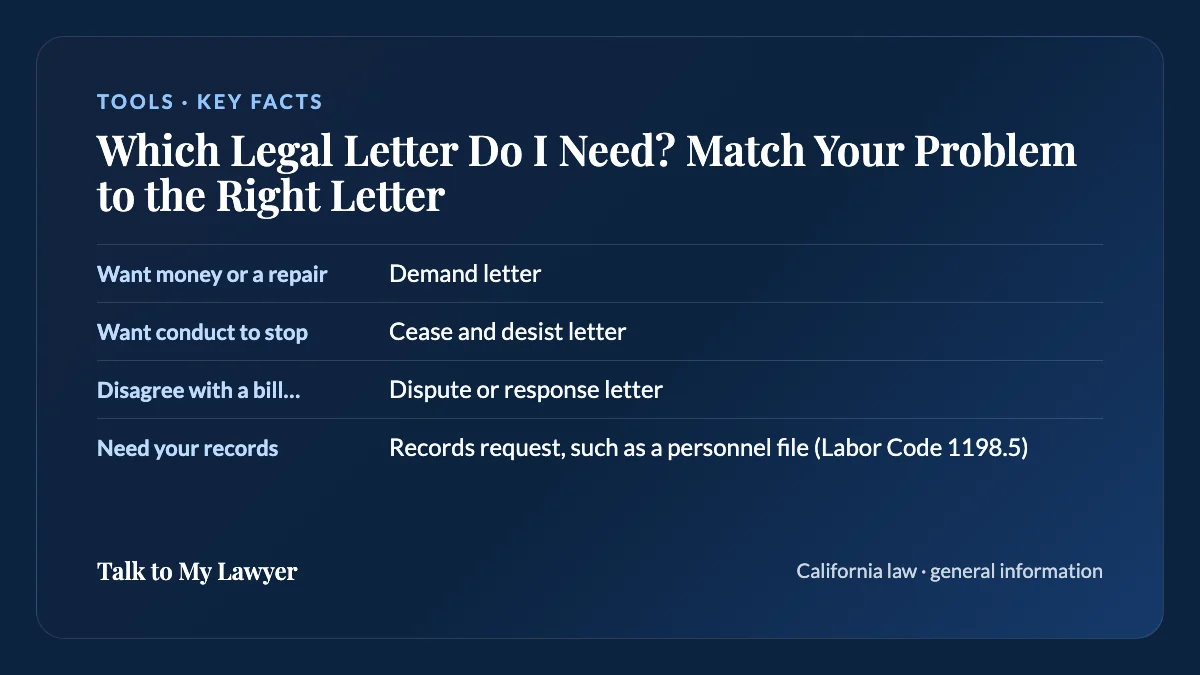
- Want money or a repair
- Demand letter
- Want conduct to stop
- Cease and desist letter
- Disagree with a bill or claim
- Dispute or response letter
- Need your records
- Records request, such as a personnel file (Labor Code 1198.5)
- Claim against a government agency
- Written claim first (Gov. Code 911.2)
- Already sued
- A court response, not a letter (CCP 412.20)
How does the legal letter finder work?
Pick the situation closest to yours from the menu. The finder points you to the guide that explains the rules for that problem and to the matching letter service.
If nothing on the list fits, the sections below sort letters by what they ask the reader to do, which is the quickest way to place an unusual problem.
What are the main types of legal letters?
Legal letters fall into five groups, defined by the action they request.
| Letter | What it asks for | Typical situations |
|---|---|---|
| Demand letter | Money, a refund, a repair or performance by a set date | Unpaid invoice, kept security deposit, contractor who left the job |
| Cease and desist letter | An end to specific conduct | Copied photos or branding, harassment, false statements |
| Dispute or response letter | Correction or withdrawal of a charge, debt or claim | Billing error, collection notice, a demand letter you received |
| Records request | Copies of documents you have a right to see | Personnel file, payroll records, HOA or partnership records |
| Statutory notice | Formal notice a law requires before a claim or lawsuit | Consumer claim under the CLRA, claim against a city or county |
The first two are the most often confused; demand letter vs cease and desist compares them. If a letter has arrived at your door instead, start with how to respond to a demand letter.
How do you tell which letter fits your situation?
Work from the outcome you want, then check for rules that dictate the form.
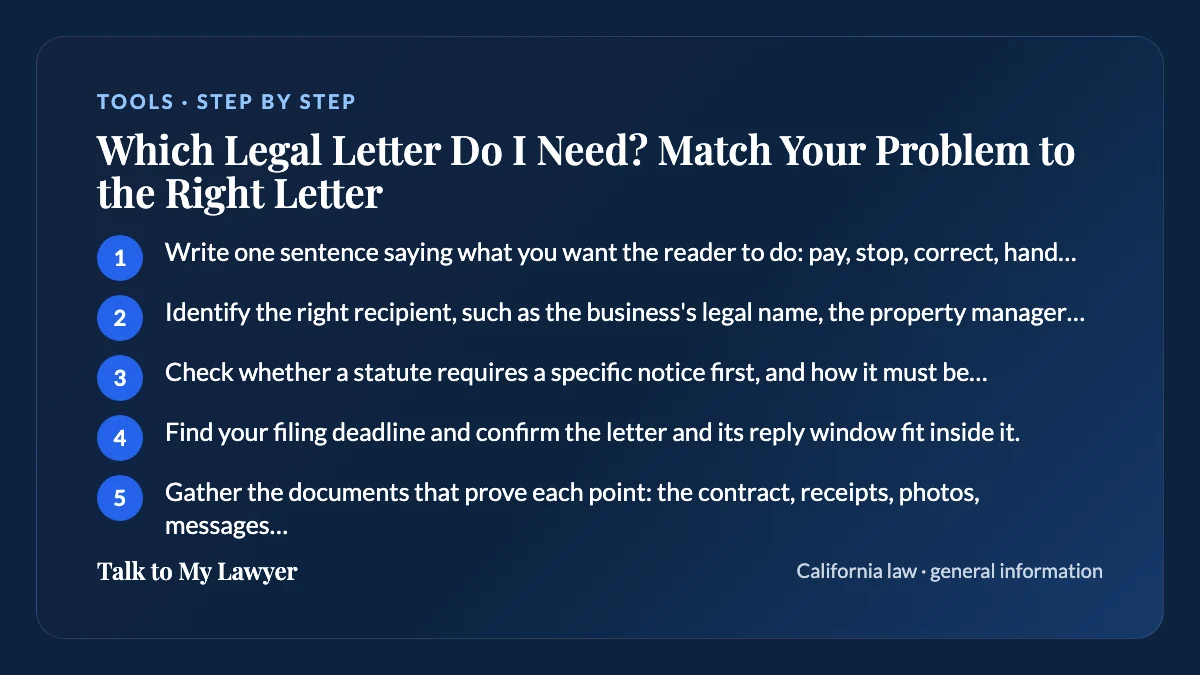
- Write one sentence saying what you want the reader to do: pay, stop, correct, hand over records, or take formal notice.
- Identify the right recipient, such as the business's legal name, the property manager, the employer or the agency.
- Check whether a statute requires a specific notice first, and how it must be delivered, since some require certified mail or a waiting period.
- Find your filing deadline and confirm the letter and its reply window fit inside it.
- Gather the documents that prove each point: the contract, receipts, photos, messages and any earlier notices.
- If you want two things, such as payment and an end to certain conduct, state each request separately in the same letter.
For step four, the statute of limitations calculator gives an estimated last day to file for common claim types.
Which letters have rules set by California law?
Some letters must follow a statute's timing or delivery rules. Three examples:
- Consumer claims under the CLRA. At least 30 days before suing a business for damages under the Consumers Legal Remedies Act, you must notify it in writing of the violations and demand a fix, by certified or registered mail, return receipt requested (Civil Code 1782).
- Claims against a public entity. A claim for death, injury to a person, or damage to personal property or growing crops must be presented within six months, and other claims within one year (Government Code 911.2). See the guide to a government claim against a California city.
- Personnel records. A current or former employee, or their representative, can request them in writing, and the employer must make them available within 30 calendar days, or up to 35 days if both agree in writing (Labor Code 1198.5).
When is a letter the wrong tool?
A letter asks; it cannot order anyone to do anything. In these situations, start somewhere else.
- You have been sued. A summons in a regular civil case gives you 30 days to file a written response with the court (CCP 412.20). In an eviction case, the response is due within 10 court days after service (CCP 1167, as amended effective January 1, 2025). A letter to the other side is not a response.
- You are in danger. Call 911. A letter offers no protection.
- You need an order to stop harassment. A civil harassment restraining order is a court order the police can enforce (CCP 527.6). The courts' self-help guide says a judge decides on temporary protection the same day the forms are turned in or by the next business day.
- Your deadline has nearly run. A letter does not pause the statute of limitations, so a filing may need to come first.
When to have an attorney write your letter
Once you know the letter type, the details still matter: the right statute, a clear amount or request, a workable deadline and a delivery method that leaves proof. With Talk to My Lawyer, a licensed California attorney writes your letter from your facts and documents and sends it on your behalf.
If a court case is already filed, someone's safety is at risk, or a deadline is days away, speak with a lawyer about your facts before sending anything.
Frequently asked questions
What is the difference between a demand letter and a cease and desist letter?
A demand letter asks for something to be done, usually payment, a refund or a repair, by a set date. A cease and desist letter asks someone to stop doing something, such as using your photos or contacting you at work. One letter can do both, for example asking a business to stop using your work and to pay for the use so far.
Is sending a legal letter the same as filing a lawsuit?
No. A letter is a private communication: nothing is filed with a court and no judge is involved. It can set out your claim, propose a resolution and create a dated record. A lawsuit begins when someone files a complaint and serves a summons, which in a regular civil case gives the defendant 30 days to respond in writing.
Do I need a lawyer to send a legal letter?
Generally no. You can write your own demand, dispute or records request. An attorney can help when the amount is significant, the law is technical, or a statute sets strict content, timing or delivery rules, as with a CLRA notice or a claim against a public entity. A letter from an attorney also shows the other side that counsel is involved.
What if the other side ignores my letter?
Then you choose the next step: a follow-up, mediation, small claims court, an agency complaint or a lawsuit, depending on the claim and the amount. Keep the letter and proof of delivery, since they show you tried to resolve the dispute. Keep an eye on your filing deadline throughout, because the letter does not pause it.
Sources
Checked against these official sources on October 18, 2026.
- California Civil Code section 1782 (California Legislative Information)
- California Government Code section 911.2 (California Legislative Information)
- California Labor Code section 1198.5 (California Legislative Information)
- California Code of Civil Procedure section 412.20 (California Legislative Information)
- California Code of Civil Procedure section 1167 (California Legislative Information)
- Civil Harassment Restraining Orders in California (California Courts Self-Help Guide)
This guide explains California law in general terms as of October 2026. It is general information, not legal advice for your situation, and local rules can add to it.
Join the email list and get a lawyer letter started
With Talk to My Lawyer, a licensed California attorney writes your letter from your facts and documents and sends it on your behalf. Join the Talk to My Lawyer email list for letter checklists, document prompts, and reminders before you start your letter.