Quick answer
New California laws for 2027 include a $17.40 statewide minimum wage from January 1, 2027, a stay-or-pay ban that now reaches only contracts signed on or after that date (AB 1697), stricter rules for serving lawsuits (AB 747), written rental pet policies from April 1, 2027 (SB 1296) and wider privacy deletion rights (SB 923). A 3-day right to cancel used-car purchases has applied since October 1, 2026.
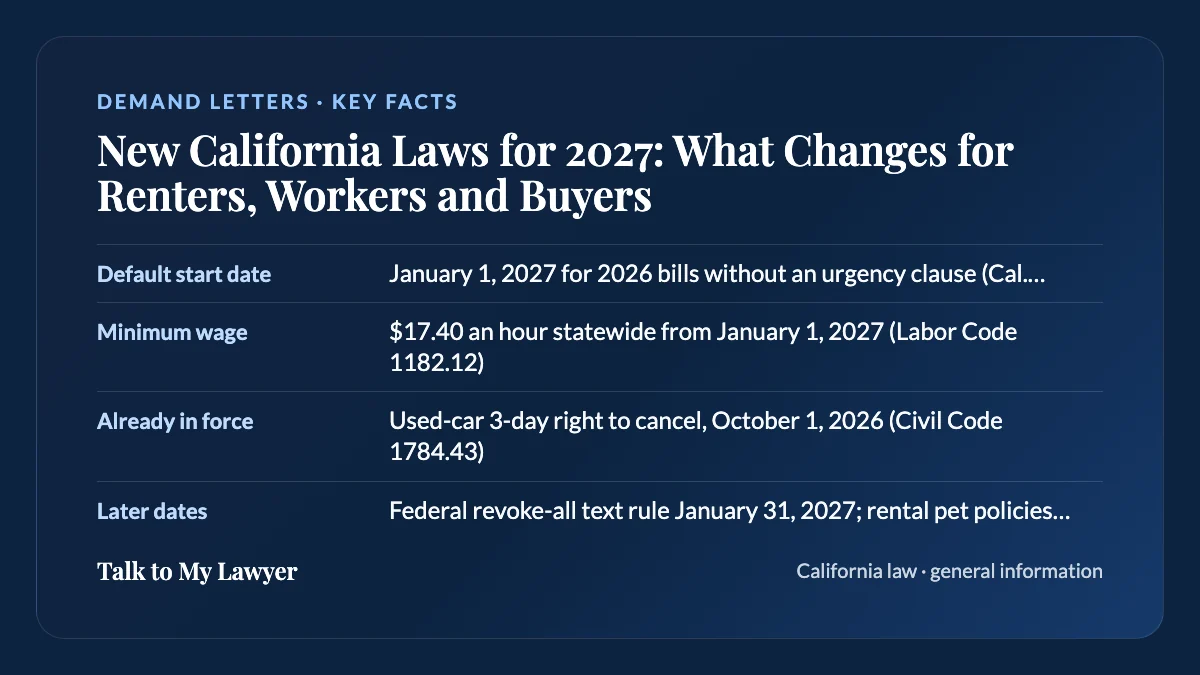
At a glance
- Default start date
- January 1, 2027 for 2026 bills without an urgency clause (Cal. Const., art. IV, sec. 8(c))
- Minimum wage
- $17.40 an hour statewide from January 1, 2027 (Labor Code 1182.12)
- Already in force
- Used-car 3-day right to cancel, October 1, 2026 (Civil Code 1784.43)
- Later dates
- Federal revoke-all text rule January 31, 2027; rental pet policies April 1, 2027
- Unchanged
- Small claims limit stays $12,500 for individuals (CCP 116.221)
When do new California laws take effect?
A bill signed in a regular session takes effect on January 1 after a 90-day period from enactment (California Constitution, article IV, section 8(c)), so 2026 bills without an urgency clause start on January 1, 2027.
Two exceptions: an urgency statute takes effect the day it is signed, and a bill can set a later operative date.
| Date | What starts | Source |
|---|---|---|
| September 30, 2026 | Stay-or-pay ban pushed back to contracts from 2027 (urgency statute, already in effect) | AB 1697, ch. 889 |
| October 1, 2026 | Car-buyer protections, including a 3-day right to cancel used-car purchases up to $50,000 (already in effect) | SB 766 (2025), Civil Code 1784.28 |
| January 1, 2027 | Most items in this guide, including the $17.40 minimum wage | Cal. Const., art. IV, sec. 8(c) |
| January 31, 2027 | Federal revoke-all text and robocall requirement, unless the FCC changes it first | FCC Order DA 26-12 |
| April 1, 2027 | Written pet policies for rental housing | SB 1296, ch. 1025 |
Each item below was checked against its chaptered text on the Legislature's site as of October 2026. Bills that did not pass are left out.
What new California laws for 2027 affect tenants?
1. Stricter service of court papers, including eviction summonses (AB 747, ch. 563 of 2025). Before a summons can be left with someone else or, in an eviction case, posted on your door, the person serving it must show reasonable diligence: good-faith attempts to hand it to you on at least three occasions, on three different days at three different times. From January 1, 2027, the proof of service for personal delivery, substituted service or posting must include a photo of the site of each attempt (showing the door, for a home) stamped with the date, time and GPS coordinates, unless taking it would put the server at risk. An eviction complaint must also state the date, time and place the termination notice was served (Code of Civil Procedure sections 415.20, 415.45, 417.10 and 1166). See our guide to the 3-day notice to pay rent or quit.
2. Emergency rent-gouging limits for every lease length (SB 1365, ch. 1028). Penal Code section 396 makes it a misdemeanor to raise rent more than 10% after a declared state of emergency or local emergency, for 30 days or any longer period the declaration is extended. Until now, that limit covered only housing with an initial lease of one year or less. From January 1, 2027, it covers rental housing regardless of lease length, and the old exemptions become affirmative defenses that the landlord must prove, such as an increase the tenant agreed to before the emergency.
3. Disclosure of edited listing photos (AB 2025, ch. 572). A rental ad with a digitally altered image must say so on or next to the image and include the unaltered version, or a link or QR code to it. Adding, removing or changing furniture, appliances, flooring or the view out a window counts, and so does an image generated entirely by computer; routine cropping, lighting or color correction does not. Effective January 1, 2027 (Civil Code section 1940.11).
4. Written pet policies (SB 1296, ch. 1025). Landlords must have a written pet policy, even one that says no pets, link to it in online listings where the platform allows, and give it out with every application. If you paid an application fee without seeing it and then cannot rent or decline because of it, you can ask in writing for a refund, due within seven business days. Operative April 1, 2027 (Civil Code section 1942.7.5). Service and support animal rights are unaffected; see our guide to a reasonable accommodation request.
What changes for California workers and employers in 2027?
5. Minimum wage of $17.40. Certified by the Department of Finance on July 31, 2026, it applies statewide from January 1, 2027 (Labor Code section 1182.12). The exempt salary floor rises to $72,384 a year, and some cities set higher rates. Our unpaid wages demand letter guide explains the claim if pay falls short.
6. Stay-or-pay contracts, pushed back a year (AB 1697, ch. 889). AB 692 (ch. 703 of 2025) barred contract terms that make a worker pay an employer, training provider or debt collector for leaving a job, starting with contracts signed in 2026. AB 1697, an urgency statute in effect since September 30, 2026, moved that start to contracts entered on or after January 1, 2027, and made pending claims for conduct between January 1, 2026 and September 30, 2026 moot. It also widened the exceptions: the bonus exception is no longer limited to sign-on payments (its conditions, such as a separate agreement and a retention period of two years or less, still apply), and new exceptions cover government-funded recruitment bonuses, certain securities and insurance affiliation payments, and repaying up to 40 hours of advanced paid time off after a voluntary quit. A worker can recover actual damages or $5,000, whichever is greater, plus attorney's fees (Labor Code section 926; Business and Professions Code section 16608). See our training repayment agreement guide.
7. Bereavement leave for a chosen person (SB 1149, ch. 679). Employers with five or more employees owe up to five days of bereavement leave. From January 1, 2027, that includes a designated person related to you by blood or whose relationship is the equivalent of family, limited to one per 12 months if the employer chooses (Government Code section 12945.7).
8. No paperwork fee for disability claims (AB 2292, ch. 734). From January 1, 2027, a doctor or other certifying practitioner may not charge an administrative fee to complete the medical certificate for a State Disability Insurance claim, including a claim to care for a seriously ill family member, or the forms needed to stay eligible. Medical services and any copay, coinsurance or deductible can still be billed if they match what a comparable visit costs (Unemployment Insurance Code section 2708).
9. Security officer rest breaks. Since 2020, Labor Code section 226.7 has allowed registered security officers employed by a registered private patrol operator, and covered by a qualifying union contract, to be kept on site and on call during rest periods. That version is repealed on January 1, 2027, and the version that becomes operative that day has no security-officer exception (Stats. 2020, ch. 343, AB 1512). No 2025 or 2026 bill extended it. From then on, the general rule in section 226.7 applies to these officers: no work during a required rest period, and one extra hour of pay at the regular rate for each workday a break is not provided. See meal and rest break violations.
Which new consumer protections start in late 2026 and 2027?
10. Car-buyer protections (SB 766, ch. 354 of 2025), in force since October 1, 2026. A dealer selling or leasing a used vehicle at retail for $50,000 or less must give a three-day right to cancel, running three calendar days from the day after signing until close of business (extended to the next open day if the dealership is closed on the third). The right is lost once the car has been driven more than 400 miles after signing, and motorcycles are excluded. The law also bars charging for add-ons that give the buyer no benefit (Civil Code section 1784.20 and following). See our car dealer fraud guide.
11. Delete data a business got elsewhere (SB 923, ch. 482). From January 1, 2027, a California privacy deletion request reaches personal information a business collected about you from any source, including data it bought or gathered elsewhere. A business that operates only online and deals with you directly must also offer an online method, such as a web form or portal, for requests (Civil Code sections 1798.105 and 1798.130). See our CCPA deletion request letter guide.
12. A browser opt-out setting (AB 566, ch. 465 of 2025). From January 1, 2027, companies that make web browsers must include an easy-to-find setting that sends an opt-out preference signal, telling sites not to sell or share your data (Civil Code section 1798.136).
13. A human on the line at large companies (AB 1609, ch. 733). From January 1, 2027, businesses with more than $500 million in national gross annual revenue may not present a customer service chatbot as a person. During regular business hours they must let you ask for a human agent and make a good-faith effort to connect you within 15 minutes or give you an appointment within one business day. Only public prosecutors can enforce it, with civil penalties up to $5,000 for a first violation and $10,000 for each later one (Business and Professions Code section 22625 and following).
How do debt lawsuits, harassment orders and robotexts change?
14. Undoing a default you never knew about (AB 747 and AB 2042, ch. 379). In a consumer debt lawsuit, at least one service attempt must be made at your home if it is known or could be found with reasonable effort. In any civil case, for service attempted or completed on or after January 1, 2027, you can move to set aside a default by offering evidence you were not lawfully served; the party that sought the default must then prove lawful service by a preponderance of the evidence, and the court may not refuse a reasonable request for a hearing with live testimony (Code of Civil Procedure sections 415.20 and 473.2). See responding to a collection letter.
15. Remote civil harassment hearings (AB 561, ch. 267 of 2025). From January 1, 2027, parties and witnesses may appear remotely at civil harassment restraining order hearings, courts may not charge a party a fee to do so, and courts must accept these petitions and related filings electronically (Code of Civil Procedure section 527.6).
16. Federal: the robotext revoke-all rule. Under 47 CFR 64.1200(a)(10), saying stop to one type of informational robocall or robotext would revoke consent for that caller's messages on unrelated matters too. The FCC delayed that part to January 31, 2027 (Order DA 26-12) while it considers changing the rule, so check fcc.gov before relying on that date. See stopping unwanted texts and calls.
What should small businesses and landlords update before 2027?
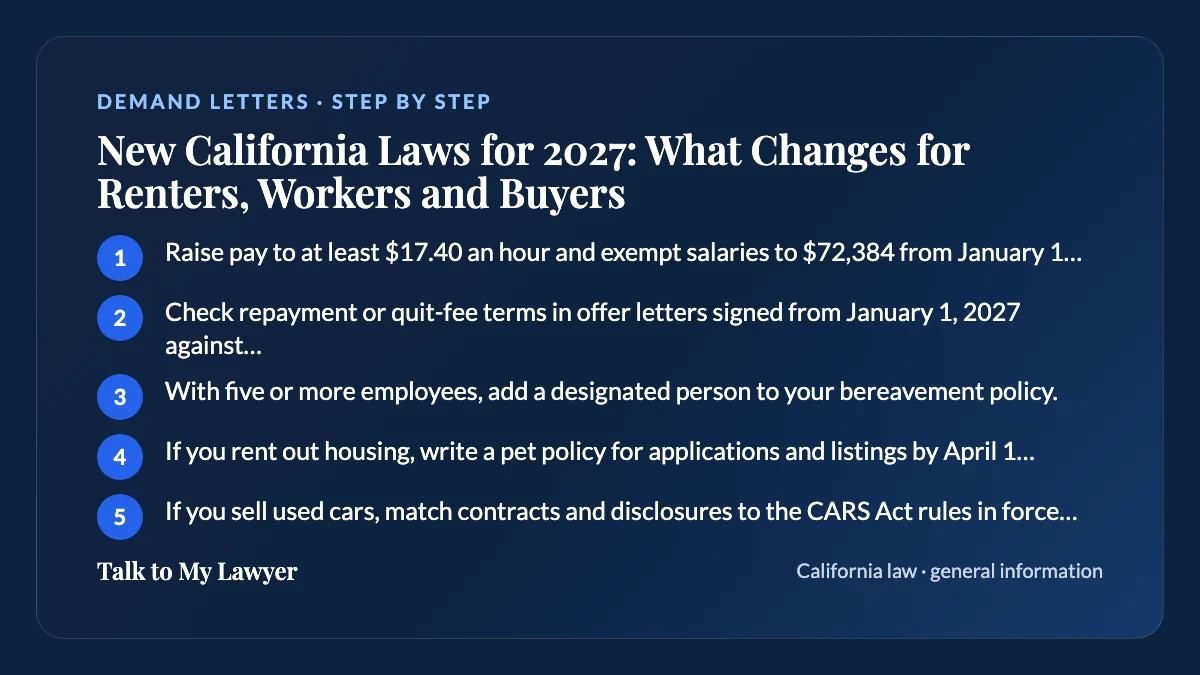
Updates due before January 2027:
- Raise pay to at least $17.40 an hour and exempt salaries to $72,384 from January 1, 2027, or the higher local rate.
- Check repayment or quit-fee terms in offer letters signed from January 1, 2027 against Labor Code section 926.
- With five or more employees, add a designated person to your bereavement policy.
- If you rent out housing, write a pet policy for applications and listings by April 1, 2027, and label edited listing photos.
- If you sell used cars, match contracts and disclosures to the CARS Act rules in force since October 1, 2026.
How do you cite a new law in a demand letter?
Cite the code section and its start date, and tie it to a date in your facts. New statutes generally apply going forward, and some, like AB 1697, reach only contracts signed after a set date.
I bought the 2019 sedan from your dealership on November 3, 2026 for $18,000 and returned it with all keys on November 5, within the three-day period in Civil Code section 1784.43, with 182 miles driven since the sale. Please refund the price, less any restocking fee the statute permits, by November 20.
When should an attorney write a letter that cites a new law?
A law that is only weeks old invites arguments: the other side may say your contract predates it, that an exception fits, or that the section does not reach their business. Getting the dates and the right subdivision on the page matters more than usual.
Through Talk to My Lawyer, a licensed California attorney writes your letter from your facts and documents (contracts, notices, dates), cites the section that applies, and sends it on your behalf. For advice about your own situation, talk to a lawyer about your facts.
Frequently asked questions
What is the California minimum wage in 2027?
The statewide minimum wage is $17.40 an hour from January 1, 2027, under the annual inflation adjustment in Labor Code section 1182.12, certified by the Department of Finance on July 31, 2026. The exempt salary floor becomes $72,384 a year. Where a city or county sets a higher minimum, the higher rate applies.
Is the California stay-or-pay ban in effect in 2026?
No. AB 1697, in effect since September 30, 2026, made the ban apply only to contracts entered on or after January 1, 2027, and made pending claims for conduct between January 1, 2026 and that date moot. Other laws, such as the rule that employers cover necessary business expenses, can still affect repayment terms in older contracts, so a lawyer can look at a specific agreement.
Can I return a used car in California?
Since October 1, 2026, a dealer selling a used vehicle at retail for $50,000 or less must offer a three-day right to cancel under Civil Code section 1784.43. It starts the day after you sign, ends at close of business on the third day, and is lost if the car is driven more than 400 miles. The dealer may charge a restocking fee.
Did the California small claims limit go up in 2027?
No. AB 1827, which would have raised the limits, was held in the Senate Appropriations Committee in August 2026. As of October 2026, an individual can claim up to $12,500 (Code of Civil Procedure section 116.221), and the general limit, which applies to businesses, stays at $6,250.
Sources
Checked against these official sources on October 18, 2026.
- California Constitution, article IV, section 8 (California Legislative Information)
- AB 1697 Employment contracts: stay-or-pay provisions (Chapter 889, Statutes of 2026) (California Legislative Information)
- AB 747 SPARE Act (Chapter 563, Statutes of 2025) (California Legislative Information)
- SB 766 California Combating Auto Retail Scams (CARS) Act (Chapter 354, Statutes of 2025) (California Legislative Information)
- California's minimum wage to increase to $17.40 per hour on January 1, 2027 (News Release 2026-66) (California Department of Industrial Relations)
- Order DA 26-12, CG Docket No. 02-278 (Federal Communications Commission)
This guide explains California law in general terms as of October 2026. It is general information, not legal advice for your situation, and local rules can add to it.
Join the email list and get a lawyer letter started
With Talk to My Lawyer, a licensed California attorney writes your letter from your facts and documents and sends it on your behalf. Join the Talk to My Lawyer email list for letter checklists, document prompts, and reminders before you start your letter.